Signs of a Cockroach Infestation: How to Tell If You Have Roaches
Think you have roaches? Check the signs that prove it, from droppings and egg cases to the musty smell, and learn how to tell one stray from an infestation.

In this guide
- Live Sightings and What They Mean
- Droppings Like Coffee Grounds or Pellets
- Egg Cases in Cracks and Cabinets
- Smear Marks Where Roaches Travel
- A Musty, Oily Smell That Lingers
- Shed Skins in Quiet Corners
- Damage to Packaging, Paper, and Books
- Where to Inspect First
- German and American Cockroaches Leave Different Signs
- One Roach or an Infestation?
- What to Do After You Find the Signs
- Frequently Asked Questions
One roach on the kitchen floor at midnight raises an uncomfortable question. Is it a stray that wandered in from outside, or the visible tip of a population living in the walls?
The signs they leave behind hold the answer, and they are present whether or not you ever see a live insect.
Quick answer. Check under sinks, behind the refrigerator and stove, and inside cabinets for droppings like coffee grounds, brown egg cases, shed skins, and dark smear marks. A musty smell in closed cupboards and roaches out in daylight point to a large established infestation.
Live Sightings and What They Mean
A single roach crossing a counter at night tells you very little on its own.
Roaches that appear night after night in the same room tell you a great deal.
Repetition is the first dividing line between a visitor and a resident population.
The hour matters as much as the sighting. Cockroaches feed and travel in the dark, and they avoid open, lit spaces while their hiding places still have room.
Penn State Extension notes that roaches seen in daylight often signal a heavy population or stress inside the harborage from too little food or water. Crowded insects get pushed into the open at hours they would normally spend hidden.
Small roaches matter as much as large ones.
Nymphs are the wingless young, and they cannot travel far from the hatch site. A nymph in a kitchen drawer means eggs hatched nearby, which means breeding inside the home.
Dead roaches count as evidence too, above all when fresh bodies keep appearing in the same spot.
Droppings Like Coffee Grounds or Pellets
Droppings are usually the first sign people find. UC IPM lists fecal spots and smears among the main traces to look for, and droppings gather where roaches rest, so they map the hiding places. Start every inspection with the droppings, because they show where the roaches spend their nights.
German cockroaches leave specks that look like ground black pepper or coffee grounds.
Look for specks along cabinet hinges, in drawer corners, on cupboard tops, and around appliance edges.
Heavy traffic leaves dense clusters instead of scattered dots.
Larger species such as the American cockroach leave solid pellets instead of specks. The pellets are cylindrical, with blunt ends and fine ridges running along the sides.
People often mistake those pellets for mouse droppings, but mouse droppings taper to a point and cockroach pellets stay blunt.
Wet areas change the picture. Under a damp sink, droppings soften into dark smears instead of dry specks. The smears spread along surfaces roaches touch most, and show up best on light paint and tile.
Egg Cases in Cracks and Cabinets
Cockroaches carry their eggs in a capsule called an ootheca. Each capsule holds a group of eggs, so one case is a batch of nymphs waiting to hatch.
According to UC IPM, the German cockroach case is light brown and small, at about 1/4 inch long. The female carries the case until shortly before it hatches, so loose German cases are rarer than the cases of larger species.
American cockroaches take the opposite approach.
The female glues her darker case in a protected spot and leaves it behind.
Cases turn up behind the refrigerator, under the sink, inside cabinet hinges, and along drawer backs.
An empty case still matters.
An empty case means a batch of nymphs already hatched somewhere close. A full case means the next batch is on its way, sealed and protected until it opens.
Smear Marks Where Roaches Travel
Smear marks are dark, irregular streaks left where roaches rest or pass every night. UC IPM notes that German cockroaches stain the surfaces they contact, and the marks build up fastest in humid spots.
Check the line where the wall meets the floor, the surfaces around pipes under the sink, and the inside faces of cupboard doors.
Smears differ from droppings in both shape and texture. Droppings sit on a surface as specks or pellets that a cloth can lift away. A smear looks dragged across the surface, like the mark of a dirty fingertip pulled along the wall.
A Musty, Oily Smell That Lingers
One roach has no smell a person can detect.
A large infestation does, and the odor is one of the clearest signs that numbers have moved past a few strays.
Penn State Extension explains that high populations produce a characteristic odor from the secretions cockroaches release. Iowa State University Extension describes the same musty cockroach odor in very heavy infestations.
Most people describe the smell as oily, stale, and faintly sweet at once.
The odor collects where air barely moves. Open a closed cupboard or the sink cabinet and check the smell before disturbing anything inside.
Shed Skins in Quiet Corners
Young cockroaches shed their skin as they grow, and every shed skin is a small hollow copy of the insect that left it. The skins are light brown, dry, and fragile, and they hold the roach shape long after the insect moves on.
Penn State Extension puts the count at six to seven molts before a German cockroach nymph reaches adulthood. A breeding population leaves many skins, tucked into cracks, cupboards, and the warm space behind appliances.
Skins in several sizes carry their own message. Different sizes mean different ages of nymphs growing up in the same hiding place. That pattern points to steady breeding, not a single batch that arrived in a delivery box.
Damage to Packaging, Paper, and Books
Cockroaches feed on far more than spilled food. They chew through paper and thin cardboard to reach food, and they feed on book-binding glue, wallpaper paste, and paper starches.
Look for chewed corners on cereal boxes, pet food bags, and stored paper.
Staining on photographs, book spines, and files in dry storage surprises many people. It happens away from the sink and stove, in quiet places nobody thinks to check.
Where to Inspect First
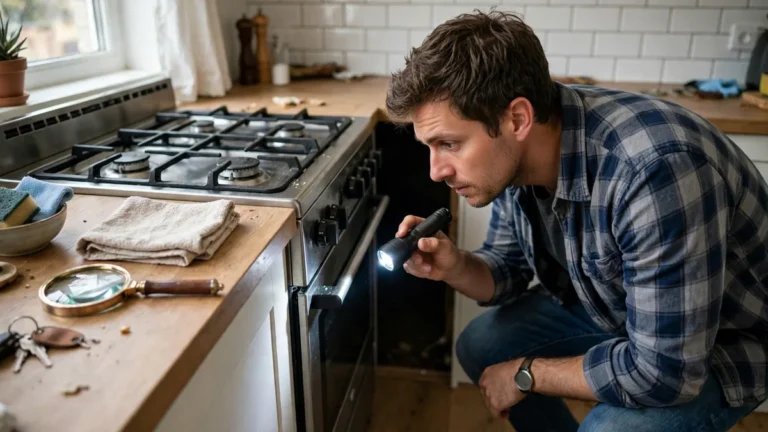
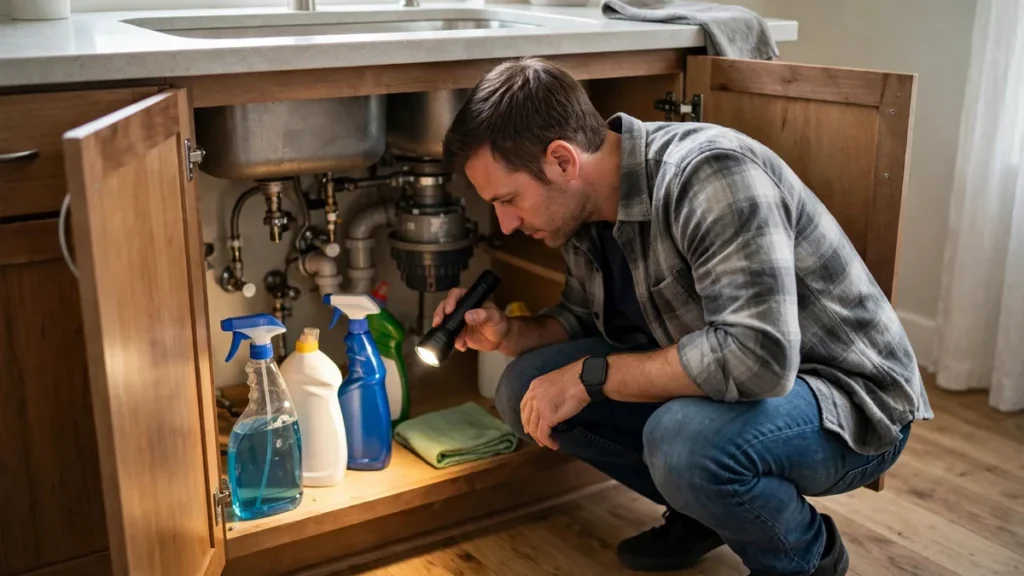
Work through the warm, dark, damp places first, and take a flashlight. UC IPM recommends inspecting cracks, counter undersides, and other dark locations, and rates sticky traps as the best way to confirm activity.
| Sign | What it looks like | Where to check |
|---|---|---|
| Live roaches | Adults at night, or small wingless nymphs | Kitchen, bathroom, inside cabinets |
| Droppings | Coffee-ground specks, or blunt ridged pellets | Cabinet hinges, drawer corners, behind appliances |
| Egg cases | Brown capsules, about 1/4 to 3/8 inch long | Behind the fridge and stove, under sinks, drawer backs |
| Smear marks | Dark streaks with a dragged look | Wall and floor junctions, around pipes, cupboard doors |
| Shed skins | Hollow, light brown shells in the shape of a roach | Cracks, cupboards, behind appliances |
| Odor | Musty, oily smell that lingers in closed spaces | Sink cabinets, pantries, closed cupboards |
Start under the kitchen sink, then behind the refrigerator, then around the stove.
Bathrooms come next. Plumbing, warmth, and steady moisture make them a second kitchen for cockroaches. Check the vanity cabinet, pipe entry points, and any gap along the tub.
German and American Cockroaches Leave Different Signs
Two species account for most indoor problems, and telling them apart early changes where you look.
| Sign | German cockroach | American cockroach |
|---|---|---|
| Appearance | About 1/2 inch long, tan, with two dark stripes behind the head | Much larger and reddish brown |
| Droppings | Specks like coffee grounds or ground pepper | Cylindrical pellets with blunt ends |
| Egg cases | Carried by the female until close to hatching | Glued in a hidden place and left behind |
| Where signs gather | Kitchen and bathroom, near food and water | Basements, drains, garages, and crawl spaces |
Kansas State University Extension advises that control begins with correct identification, because the species live in different places. German cockroaches breed indoors near food and water, while American cockroaches often arrive from drains and crawl spaces. Identification also decides which rooms and hiding places get attention first.
One Roach or an Infestation?
A lone large roach near a door or a floor drain in summer is often a wanderer from outside. American and Oriental cockroaches live outdoors and in drains, and one can slip through a gap or ride in a box.
A sighting like that earns a check of the house, not a panic.
Signs It Is Likely a Stray
- One large roach, seen once, near a door, a drain, or the garage
- No droppings, egg cases, or shed skins anywhere you check
- No further sightings over the following week
Signs of a Breeding Infestation
- Small roaches or nymphs indoors, at any hour
- Roaches seen in daylight, or in more than one room
- Droppings, egg cases, or shed skins in cabinets or behind appliances
- A musty smell that hangs in closed cupboards
The German cockroach breaks the stray rule. It lives and breeds indoors, so one German cockroach in a kitchen almost always means an active population close by.
When the evidence stays mixed, sticky traps settle the question within a few nights.
Place traps behind the stove and refrigerator and inside the sink cabinet, the monitoring spots UC IPM recommends. Catches on the first nights, or traps that keep filling, confirm an active problem rather than a visitor. Keep a short written note of the count from each trap.
What to Do After You Find the Signs
Photograph what you find before cleaning, and write down the room and the date.
The pattern of signs shows a pest professional where the roaches are hiding, and whether numbers fall once treatment begins.
Vacuum up droppings and shed skins instead of sweeping, then wash the surfaces. UC IPM notes that cockroach droppings carry a scent that draws other cockroaches, so leaving them in place works against you.
Prevention starts on the same day, with the food, water, and hiding places that let the population grow. Our guide to keeping cockroaches out of an apartment without chemicals works through those fixes step by step.
Sealing the gaps around pipes and doors protects the rooms the roaches have not reached yet. The room-by-room checklist in our guide to pest-proofing your home covers entry points, food storage, and moisture in one pass.
A growing German cockroach infestation, or signs spread across several rooms, is a job for a licensed professional.
Frequently Asked Questions
What do cockroach droppings look like?
German cockroach droppings look like coffee grounds or ground black pepper scattered along edges. Larger species leave blunt, ridged pellets that resemble mouse droppings without the pointed ends.
Does seeing one cockroach mean I have an infestation?
Not always. One large outdoor species near a drain can be a stray that wandered in. A small German cockroach, a nymph of any size, or repeat sightings point to breeding indoors.
Why am I seeing cockroaches during the day?
Daylight activity often means hiding places are crowded or short on food and water. Penn State Extension links the pattern to heavy populations, so treat it as a reason to inspect the same day.
Can you have an infestation and never see a roach?
Yes, because cockroaches hide through the day and feed at night, droppings, cases, skins, and odor often appear weeks before the first live sighting.
What does a cockroach infestation smell like?
The smell is musty and oily, and it lingers in closed cupboards and on stored items nearby. Extension sources tie a noticeable odor to large populations, so the smell usually means an established problem.

Nathan Ellis
Nathan Ellis writes about cockroaches and other indoor pests that commonly appear in homes. His work explains different species, their habits, and the signs they leave behind. He enjoys turning detailed research into helpful...
View all guides →