
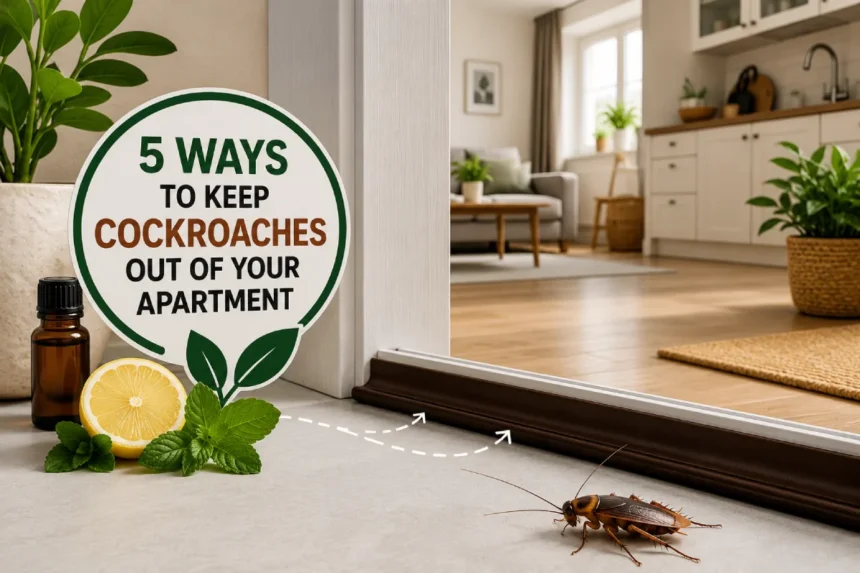
Nobody wants roaches in their apartment. Yet 78% of urban apartment dwellers report encountering them at some point during their tenancy, according to pest management surveys. If you want to keep cockroaches out without harsh chemicals, you’re not alone — renters with children, pets, or chemical sensitivities need safe alternatives. 5 methods work: physical barriers, sanitation, natural repellents, and monitoring. Together they form the integrated pest management (IPM) approach professionals recommend.
This guide covers where to apply each technique in an apartment setting, addressing the specific challenges of multi-unit buildings.
Why Apartments Are Especially Vulnerable to Cockroaches
Apartments face roach threats that single-family homes don’t.
How Cockroaches Travel Between Apartment Units
Cockroaches exploit shared building infrastructure to move between units — plumbing chases, wall voids, electrical conduits, and utility pipes. A German cockroach (Blattella germanica) can flatten its body to fit through gaps as thin as 1.6 millimeters, so even tiny cracks in shared walls become open highways.
Apartment buildings create interconnected pest networks. A roach infestation in one unit can spread to neighboring units within two to four weeks. Garbage chutes allow vertical migration between floors, and laundry or boiler rooms serve as communal harborage. A spotless apartment can still attract roaches from next door.
Roaches are also thigmotactic — they prefer surfaces that touch their bodies on multiple sides. Apartment walls, cabinet interiors, and pipe cavities offer exactly that kind of tight shelter.
Why Harsh Chemicals Can Backfire in Small Apartment Spaces
Standard chemical sprays carry unique risks indoors. Apartments average only 800 to 1,000 square feet, so fumes concentrate faster, and poor ventilation in older buildings traps them.
Foggers — “roach bombs” — can drift through shared ductwork. The Environmental Protection Agency (EPA) warns that foggers push roaches deeper into wall voids, scattering the problem instead of solving it. Roaches relocate to a neighbor’s unit temporarily, then return.
Chemical resistance is also a growing concern. Studies from the University of Florida’s Entomology Department show German cockroach populations develop resistance to common insecticides within one to two generations. Over-reliance on chemicals accelerates this.
A natural, prevention-first strategy works best in apartments.
5 Natural Ways to Keep Cockroaches Out of Your Apartment
These five methods form a layered defense, each targeting a different aspect of roach behavior. Used together, they make your apartment inhospitable without any harsh chemicals.
1. Seal Every Entry Point Like Your Lease Depends on It
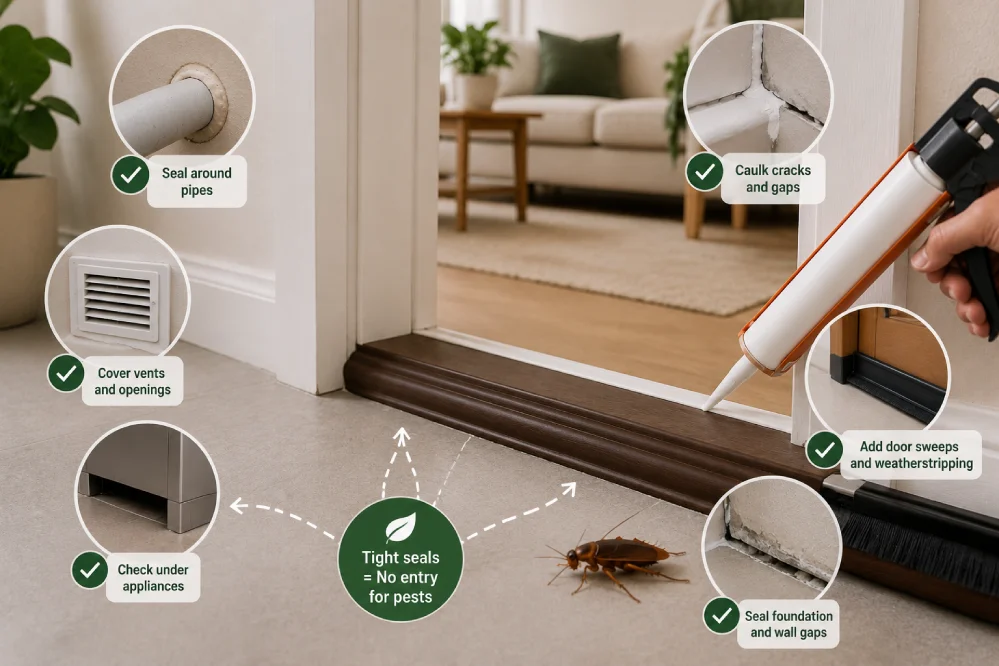
Physical exclusion is the single most effective cockroach prevention method. If roaches can’t get in, they can’t infest.
Where to Seal in an Apartment (Room-by-Room Checklist)
Cockroaches enter through predictable pathways. Target these locations.
Kitchen:
- Gaps around plumbing pipes under the sink (the number one entry point)
- Spaces behind the stove and refrigerator where pipes or wires pass through walls
- Cracks along baseboards, especially on walls shared with neighboring units
- Openings around dishwasher water supply lines
- Gaps where countertops meet the wall
Bathroom:
- Pipe penetrations behind the toilet
- Openings around sink drain pipes inside the vanity cabinet
- Cracks around bathtub plumbing access panels
- Gaps where exhaust vents exit through the wall
General Living Areas:
- Electrical outlet holes on shared walls (roaches use wall voids as highways)
- Window frame gaps, especially on ground-floor units
- Door gaps facing hallways or common corridors
- Baseboard-to-floor junctions throughout the apartment
- Spaces around air conditioning units or window-mounted units
Best Sealing Materials for Apartment Renters
Different gap sizes need different materials.
| Material | Best For | Cost Range | Renter-Friendly? |
|---|---|---|---|
| Silicone caulk | Small cracks (under 6mm) around pipes, baseboards, window frames | $5–$8 per tube | Yes — easily removable |
| Expanding foam sealant | Larger gaps around pipe penetrations and utility openings | $6–$10 per can | Yes — trim excess cleanly |
| Steel wool (grade 0000) | Stuffing into large pipe gaps before caulking over | $5–$8 per pack | Yes — roaches cannot chew through it |
| Weatherstripping tape | Door frames and window sashes | $4–$7 per roll | Yes — peel-and-stick |
| Foam gasket pads | Behind electrical outlet and switch plates on shared walls | $3–$5 per pack | Yes — invisible once plate is replaced |
| Door sweeps | Bottom of entry doors facing hallways | $8–$15 each | Yes — screw-on models work best |
Pro tip: Ask building maintenance to seal pipe penetrations from inside the wall cavity. Landlords are typically responsible for structural pest exclusion under most lease agreements — document your request in writing.
Why this works without chemicals: Sealing creates a physical barrier. No repellent or toxin is needed — you’re simply removing the access points roaches use.
2. Cut Off Their Food and Water Supply
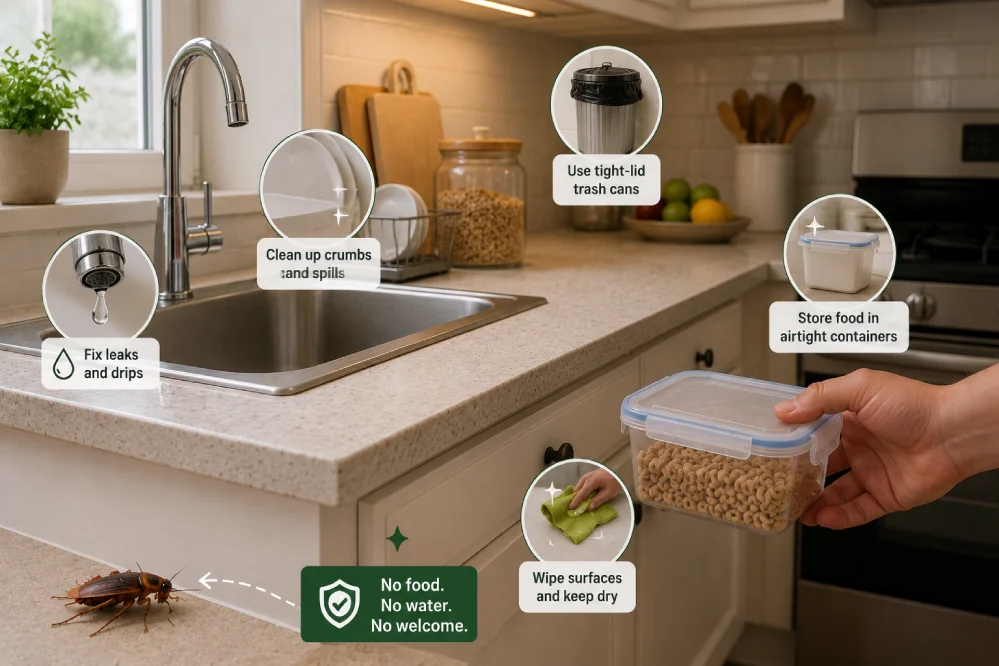
Cockroaches enter apartments searching for food, water, and shelter. Remove the first two and your apartment loses its appeal.
A single German cockroach can survive on as little as 0.05 grams of food per day, according to research in the Journal of Economic Entomology. Even invisible grease films and microscopic crumbs sustain whole colonies, so your cleaning routine needs to be precise and consistent.
Kitchen Food Storage and Nightly Cleaning Routine
Food storage:
- Transfer dry goods into airtight glass or hard plastic containers. Cardboard and thin plastic offer no real barrier.
- Store pet food in sealed containers. Don’t leave bowls filled overnight.
- Keep fruits and vegetables in the refrigerator, not on the counter.
- Check grocery deliveries and cardboard boxes before bringing them inside — roaches hitchhike on packaging from warehouses and stores.
Nightly cleaning checklist:
- Wipe down countertops, the stovetop, and the table with a degreasing cleaner to remove invisible grease residue.
- Sweep or vacuum the kitchen floor, especially behind and under appliances.
- Wash dishes before bed. Never leave them soaking overnight.
- Empty the kitchen trash nightly. Use a bin with a tight-sealing lid during the day.
- Wipe the inside of the microwave — food splatters attract roaches quickly.
The National Pest Management Association (NPMA) identifies accessible food as the primary driver of residential cockroach infestations. Cutting off food access disrupts the roach life cycle at its foundation.
Fixing Leaks and Controlling Apartment Humidity
Cockroaches need water even more urgently than food. Research from Texas A&M AgriLife Extension shows German cockroaches survive only one week without water, compared to roughly a month without food.
Water control:
- Report dripping faucets and leaking pipes to your landlord right away — even a slow drip supplies enough moisture for dozens of roaches.
- Wrap cold water supply pipes under sinks with foam pipe insulation to prevent condensation, a hidden water source.
- Run the bathroom exhaust fan during and after showers for at least 20 minutes.
- Wipe down shower walls and the sink basin after each use.
- Don’t leave wet sponges, dishcloths, or mops sitting out overnight.
- If your apartment feels humid, run a portable dehumidifier to keep relative humidity below 50%. Roach activity drops significantly below this threshold.
In older buildings, hidden plumbing leaks inside wall cavities create permanent moisture zones. If roach activity concentrates near a shared wall, report a possible hidden leak to building management.
3. Apply Diatomaceous Earth as a Chemical-Free Barrier
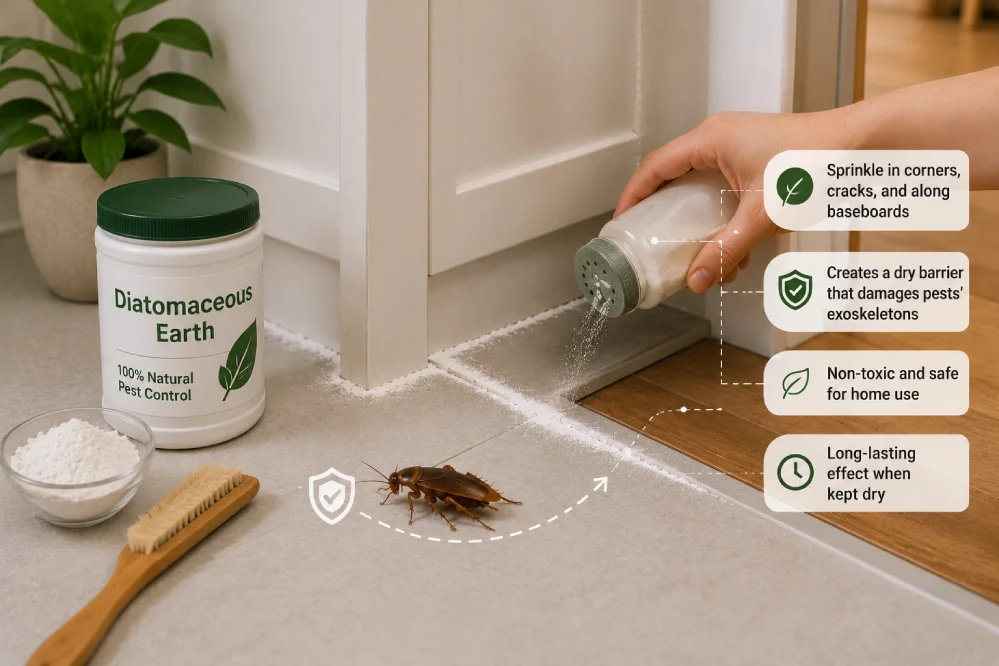
Diatomaceous earth (DE) is one of the most effective insect control tools available. Unlike chemical pesticides, it works mechanically, so roaches can’t develop resistance to it.
How Diatomaceous Earth Kills Cockroaches
DE consists of fossilized diatoms — microscopic algae with silica-based skeletons. Ground into powder, the particles have razor-sharp microscopic edges.
When a roach walks through DE, particles adhere to its exoskeleton and scrape away the waxy outer layer that normally prevents moisture loss. Once that layer is damaged, the roach loses moisture rapidly through desiccation and dies within 24 to 72 hours of sustained contact — a purely physical mechanism.
Where to Apply DE in an Apartment Safely
Apply a thin, barely visible layer in these locations.
| Location | Application Method | Notes |
|---|---|---|
| Behind the refrigerator | Squeeze duster along the floor-wall junction | Highest activity zone in most apartments |
| Behind the stove | Dust the floor area and any visible gap openings | Grease residue attracts roaches here |
| Under the kitchen sink | Apply inside the cabinet along pipe entry points | Combine with sealing (Method 1) |
| Inside cabinet corners | Light dusting in rear corners of all lower cabinets | Focus on cabinets adjacent to shared walls |
| Behind the toilet | Dust along the base and around supply pipe | Common bathroom harborage area |
| Along baseboards | Thin line using a squeeze duster | Prioritize walls shared with neighbors |
| Behind electrical plates | Remove cover plate, dust lightly inside the box, replace plate | Targets wall-void pathways |
| Around the water heater | Dust around the base if accessible | Warm, dark harborage zone |
Safety notes:
- Always use food-grade diatomaceous earth. Pool-grade DE is chemically treated with crystalline silica and poses serious respiratory hazards — never substitute.
- Wear a simple dust mask during application. Fine DE dust irritates the lungs temporarily; once settled, food-grade DE is safe for humans and pets.
- Keep DE away from areas where pets groom frequently. It’s non-toxic, but large amounts ingested may cause mild gastrointestinal discomfort in animals.
- Don’t apply DE in wet or humid areas — moisture clumps the particles and renders it ineffective. Reapply after cleaning or if the area gets wet.
Results typically appear within 7 to 14 days of consistent application, and DE stays effective indefinitely as long as it stays dry.
The National Pesticide Information Center (NPIC) classifies food-grade diatomaceous earth as a safe, low-toxicity pest control option. It carries no EPA registration requirement for pest use because it acts mechanically, not chemically.
4. Use Natural Scent-Based Repellents Strategically
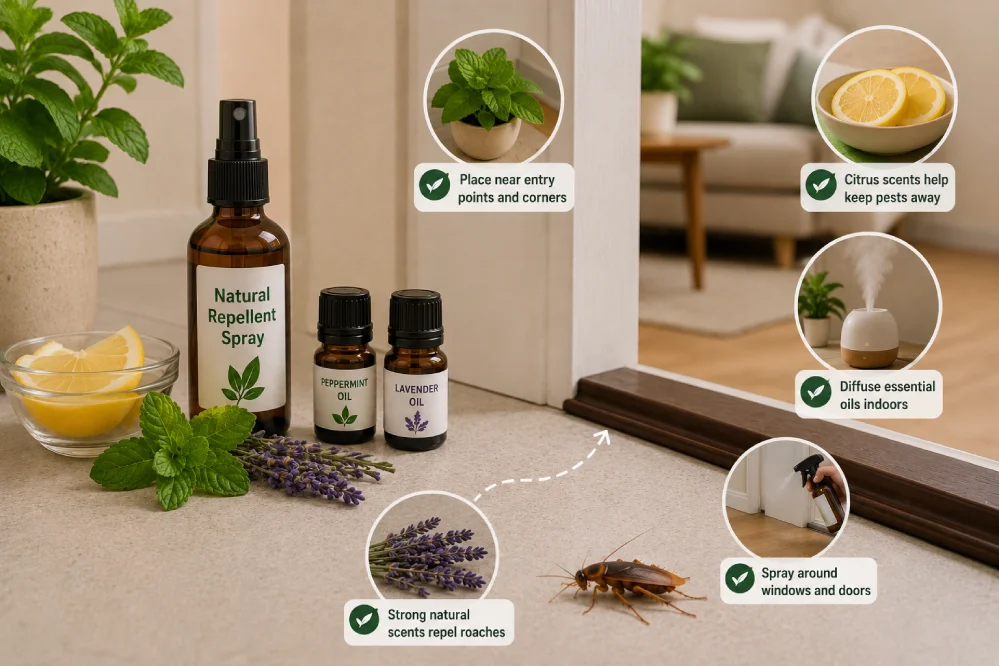
Cockroaches navigate largely through chemical signals, following pheromone trails left by other roaches to find food and shelter. Strong natural scents disrupt these pathways and make treated areas feel unsafe.
Peppermint Oil, Tea Tree Oil, and Garlic
Three natural repellents show consistent effectiveness.
Peppermint oil:
- Mix 15 to 20 drops of peppermint essential oil with one cup of water in a spray bottle.
- Add a small squirt of dish soap to help the oil mix with water.
- Spray along baseboards, behind appliances, near entry points, and inside cabinets.
- Reapply weekly or after cleaning.
Research from Auburn University’s Department of Entomology found peppermint oil showed significant repellent activity against German cockroaches in controlled laboratory settings.
Tea tree oil:
- Use the same method: 15 to 20 drops per cup of water.
- Tea tree oil also carries insecticidal properties beyond simple repellency.
- Apply at wall void entry points and pipe penetrations on shared walls.
Garlic:
- Crush fresh cloves and place them near known entry points.
- Tuck crushed cloves behind appliances, under sinks, and inside cabinet corners.
- Replace every three to four days as the scent fades.
- Sulfur compounds in garlic create an environment roaches actively avoid.
Other effective natural repellents:
- Bay leaves: Place whole dried leaves in drawers, cabinets, and pantry shelves.
- Cayenne pepper and onion powder: Mix equal parts and sprinkle in hidden areas like under appliances.
- Citrus: Wipe surfaces with lemon juice diluted in water — the limonene compound deters roaches.
Are Essential Oil Repellents Safe Around Pets?
Not all natural repellents are equally safe for animals.
| Repellent | Safe Around Dogs? | Safe Around Cats? | Precaution |
|---|---|---|---|
| Peppermint oil | Use with caution | No — toxic to cats | Apply only in areas cats cannot access |
| Tea tree oil | Use with caution | No — toxic to cats | Keep concentrations low; avoid direct contact |
| Garlic | No — toxic to dogs | No — toxic to cats | Use only in sealed areas pets cannot reach |
| Bay leaves | Generally safe | Generally safe | Monitor to prevent ingestion |
| Lemon/citrus spray | Generally safe | Mildly irritating | Avoid direct application on pet bedding |
If you have cats, avoid tea tree and peppermint oil entirely in open living spaces — bay leaves and citrus sprays are the safest alternatives.
If you have dogs, keep garlic-based repellents out of reach entirely; use sealed bait stations or inaccessible cabinet corners only.
Natural repellents work best as a supporting layer within a broader system, combined with sealing (Method 1) and sanitation (Method 2). They won’t solve an active infestation on their own.
5. Monitor with Sticky Traps to Catch Problems Early
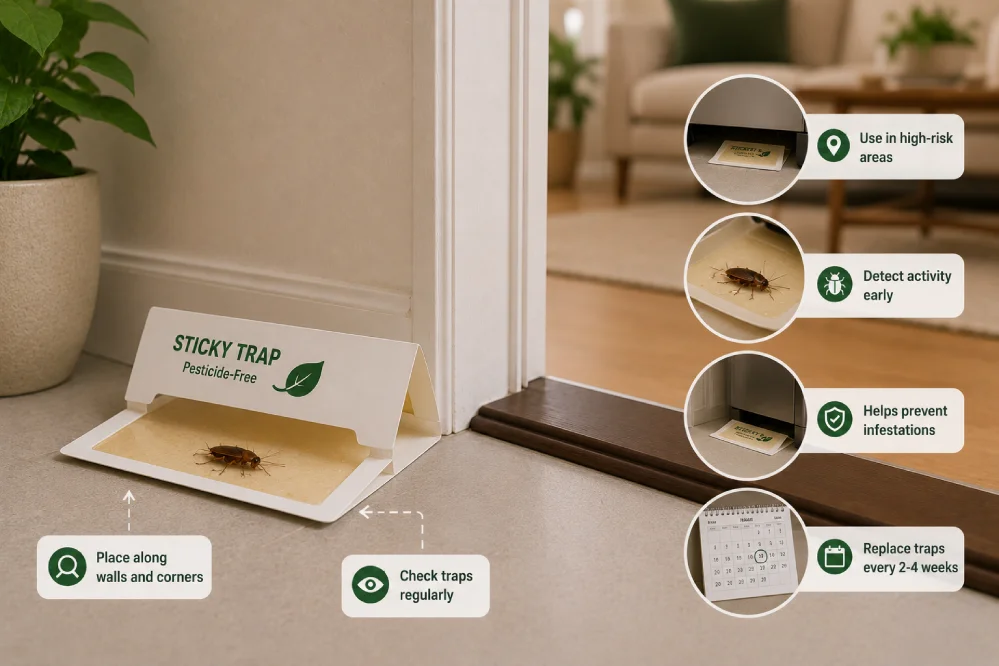
Monitoring turns you from reactive to proactive. Even with perfect prevention, neighboring units remain a constant potential source in apartment buildings. Sticky traps give you early intelligence.
Best Placement Locations for Apartment Roach Traps
Sticky traps — also called insect monitors or glue boards — are non-toxic flat traps with adhesive surfaces. Roaches walk onto them and get stuck. No chemicals, no bait, no risk.
Place traps in these high-probability locations:
- Behind the refrigerator — warmth and darkness create an ideal harborage zone.
- Under the kitchen sink — moisture and pipe access attract roaches consistently.
- Behind the stove — food residue and heat make this a prime location.
- In the back corners of lower kitchen cabinets — especially cabinets on shared walls.
- Behind the toilet — moisture and darkness combine here.
- Near the water heater closet — if accessible, this warm area attracts many pests.
- Along baseboards on walls shared with neighboring units — this catches roaches entering from adjacent apartments.
- Inside the utility closet — if your apartment has one containing pipes or a laundry hookup.
Position traps flush against walls. Cockroaches follow edges due to their thigmotactic behavior — traps in open floor areas catch fewer roaches.
How to Use Trap Data to Inform Your Next Steps
Check traps weekly and record what you find. The data tells a story.
| Trap Finding | What It Means | Recommended Action |
|---|---|---|
| No roaches after 2+ weeks | Low or no activity — prevention is working | Continue current routine; replace traps monthly |
| 1–3 roaches per week | Light activity — possible entry from neighboring unit | Intensify sealing on shared walls; add DE near the active trap |
| 4–10 roaches per week | Moderate activity — established presence likely | Increase all five methods; consider natural bait stations |
| 10+ roaches per week or daytime sightings | Heavy infestation likely | Contact landlord; professional pest control may be necessary |
| Egg cases (ootheca) found | Active reproduction occurring | Aggressive intervention needed immediately |
Trap data doubles as documented evidence for landlord communication. If traps consistently show roaches concentrated near a shared wall, that supports your case that the infestation originates next door. Photograph traps with dates for your records.
Replace traps every 30 days, or sooner if they fill up — old traps lose adhesive effectiveness and collect dust, reducing their value as monitoring tools.
What to Do If You Already See Cockroaches in Your Apartment
Prevention works best before an infestation establishes, but the five methods above still help afterward. The key is increasing intensity and adding a targeted elimination component.
Natural Bait Recipes That Actually Work
Natural baits attract roaches with food and kill them with common household substances, complementing the prevention methods above.
Baking Soda and Sugar Bait (1:1 ratio):
- Mix equal parts baking soda and powdered sugar.
- Place small amounts in shallow bottle caps or on small squares of wax paper.
- Position baits behind appliances, under sinks, and inside cabinet corners.
- The sugar attracts roaches; the baking soda reacts with their digestive acid and kills them.
- Refresh every three to four days.
Borax and Sugar Bait (3:1 ratio):
- Mix three parts borax (sodium tetraborate) with one part powdered sugar.
- Apply using the same bottle-cap method.
- Borax damages the roach’s digestive system and exoskeleton.
- Keep borax baits completely away from children and pets — it’s low-toxicity, not non-toxic.
These baits work best combined with the five prevention methods above. Baits address existing roaches; the five methods prevent new ones from arriving.
How to Prevent Cockroaches from Coming Back
Sustained prevention takes ongoing habits, not one-time fixes.
Grocery and Package Inspection Habits
Cockroaches frequently hitchhike into homes through external sources. The NPMA ranks cardboard packaging from warehouses and grocery stores among the top three roach introduction pathways.
Inspection habits:
- Examine cardboard boxes and produce containers before bringing them inside.
- Remove items from cardboard packaging immediately upon arriving home.
- Avoid storing cardboard boxes inside your apartment long-term.
- Inspect secondhand furniture, electronics, and appliances thoroughly before bringing them inside.
Ongoing Maintenance Schedule for Apartment Dwellers
Consistency prevents reinfestation.
| Frequency | Task |
|---|---|
| Daily | Wipe kitchen counters and stovetop; wash dishes; sweep kitchen floor; empty trash |
| Weekly | Check sticky traps; reapply essential oil sprays; vacuum behind appliances; inspect sealed entry points |
| Monthly | Replace sticky traps; reapply diatomaceous earth if needed; deep-clean under and behind all appliances |
| Quarterly | Re-inspect all sealed gaps for new cracks; check door sweeps and weatherstripping for wear; report any building maintenance needs to landlord |
FAQs
Can cockroaches really travel between apartments?
Yes. Cockroaches regularly migrate between units through plumbing chases, wall voids, electrical conduits, and shared ductwork. A German cockroach can squeeze through a gap of just 1.6 millimeters. In multi-unit buildings, even the cleanest apartment can see roach activity originating next door. Sealing shared-wall entry points is your primary defense.
What smells keep cockroaches away?
Peppermint oil, tea tree oil, garlic, cayenne pepper, bay leaves, and citrus (lemon juice) repel cockroaches by disrupting the chemical signals they use to navigate. Apply these near entry points and combine them with physical sealing. No scent-based repellent works well on its own.
Is diatomaceous earth safe for pets and children?
Food-grade diatomaceous earth is non-toxic to humans and pets. The main concern is mild respiratory irritation from inhaling fine dust during application — always wear a dust mask. Place DE in cracks, crevices, and hidden areas that children and pets can’t easily reach. Never use pool-grade DE, which contains crystalline silica and poses serious health risks.
How long do natural cockroach prevention methods take to work?
Results vary by method. Sealing works immediately. Diatomaceous earth shows results within 7 to 14 days. Sticky traps provide intelligence from day one. Natural repellents begin working on application but need weekly reapplication. Sanitation reduces attraction within days. A complete system typically shows measurable results within two to three weeks.
Why do I have cockroaches in my clean apartment?
Clean apartments attract roaches when shared building infrastructure provides entry points. Cockroaches travel through wall voids, plumbing pipes, and utility conduits between units — a neighboring unit’s infestation can push roaches into your space regardless of your cleanliness. Roaches also hitchhike inside grocery bags, cardboard boxes, and secondhand items. Sealing entry points addresses this specific vulnerability.
Does baking soda really kill cockroaches?
Yes. Baking soda (sodium bicarbonate) reacts with acids in the cockroach’s digestive system, producing gas the roach can’t expel, which eventually kills it. Mix baking soda with equal parts powdered sugar to attract roaches to the bait. Place small amounts in bottle caps behind appliances and in cabinet corners, and refresh every three to four days.
What is the best natural cockroach repellent for apartments?
Peppermint oil shows the most consistent evidence-based repellent activity against cockroaches. Mix 15 to 20 drops with water in a spray bottle and apply along baseboards, behind appliances, and near entry points. No single repellent works alone, though — the best approach combines repellents with sealing, sanitation, diatomaceous earth, and monitoring.
Should I use a fogger or roach bomb in my apartment?
No. The EPA specifically warns that foggers are ineffective against cockroaches in apartment settings. They push roaches deeper into wall voids and can spread the infestation to neighboring units through shared ductwork, and they leave residue on surfaces in small kitchens. Use the natural methods in this article instead.
Conclusion
Keeping cockroaches out of your apartment without harsh chemicals is achievable. The five methods here — sealing entry points, eliminating food and water, applying diatomaceous earth, using natural repellents, and monitoring with sticky traps — form a proven, layered defense.
Apartments face challenges houses don’t: shared walls, plumbing infrastructure, and neighboring units. That’s exactly why prevention matters more here. A prevention-first approach protects your space before roaches get a foothold.
Start today. Seal the gaps under your kitchen sink. Set a sticky trap behind your refrigerator tonight. Transfer your cereal into an airtight container. Small actions compound into real protection over time.