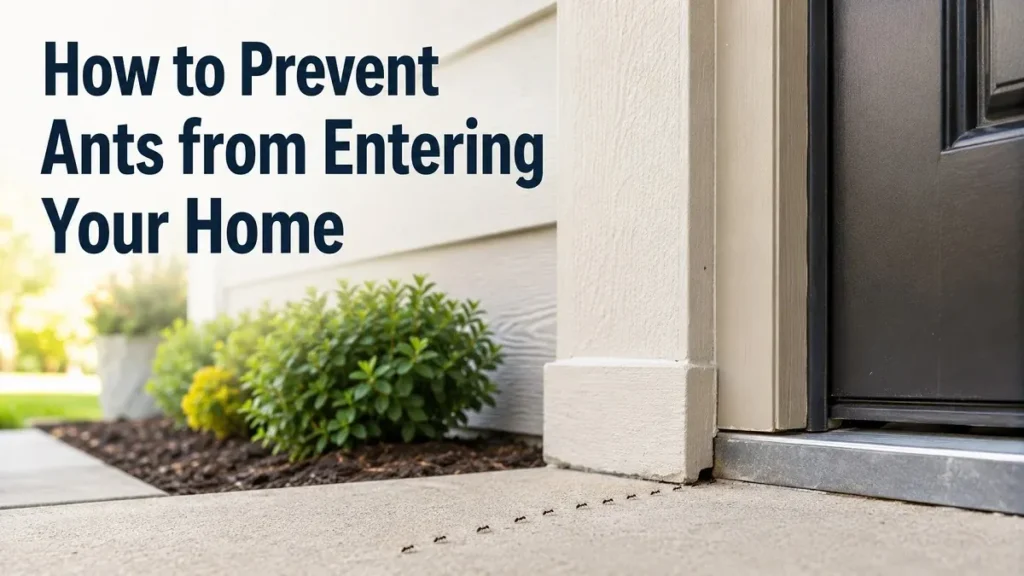
How to Prevent Ants from Entering Your Home
Learn how to find where ants are actually entering your home, seal the right gaps, and stop them from coming back for good.

In this guide
- Why Ants Keep Getting In
- Find Where Ants Are Actually Entering
- Seal the Entry Points You Find
- Remove What’s Attracting Them Indoors
- Keep Trees and Garden Areas Away From Walls
- Get Ahead of Seasonal Ant Activity
- Why Outdoor Sprays Alone Don’t Always Work
- Do Natural Ant Repellents Actually Work?
- What Each Prevention Method Actually Does
- Using Ant Control Safely Around Children and Pets
- How Long Does Ant Prevention Take to Work?
- Quick Ant Prevention Checklist
- Frequently Asked Questions
- Bottom Line
If ants keep showing up no matter how often you wipe the counters or remove the ones you can see, the problem may be less about the insects already indoors and more about how they are getting there.
Most household invasions follow a predictable pattern. Foraging workers locate food, water, or shelter, establish a route back to the nest, and other colony members begin using the same path. Breaking that cycle means tracing the route, closing access points, removing attractants, and dealing with an established nest when necessary.
Here is how to make your home much harder for ants to enter and less rewarding when scouts do make it inside.
Why Ants Keep Getting In
A few ants appearing in the kitchen can quickly become a steady stream because many species navigate with chemical signals called pheromone trails. A scout that discovers something useful can leave a scent route other workers follow between the food source and the nest.
Weather can also change where colonies forage. Hot, dry conditions may increase the search for moisture, while heavy rain can disturb outdoor nesting areas and push activity toward sheltered spaces.
Species matters too.
Odorous house ants commonly forage indoors for sugary foods, while carpenter ants are more closely associated with damp or deteriorating wood. If the infestation behaves differently from what you expect, identifying the type of ant can help narrow down where the nest and access route are likely to be.
Find Where Ants Are Actually Entering
Before reaching for caulk or insecticide, figure out which opening the foragers are actually using.
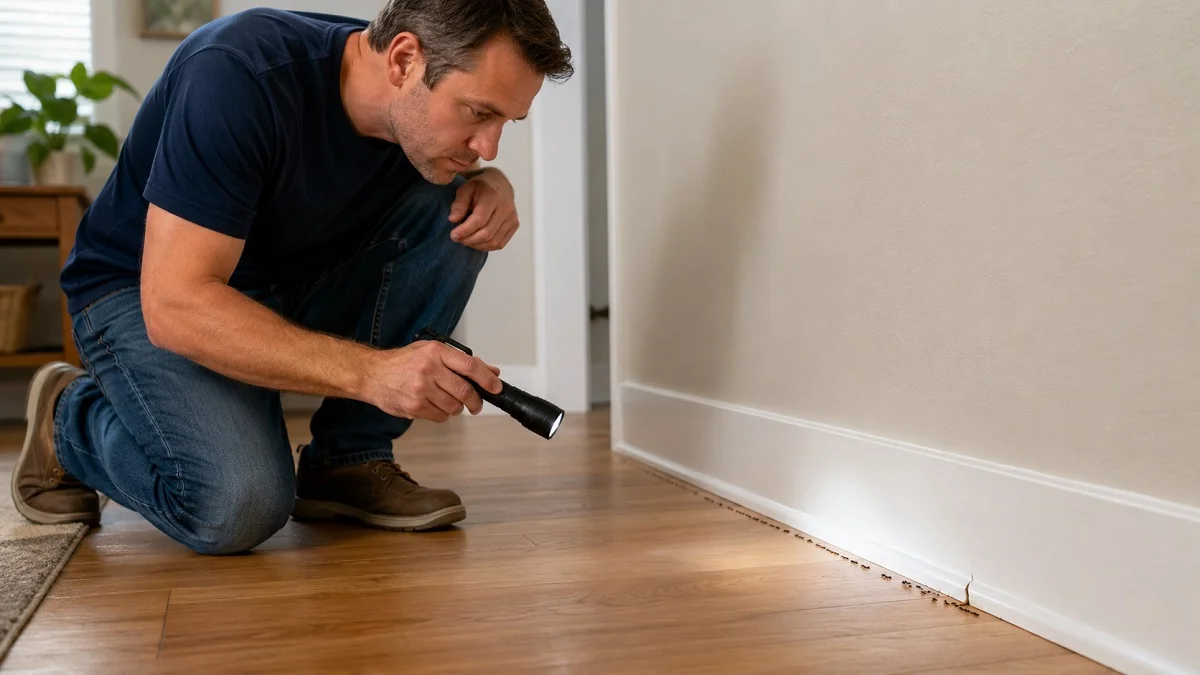
Watch an active line without disturbing it. Follow the movement toward the edge of the room and look for the point where the traffic narrows or disappears.
Common routes include:
- Gaps along baseboards
- Window and door frames
- Foundation cracks
- Spaces around plumbing
- Cable and utility penetrations
- Wall voids
- Openings around electrical fixtures
Do not assume the nearest visible crack is the real access point. Ants can travel behind walls and emerge several feet away from the place where they originally entered the structure.
If activity is difficult to spot during the day, inspect the area after dark with a flashlight. Some species, including carpenter ants, may be easier to track at night.
When the trail keeps disappearing, a tiny amount of attractive food placed near the suspected area can sometimes make the route easier to follow. Once workers begin visiting it, watch where they travel afterward instead of immediately wiping them away.
Check the exterior side of the same wall as well. A trail heading outdoors often indicates that the nest itself is outside and the workers are simply entering to forage.
Seal the Entry Points You Find
Once an active access route has been confirmed, block it.
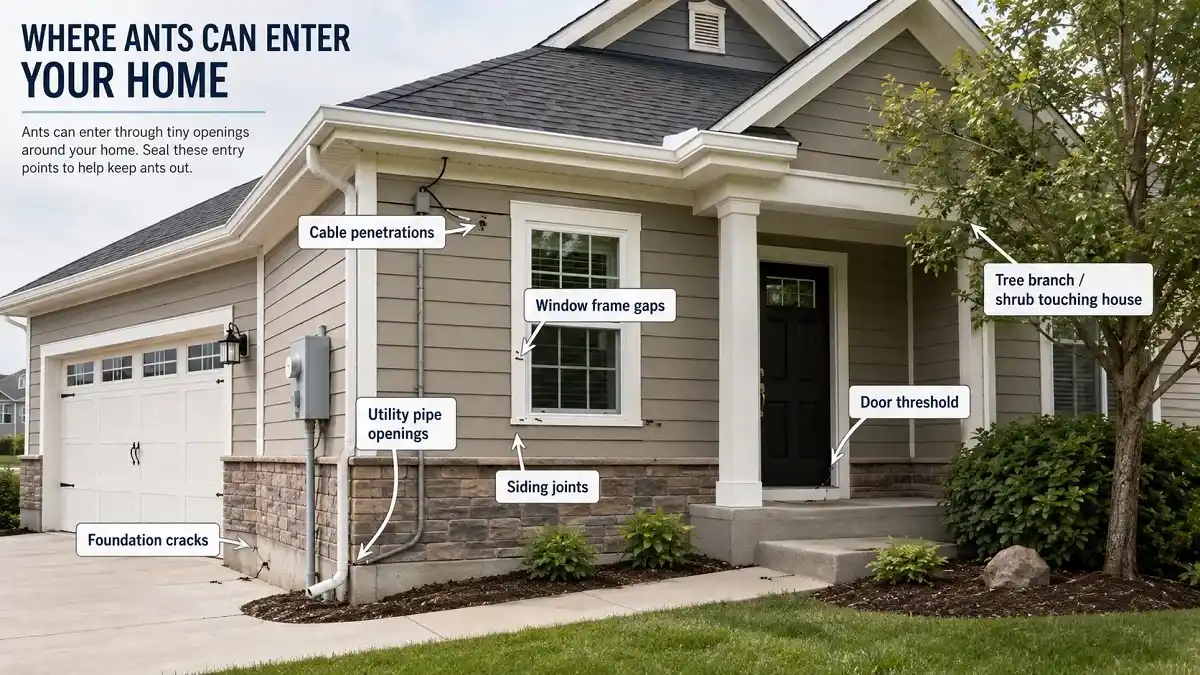
Silicone caulk can be useful around small cracks near window frames, baseboards, utility openings, and other stationary joints. Worn door sweeps or weather stripping should also be replaced when they leave visible space along the threshold.
Think beyond obvious cracks. Structural penetrations around pipes, cables, vents, and wiring can provide surprisingly convenient pathways.
Exterior inspection is just as important. Look around the foundation, siding joints, window trim, door frames, and places where utilities enter the building.
Blocking one opening does not guarantee the nearby colony will disappear. Foragers may begin testing other seams along the same wall, so continue watching the area for new activity after the original route has been closed.
Remove What’s Attracting Them Indoors
Exclusion works much better when there is little reason for scouts to keep searching inside.
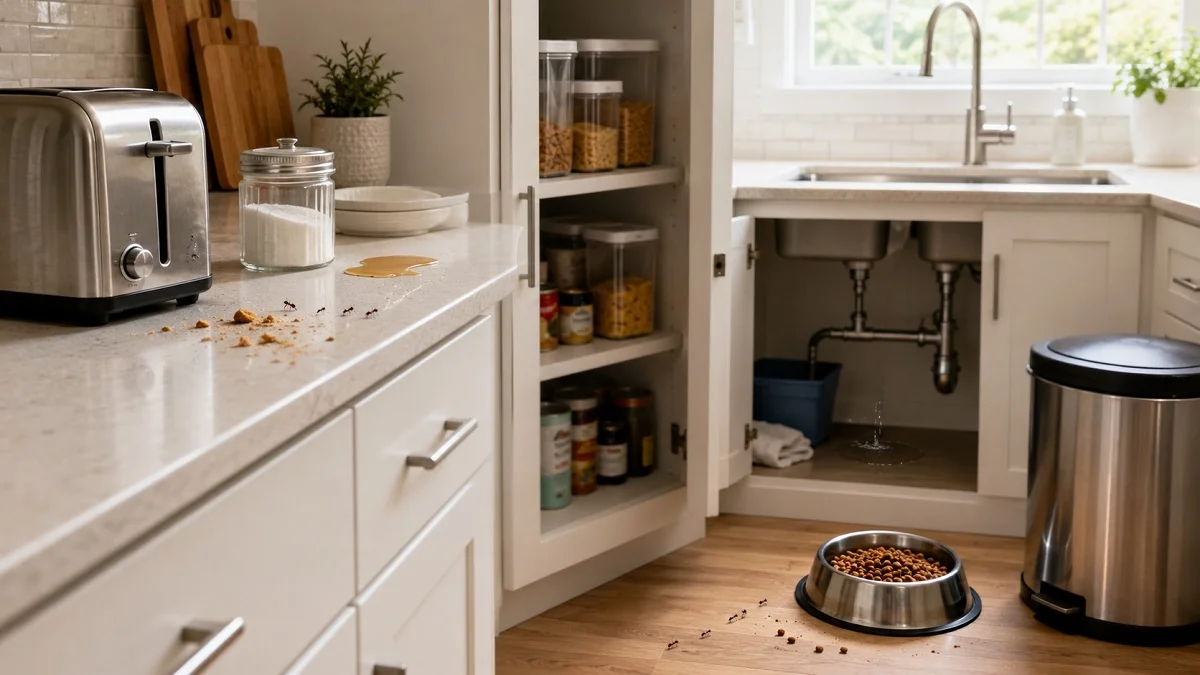
Start with food residue that is easy to overlook. Crumbs beneath appliances, grease around a stovetop, syrup on a cabinet handle, pet-food fragments, or a recycling container that was never rinsed can provide enough of a reward to maintain regular foraging.
Store pantry foods such as sugar, cereal, flour, and pet food in tightly sealed containers rather than relying on opened cardboard boxes or thin bags.
Wipe kitchen surfaces after preparing food and clean sweet spills promptly. Empty food waste regularly and rinse the inside of garbage or recycling bins when residue builds up.
Moisture deserves the same attention.
- Dripping faucets
- Plumbing beneath sinks
- Refrigerator water lines
- Condensation near windows
- AC drain or drip areas
- Damp basements or crawl spaces
- Moisture around tubs and showers
A hidden water source can keep ant activity going even when the kitchen looks spotless.
Keep Trees and Garden Areas Away From Walls
The route into a home does not always begin at ground level.
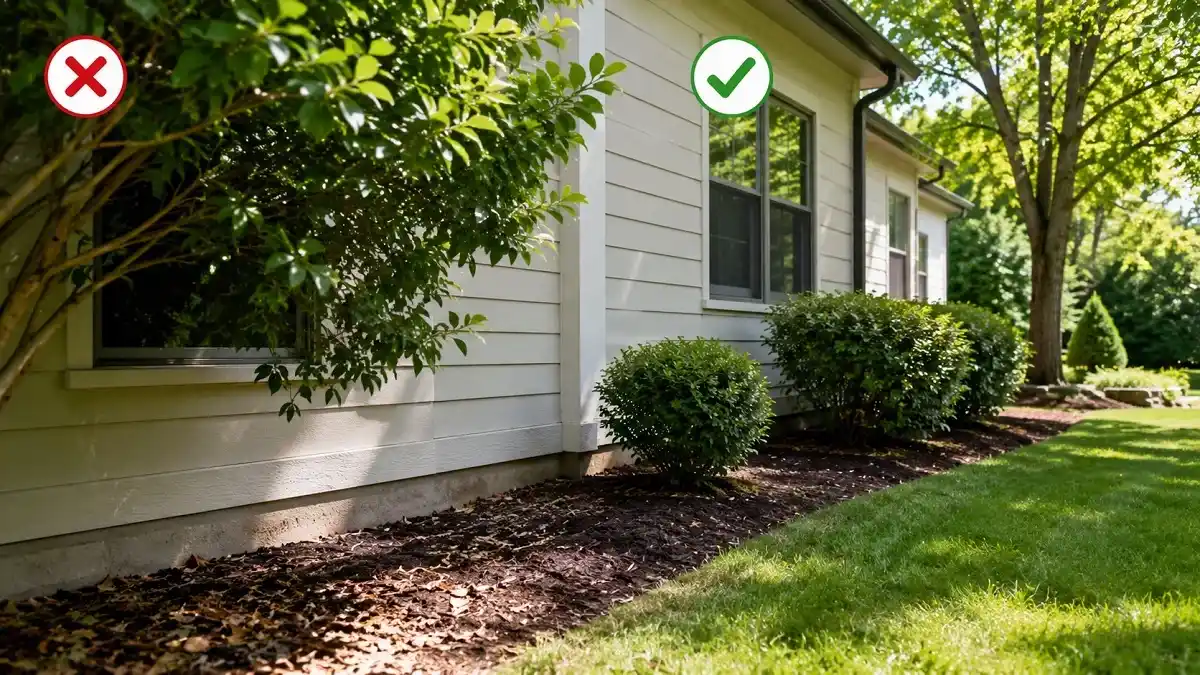
Branches, climbing vines, shrubs, and other vegetation touching the structure can act as bridges to siding, rooflines, windows, and small openings higher on the building.
Trim plants so they no longer make direct contact with the exterior.
Pay attention to the ground around the foundation too. Thick mulch, leaf litter, stacked timber, and other organic debris can create protected nesting conditions close to the building.
Where practical, maintain some separation between dense vegetation or mulch and the foundation rather than piling landscaping material directly against the wall.
Plants near the house can create another food source as well. Aphids and similar insects produce honeydew, a sugary substance that many ant species readily feed on. Heavy ant traffic on shrubs or trees may therefore be connected to insect activity on the plants rather than something inside your kitchen.
Get Ahead of Seasonal Ant Activity
Ant pressure is not identical everywhere, but activity commonly changes with warmer weather, rainfall, drought, and local colony cycles.
Instead of waiting for a trail to appear indoors, inspect the exterior before the period when ants are normally most active in your area.
Check whether:
- Old caulk has separated
- Door sweeps still reach the threshold
- Vegetation has grown against the building
- Mulch has accumulated against the foundation
- Plumbing or exterior fixtures have developed gaps
- Moisture problems have appeared since the last inspection
Small maintenance jobs are easier to handle before a well-established foraging route develops.
Why Outdoor Sprays Alone Don’t Always Work
It can be frustrating to treat the perimeter and still find ants inside a few days later.
One reason is that a surface treatment mostly affects workers that contact the treated area. The nest itself may remain active nearby, allowing replacement foragers to search for another route.
Weather and outdoor conditions can also affect how long a perimeter treatment remains useful.
More importantly, repeatedly killing visible workers does not necessarily solve a colony-level problem. If a nest continues producing foragers, indoor activity can resume.
That is why exclusion, sanitation, and colony-targeting methods generally make more sense as a combined strategy than relying on routine spraying alone.
If bait is required, placement matters. Outdoor-origin infestations are often better addressed with bait near active trails, nest areas, or appropriate exterior locations rather than automatically placing attractant bait throughout the house. Follow the product label and use a formulation intended for the species and location you are treating.
The best time of year to treat for ants can also vary with local conditions and the species involved.
Do Natural Ant Repellents Actually Work?
Home remedies are popular because they are inexpensive and easy to try, but they should not be treated as substitutes for finding the source of an infestation.
Vinegar and Water
A mild vinegar-and-water solution can be useful for wiping surfaces where workers have been traveling. Cleaning the route helps temporarily interfere with the chemical trail used for navigation.
It does not eliminate a nearby nest, so new scouts can eventually establish another route if the access point and attractants remain.
Peppermint, Cinnamon, Coffee Grounds, and Other Strong Scents
Strong-smelling substances are frequently recommended online as barriers, but their performance is inconsistent.
They may alter activity temporarily in a small area, but there is not a dependable household scent that can be expected to prevent every ant species from crossing a surface.
Use these remedies, if at all, as minor supplemental measures rather than the foundation of an ant-prevention plan.
Diatomaceous Earth
Some products containing diatomaceous earth are labeled for insect control, but correct application and safety precautions matter. Avoid treating it as harmless simply because the material is commonly described as natural.
If you use any pest-control product, follow its label instructions, avoid creating airborne dust, and keep it where children or animals will not come into contact with it.
For inexpensive approaches focused primarily on sanitation and exclusion, these low-cost DIY ant-control methods may also be useful.
What Each Prevention Method Actually Does
Understanding the purpose of each tactic makes it easier to choose the right combination.
| Method | Helps Reduce Indoor Entry | Targets the Colony |
|---|---|---|
| Sealing active openings | Yes | No |
| Cleaning and sanitation | Yes | No |
| Removing moisture sources | Yes | No |
| Trimming vegetation | Yes | No |
| Properly placed ant bait | Indirectly | Yes |
| Surface or perimeter spray | Temporarily | Usually not |
A home with an active outdoor nest may require a different approach from one where only a few scouts have wandered inside. Match the method to the actual source instead of applying every treatment at once.
Using Ant Control Safely Around Children and Pets
Homes with children or animals require extra care with pesticides, powders, and bait.
Do not leave homemade borax or boric-acid mixtures in exposed dishes or places that can be reached easily.
When bait is necessary, an appropriate enclosed station can reduce direct access, but placement still matters. Keep pest-control products where children and pets cannot reach or disturb them and follow all directions on the product label.
Avoid assuming that a product is automatically safe because it is described as natural.
If an infestation is already established and exclusion alone is not solving it, the strategy for getting rid of ants permanently in your house may need to focus more directly on the nest.
How Long Does Ant Prevention Take to Work?
Closing an opening or removing a food source does not always make every worker disappear immediately.
Some foragers may already be indoors, while others may continue checking an established route until the chemical trail fades. A nearby colony can also begin testing alternate openings after its usual path is blocked.
Look at the overall trend rather than one stray scout.
A successful intervention should produce:
- Fewer workers on established routes
- Shorter or broken trails
- Less activity around previous food sources
- No new concentrated traffic at nearby openings
Baits require patience because workers must carry the material back toward the nest. Depending on the product, species, and colony size, visible improvement may take several days or longer.
If activity remains unchanged or becomes heavier, inspect the area again. A second access route, hidden moisture source, or untreated nest may have been missed.
Some black ants and other common house ants can use several structural routes around the same room, so checking only the first opening you discover is not always enough.
Quick Ant Prevention Checklist
- Trace active foraging routes before sealing random cracks.
- Caulk confirmed openings around foundations, windows, doors, pipes, and utilities.
- Replace damaged door sweeps or weather stripping.
- Clean crumbs, grease, and sugary residue promptly.
- Keep pantry food and pet food in sealed containers.
- Empty and rinse food-waste bins regularly.
- Repair leaks and investigate hidden damp areas.
- Wipe active trails to remove scent residue.
- Trim trees, vines, and shrubs away from the structure.
- Avoid piling thick mulch or leaf litter against the foundation.
- Check outdoor plants for ant activity associated with honeydew-producing insects.
- Use bait only when needed and place it appropriately.
- Reinspect previous entry routes after treatment.
Frequently Asked Questions
What should I do if I can’t tell where ants are coming from?
Watch active workers rather than removing them immediately. Follow the direction they travel along walls, baseboards, pipes, windows, or cabinets. If activity is difficult to trace, a very small amount of attractive food near the suspected area can help reveal the foraging route. Once you know where they disappear, inspect the same location from outside if possible.
Can ants come back after I’ve sealed an entry point?
Yes. Closing an active opening blocks that particular route, but a nearby nest can send scouts looking for another one. Continue monitoring adjacent windows, door frames, utility penetrations, and foundation seams while also removing food and moisture that would reward new foragers.
Is seeing one or two ants normal after treatment?
A few scouts may still appear after an access route has been sealed or a baiting program has started. The important signal is whether activity is declining. A shrinking trail is different from a new line of workers appearing every day.
What smell do ants dislike the most?
There is no single household smell that reliably keeps every ant species away. Strong odors may temporarily alter a trail, but cleaning the route, removing attractants, and blocking the actual opening are more dependable preventive measures.
Can weather make ants come inside?
Yes. Changes in heat, moisture, rainfall, and outdoor nesting conditions can influence where colonies forage. Indoor activity may increase when ants are searching for water, food, shelter, or more favorable conditions.
Does sealing cracks really stop ants?
Sealing confirmed access points is one of the most useful ways to reduce indoor invasions. It works best when combined with sanitation and moisture control. If a substantial colony remains nearby, workers may search for another opening, so continue inspecting the surrounding area after sealing the original route.
Bottom Line
Preventing ants from entering your home is less about applying more products and more about removing the conditions that make indoor foraging easy.
Start by following the active route. Seal the opening that workers are actually using, remove accessible food and moisture, trim vegetation that provides a bridge to the structure, and keep nesting-friendly debris away from the foundation.
When a colony is already established, use an appropriate bait or other targeted treatment rather than repeatedly killing only the workers you can see.
The goal is simple: remove the route, remove the reward, and address the nest when necessary. That combination gives you a much better chance of preventing the next trail before it becomes another indoor infestation.

Evan Brooks
Evan Brooks enjoys writing about ants and the way they live, build colonies, and adapt to different environments. His articles cover common ant species, nests, queens, seasonal activity, and everyday questions. He believes simple...
View all guides →