How to Get Rid of Sugar Ants (Black Ants): Complete Removal & Prevention Guide
Learn how to get rid of sugar ants for good — what attracts them, why bait beats spraying, realistic timelines, and prevention tips that stop them returning.

In this guide
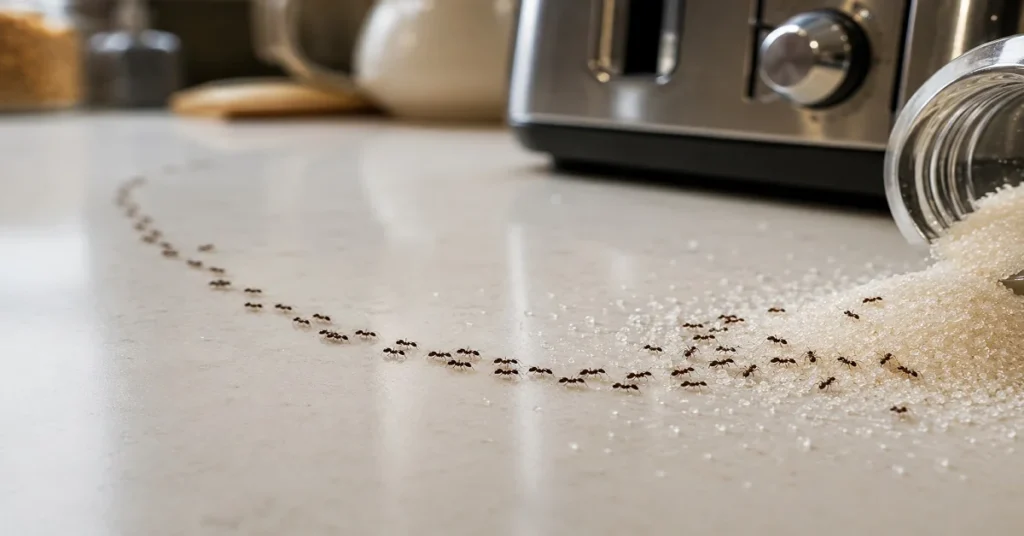
In many homes, the first sign isn’t hundreds of ants — it’s usually a single trail leading to a forgotten spill behind a toaster or coffee maker. A drop of syrup or a few sugar granules is enough to start it: within an hour or two, a thin line of tiny brown ants stretches from a crack in the wall straight to the spill. However, wiping the trail away rarely helps for long, because the colony behind them is still active.
This guide gets straight to the point: what sugar ants are, why they’re in your home, and exactly how to get rid of them — with realistic timelines, the mistakes that make infestations worse, and how to stop them from coming back. (If you’re dealing with more than just sugar ants, our general ant removal guide covers broader ant solutions for every situation.)
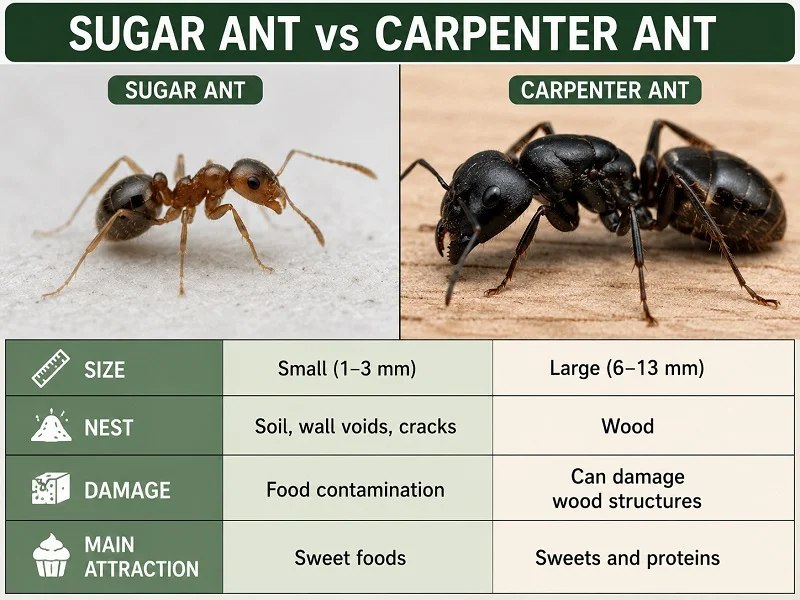
Important Warning: If you are finding large black ants (over ½ inch) near window frames, along with small piles of sawdust or wood shavings, you may have carpenter ants. Unlike regular ants, they can damage the wooden structure of your home. If you see sawdust, skip the DIY sprays and scroll straight to the professional pest control section at the bottom — our carpenter ant guide walks through it in more detail.
What Are Sugar Ants?
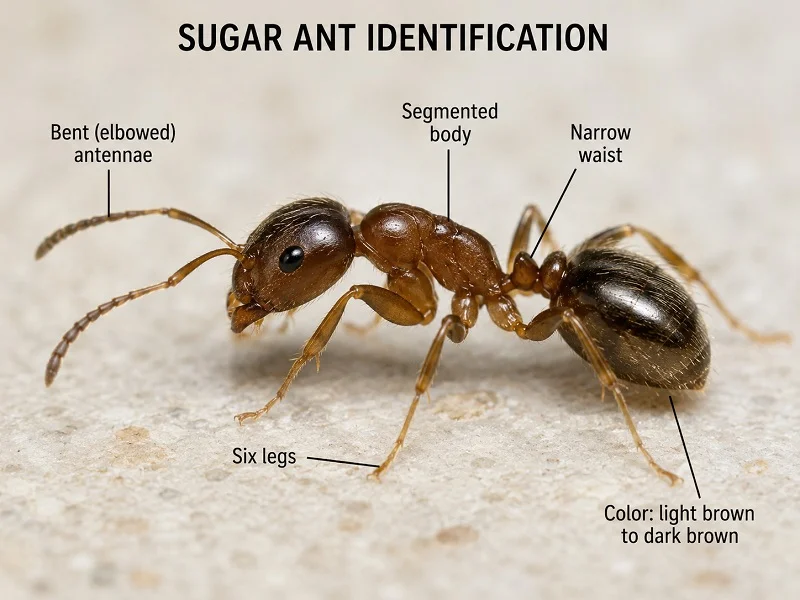
“Sugar ant” isn’t an official species — instead, it’s a common nickname for several small household ants that share a strong attraction to sweets. Depending on where you live, this usually means the Odorous House Ant, Argentine Ant, Pharaoh Ant, Pavement Ant, or Acrobat Ant. Typically, they’re 1–3 mm, light brown to black, with a narrow waist and bent antennae. Meanwhile, a queen lays eggs while worker ants forage for food and lay down pheromone trails for the rest of the colony to follow — which is why a single ant can turn into a visible line overnight.
The species most commonly nicknamed “sugar ant” is the Odorous House Ant, easiest to identify by the rotten-coconut smell it releases when crushed. Two other frequent visitors are little black ants (even smaller, often nesting in wall voids) and the black garden ant (slightly larger, common near foundations). All three are nuisance ants that don’t damage structures, which is exactly why one removal method works for all of them. If what you’re seeing doesn’t match these descriptions, take a moment to identify other ant types before choosing a treatment.
That said, exact species matters less for DIY removal than colony location and food source — the steps below work across all of them.
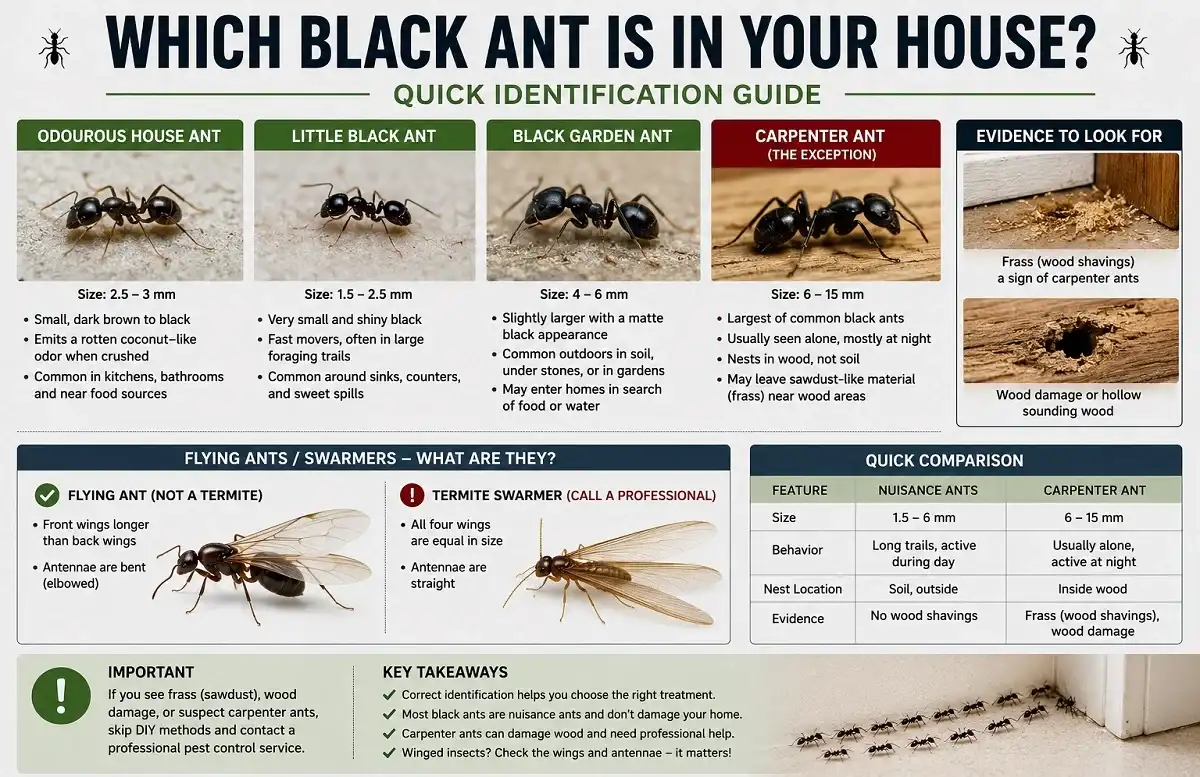
Quick ways to tell them apart:
- Size: Carpenter ants are noticeably larger than typical house ants — if yours are tiny (1–3 mm), they’re almost certainly nuisance sugar ants, not carpenters.
- Behavior: Nuisance ants form long foraging trails; carpenter ants are more often seen alone at night.
- Evidence: Frass or small wood shavings point to carpenter ants, not ordinary black ants.
- Flying ants (swarmers): Seeing winged ants indoors means a mature colony is nearby. If the wings are equal in size and the antennae are straight, it may be a termite — see flying ants vs termites to check. If the wings are different sizes and the antennae are bent, it’s a flying ant.
Why Sugar Ants Come Into Your House
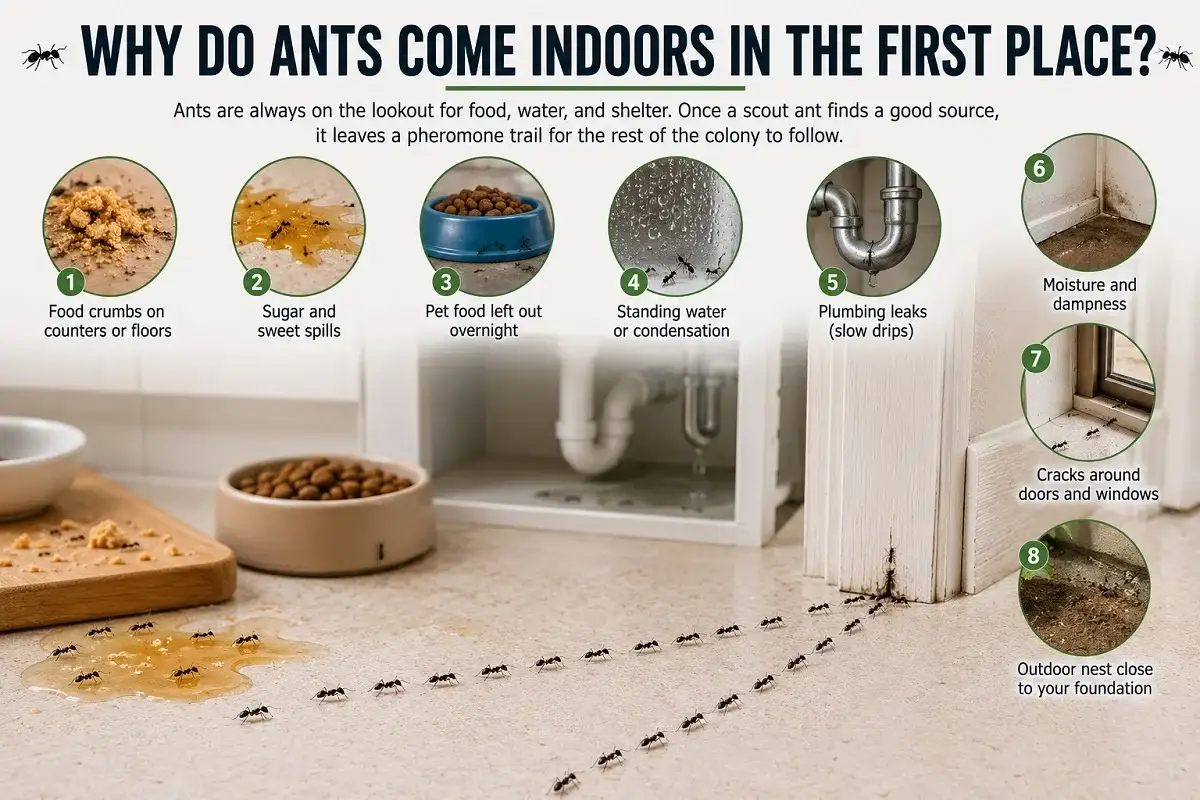
Sugar ants enter homes searching for food, water, or shelter. Specifically, a scout ant finds a reliable food source, lays a pheromone trail back to the colony, and other workers follow it — that’s how one ant becomes a steady line within hours.
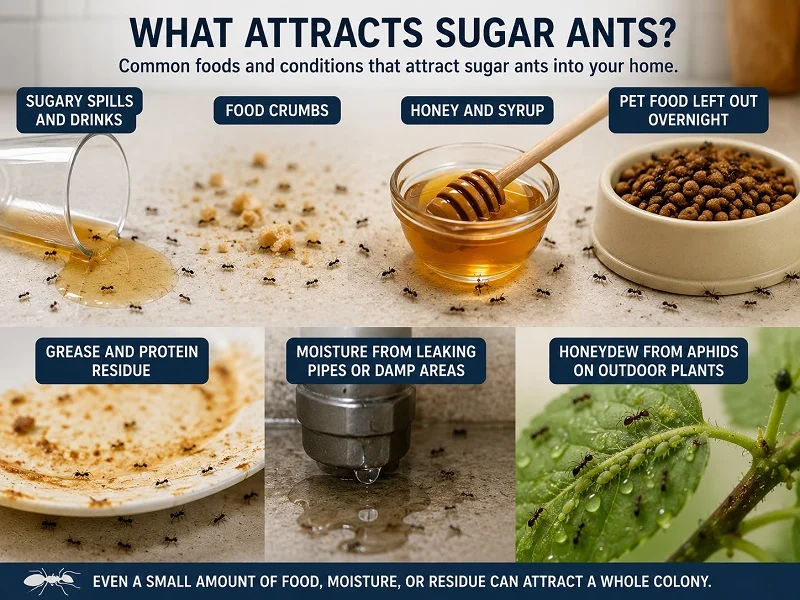
What Attracts Them
- Sugary spills and drinks, honey, syrup
- Food crumbs and grease/protein residue
- Pet food left out overnight
- Moisture from leaking pipes or damp areas
- Honeydew from aphids on outdoor plants
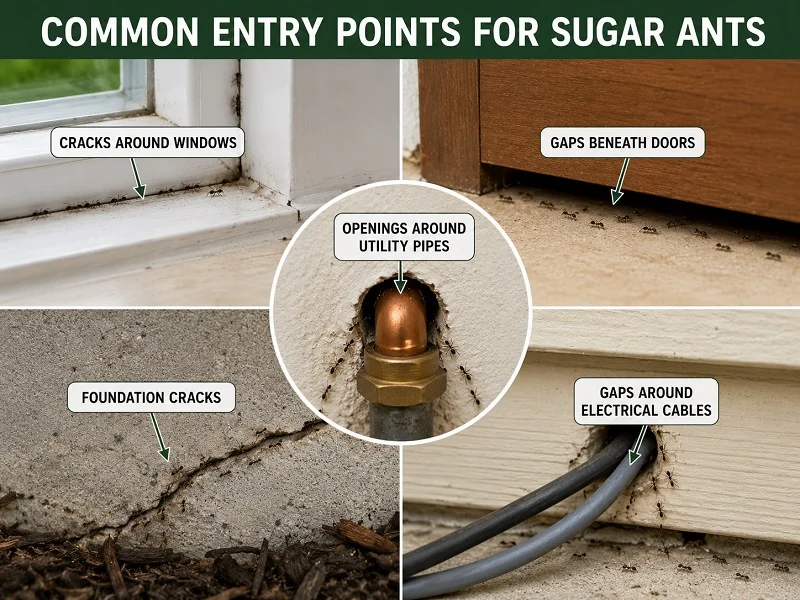
Common Entry Points
- Cracks around windows
- Gaps beneath doors
- Openings around utility pipes
- Foundation cracks
- Gaps around electrical cables
Signs You Have an Infestation
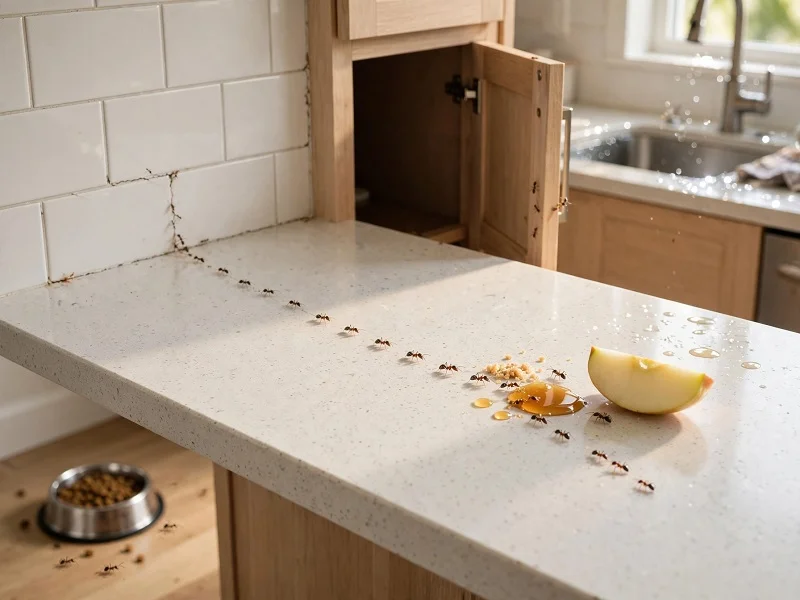
- Visible trails leading to food, especially near counters and sinks
- Activity around pet food bowls or inside the pantry
- Frequent sightings in bathrooms or damp areas
- Winged ants (a sign of the reproductive season, not a new species)
How to Get Rid of Sugar Ants (Step by Step)
The goal isn’t to kill the ants you can see — instead, it’s to eliminate the colony behind them. In fact, spraying visible ants often backfires because it scatters the trail and pushes the colony to open a new one, rather than letting workers carry bait back to the nest.
Step 1 — Find the Trail
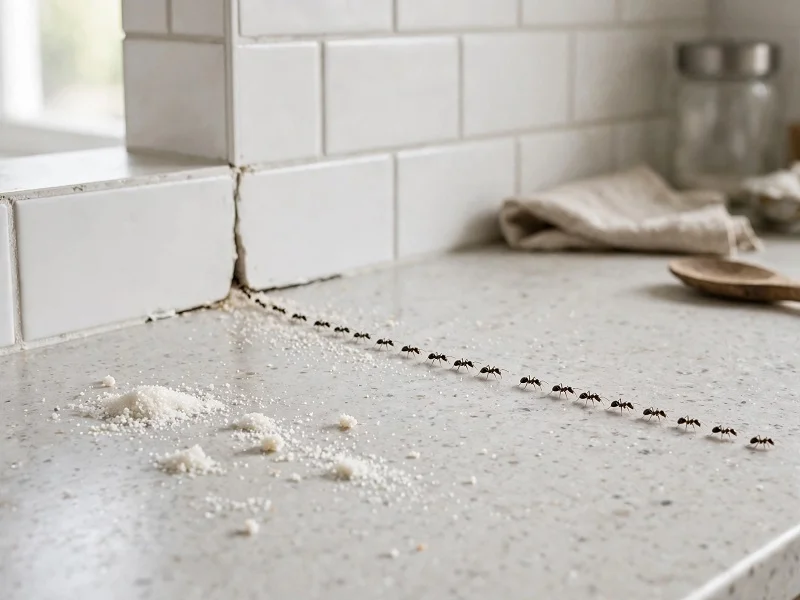
First, follow the trail as far as you can, both directions, to locate the entry point and get a sense of which direction the nest is in. However, don’t disturb it yet — you’ll use this exact spot for bait placement.
Step 2 — Remove Competing Food Sources
Next, clean crumbs, wipe sticky spills immediately, and store food in airtight containers. This isn’t just about cleanliness — if ants have other easy food nearby, they’ll ignore your bait, since bait only works when it’s the most attractive food source available. If you’re seeing ants near the sink, check for a plumbing leak first — water is often a bigger draw than food.
Step 3 — Natural Trail-Cleaning (Vinegar/Soap)
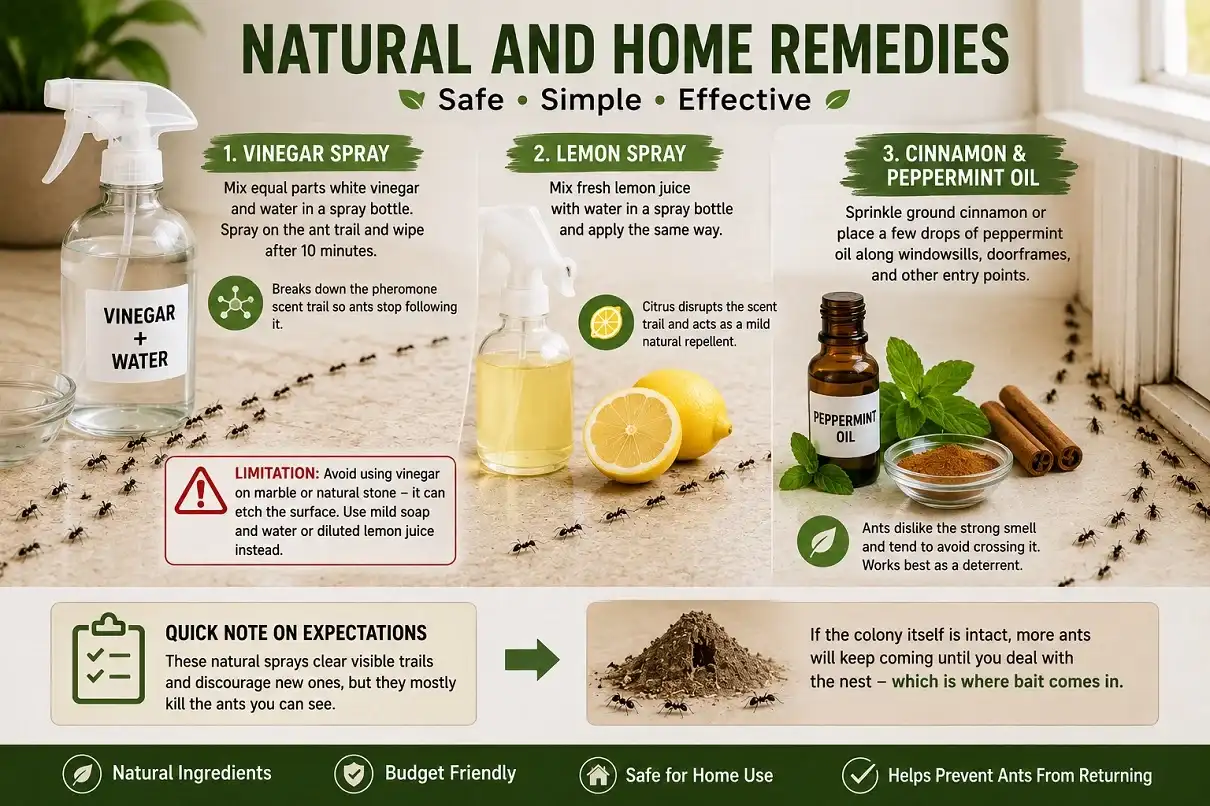
Then, wipe the trail with soapy water or a 50/50 mix of white vinegar and water. As a result, this erases the pheromone scent markers, so new ants can’t follow the old path.
Limitation: Avoid using vinegar on marble or natural stone countertops, since the acid can etch the surface over time. Use a mild soap and water solution or diluted lemon juice instead.
Lemon spray (optional): Mix fresh lemon juice with water in a spray bottle and apply it the same way as the vinegar spray. Citrus disrupts the scent trail and also acts as a mild natural repellent at entry points.
Cinnamon and peppermint oil (optional deterrent): Sprinkle ground cinnamon or place a few drops of peppermint oil along windowsills and doorframes. Ants dislike the strong smell and tend to avoid crossing it, though this works better as a deterrent than a full colony killer.
- How long it takes: works immediately on scent, but ants often re-lay a new trail within hours if the food source or nest is untouched.
- What it does — and doesn’t — fix: disrupts foraging; however, it does not reach the nest or the queen. Always pair it with bait (Step 4).
- Common mistake: relying on vinegar alone and assuming the problem is solved because the visible trail disappears for a day or two.
For more low-cost natural options with exact recipes, see our guide to 7 DIY ant control methods under $5.
Step 4 — Use Ant Bait (the Step That Actually Ends the Colony)
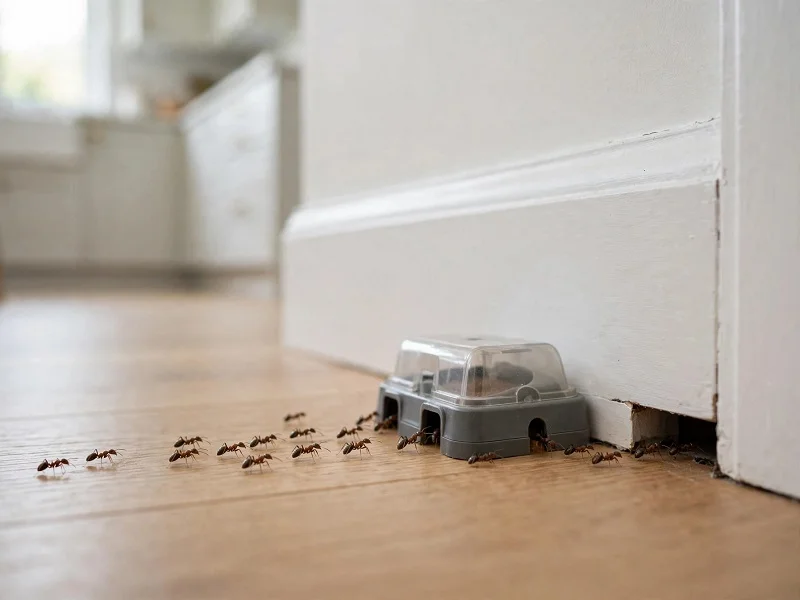
Bait stations let worker ants carry slow-acting bait back to the nest, where it’s shared with other workers and eventually the queen — this is what actually shrinks the colony, not the visible foraging line. According to the UC Statewide Integrated Pest Management Program, baits work precisely because the active ingredient is slow enough that workers survive long enough to carry it back and share it with the rest of the colony.
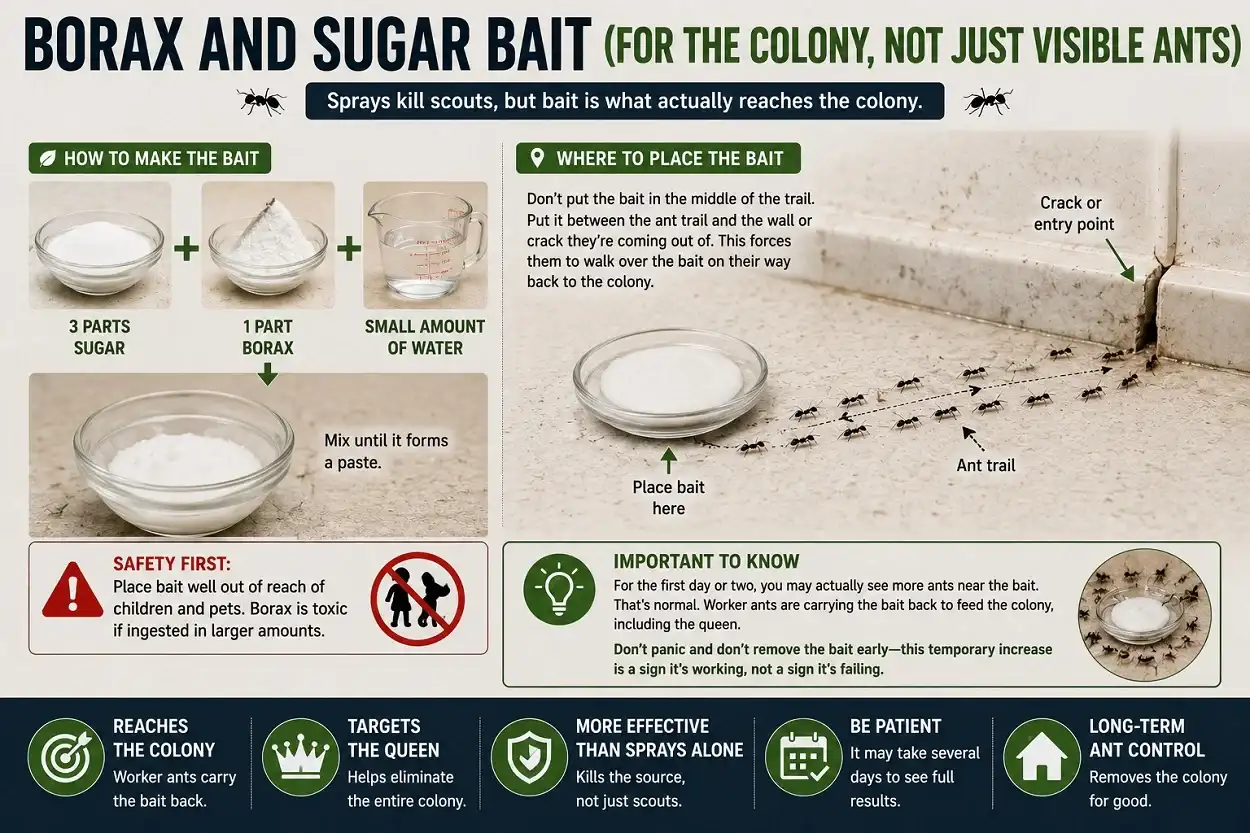
DIY borax bait recipe: Mix 3 parts sugar, 1 part borax, and a small amount of water until it forms a paste. Place small amounts near the trail, well out of reach of children and pets — borax is toxic if ingested in larger amounts.
Placement tip: Don’t put the bait in the middle of the trail. Put it between the ant trail and the wall or crack they’re coming out of. This forces them to walk over the bait on their way back to the colony.
- What to expect: increased ant activity for the first 1–2 days is normal — more ants are visiting the bait, not a sign it’s failing. Don’t panic and don’t remove the bait early.
- Timeline: trails typically start shrinking in 3–5 days; larger or well-established colonies can take 1–3 weeks.
- Common mistake: spraying insecticide near or on the bait — this repels ants from the bait station and stalls the whole treatment.
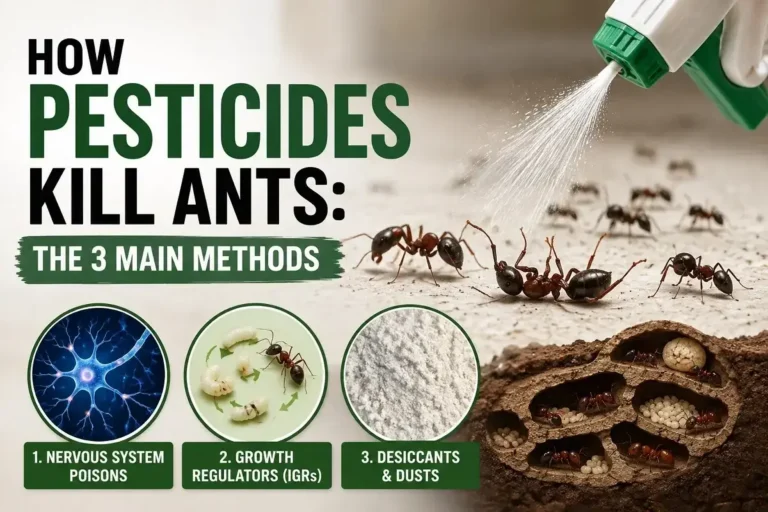
For extra guidance on using pesticides safely around your home, the National Pesticide Information Center offers free, science-based safety resources.
| Bait Type | Best For | Notes |
|---|---|---|
| Liquid / gel bait | Sweet-feeding ants (most “sugar ants”) | Sugar-based, closely matches what scouts are already looking for; generally faster uptake |
| Granular bait | Outdoor perimeter, garden beds | Weather-resistant, good for outdoor nests near the foundation |
| Protein-based bait | Mixed diet ants (e.g., some Pharaoh ant activity) | Useful if sweet bait isn’t being taken — ants may be in a protein-seeking phase |
Step 5 — Seal Entry Points (Timing Matters)
Finally, wait until bait activity has clearly slowed before sealing cracks. Otherwise, sealing too early traps foraging ants inside the wall void, and as a result they’ll simply chew or find another route back into your kitchen instead of dying off with the colony.
- Silicone caulk for windows, doors, and utility pipe gaps
- Expanding foam for larger foundation gaps
- A light layer of diatomaceous earth on stubborn small cracks before sealing, for extra insurance against remaining stragglers
Natural vs. Chemical Methods
| Method | Speed | Reaches the Nest? | Best Use |
|---|---|---|---|
| Vinegar / soap wipe-down | Immediate (on contact) | No | Trail disruption, cleanup — pair with bait |
| Diatomaceous earth | Days | Partial (contact only) | Cracks and dry entry points |
| Borax-based bait | 3–5 days onward | Yes | Established indoor colonies |
| Commercial gel/liquid bait | 3–5 days onward | Yes | Fastest, most consistent uptake |
What NOT to Do
- Don’t spray insecticide directly on or near a bait station — it repels ants instead of letting them carry bait to the nest.
- Avoid sealing entry points before bait activity has slowed — otherwise you’ll trap ants inside the wall instead of eliminating the colony.
- Never leave pet food out overnight — it’s one of the biggest overlooked attractants.
- Resist the urge to overuse borax powder — a thick, visible layer often makes ants avoid it rather than track it back to the nest.
- Also, don’t expect overnight results — a real colony reduction takes days, not hours, so judge success by the trend, not the first day.
Are Sugar Ants Dangerous?
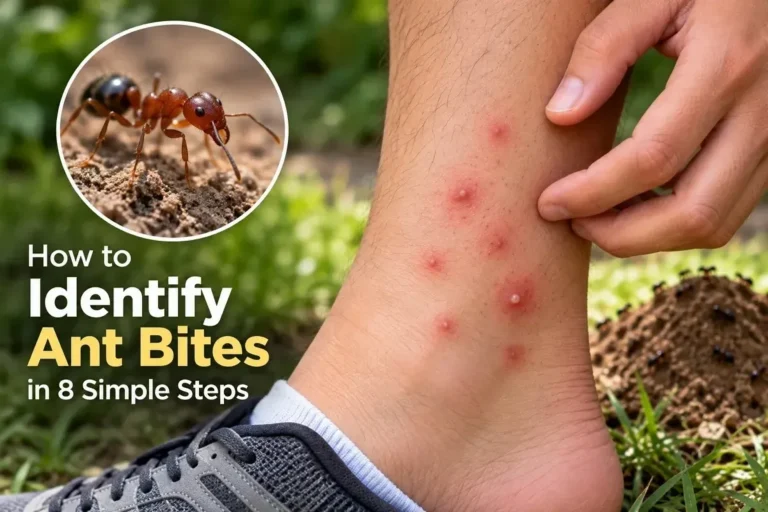
Overall, sugar ants are mostly a nuisance, not a health threat. Most species rarely bite, and any bite is usually mild — if you’re getting painful stings, you’re more likely dealing with fire ants instead. That said, the real risk is food contamination: any uncovered food ants have crawled over should be thrown out. It’s uncommon, but ants can also pick up bacteria while foraging through garbage or drains and carry it onto food surfaces — one more reason to keep counters clean and food sealed. Additionally, they’re not considered dangerous to pets, though pet food bowls are one of the biggest things drawing them indoors in the first place.
How to Prevent Sugar Ants From Coming Back
Once the colony is gone, a few habits keep new scouts from finding a reason to stay. For starters, store sugar, cereal, snacks, and other pantry items in airtight containers. Also, wipe crumbs and sugary spills as soon as they happen, and don’t leave pet food out overnight. In addition, fix leaking pipes and standing water, since moisture is as strong a draw as food. Outside, trim any plants or branches touching exterior walls, because vegetation acts as a bridge indoors, and regularly re-check the seals around doors, windows, and utility pipes. For a whole-home approach, see our full home ant-proofing guide.
Prevention Checklist
- Store food in airtight containers
- Clean sugary spills immediately
- Wipe kitchen counters daily
- Sweep crumbs from floors
- Take out the garbage daily — a full bin with food waste is basically an open invitation
- Remove pet food after feeding
- Fix plumbing leaks and remove standing water — check under sinks, around AC units, and in plant trays
- Seal cracks around doors, windows, and pipes
- Trim vegetation touching your home
- Inspect houseplants — ants are sometimes brought in through potting soil or drawn to plant nectar
- Check for outdoor nests near your foundation — treating one outside can prevent an entire indoor infestation
- Inspect your home regularly for new activity
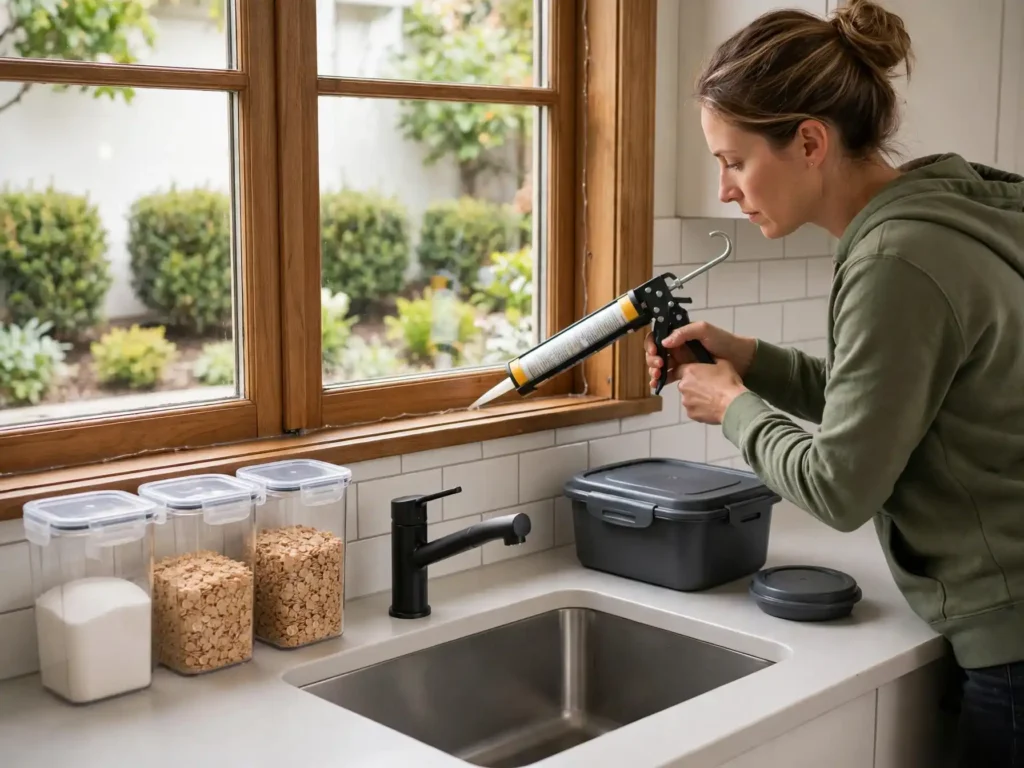
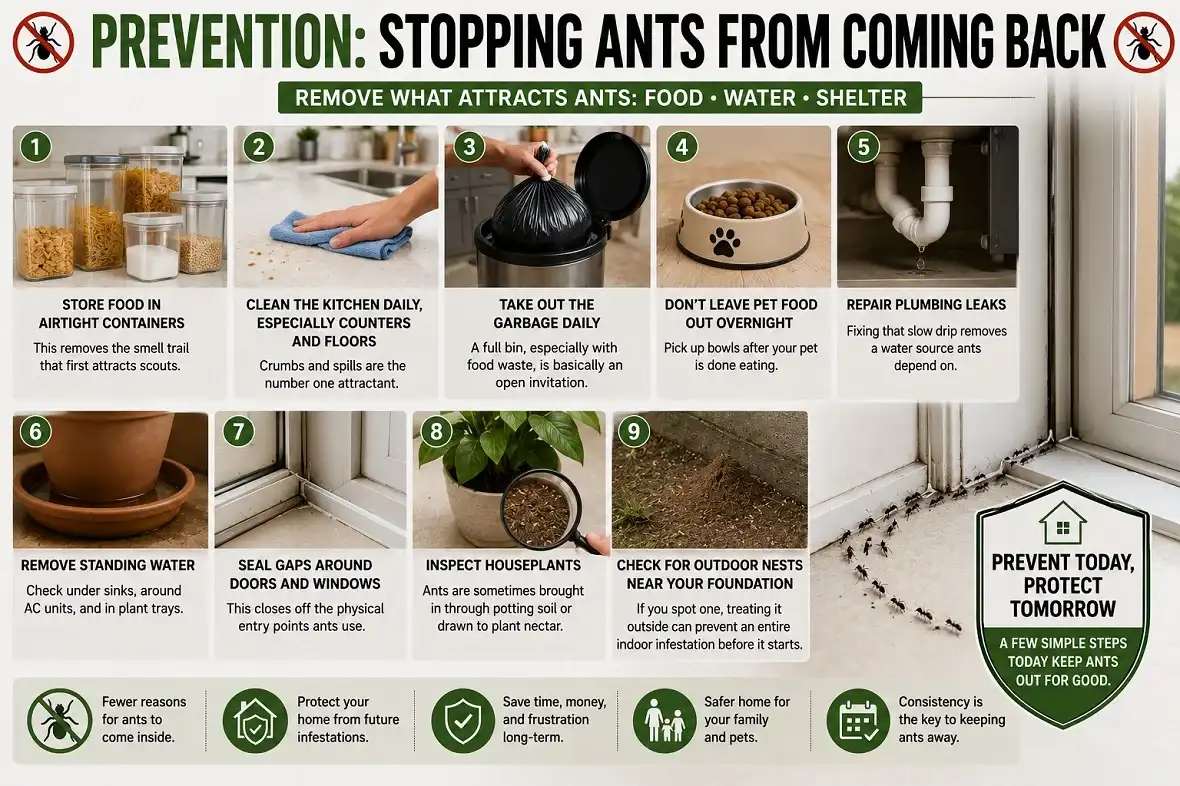
Sealing entry points, storing food properly, fixing moisture problems, and keeping the kitchen clean are what actually stop sugar ants from returning.
DIY vs. Calling a Pest Control Professional
| Situation | Recommended Approach |
|---|---|
| Single trail, one room, first time seeing it | DIY — bait + sealing is usually enough |
| Bait shows no improvement after 1–3 weeks | Professional — likely a larger or hidden nest |
| Ants appearing in multiple rooms at once | Professional — possible multiple colonies/satellite nests |
| Can’t locate the nest despite tracing trails | Professional inspection recommended |
| Colony nesting inside a wall | Professional — wall voids need specialized treatment |
| Frass or wood damage found | Professional — likely carpenter ants; see the carpenter ant guide |
| Infestation keeps growing despite consistent effort | Professional treatment |
Ultimately, a licensed pest control professional can confirm the exact species, locate hidden nests, and use treatments matched to that species — useful when DIY bait isn’t budging the problem. There’s no shame in calling for backup once a colony has become established indoors — it’s often faster and cheaper than months of recurring DIY treatments.
Sugar Ant Identification Chart
Useful if you want to confirm exactly what you’re dealing with before treating.
| Feature | Sugar Ants | Carpenter Ants | Fire Ants |
|---|---|---|---|
| Size | 1–3 mm | 6–13 mm | 2–6 mm |
| Color | Light brown to black | Black/reddish-black | Reddish brown |
| Nest | Soil, wall voids, cracks | Wood (hollowed, not eaten) | Outdoor soil mounds |
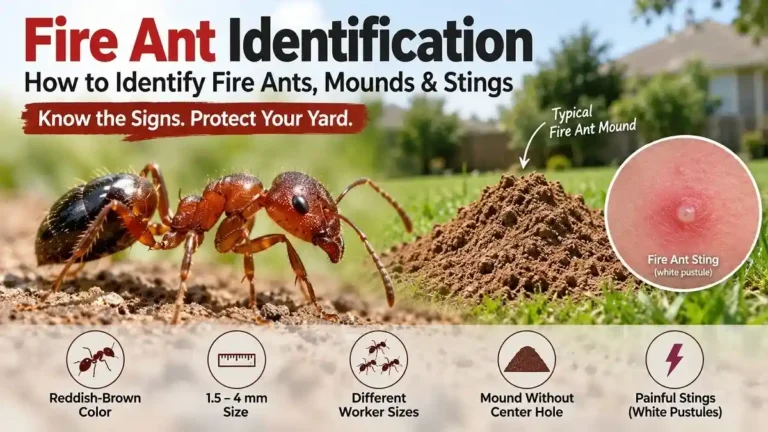
| Bite/Sting Risk | Rarely bite | Can bite, no sting | Painful stings |
| Main Attraction | Sweet foods | Sweets and proteins | Varied; aggressive defenders |
Frequently Asked Questions
What are sugar ants?
Sugar ants are small ants attracted to sweet foods and sugary spills. In short, it’s a nickname for several species, not one official species.
Why do sugar ants suddenly appear overnight?
A single scout ant finds a food source and lays a pheromone trail back to the colony. Then, once other workers pick up that trail, a handful of ants can turn into a steady line within hours.
Should I kill every ant I see?
No — killing or spraying visible ants disrupts the trail without reaching the colony, and can push ants to open a new route instead. Instead, bait is more effective because it lets workers carry it back to the nest.
How long does bait take to work?
Generally, most homes see the trail shrinking within 3–5 days; larger, more established colonies can take 1–3 weeks. Meanwhile, a brief spike in activity in the first day or two is normal.
Do sugar ants come back every year?
They can, especially in the same season if the original attractants (food, moisture, entry points) weren’t addressed. Ultimately, consistent prevention habits are what stop the yearly repeat.
Can weather cause ant activity?
Yes — heavy rain can drive outdoor colonies to seek dry shelter indoors, and similarly, hot, dry weather can send them searching for moisture. As a result, seasonal spikes are common.
Should I spray after using bait?
No — spraying around an active bait station repels ants from it and can stall the entire treatment. Instead, hold off on spraying until well after the bait has visibly worked.
Do sugar ants bite?
Most species rarely bite, and any bite is usually mild. On the other hand, painful stings point more toward fire ants, not sugar ants.
Do black ants spread disease?
It’s uncommon, but ants can pick up bacteria while foraging through garbage or drains and carry it onto food surfaces. This is one more reason to keep counters clean and food sealed.
Are these remedies safe for kids and pets?
Vinegar, lemon, and cinnamon are all safe around children and pets. Borax bait and commercial gels should always be placed out of reach, since they’re designed to be toxic to ants and can be harmful if ingested by people or animals.
Your Next Steps
Here’s exactly what to do based on where you stand right now:
- Seeing just a few ants today? Clean the kitchen thoroughly and apply a vinegar spray on any visible trail.
- Still seeing activity after 3–5 days? Move to a borax and sugar bait or a commercial gel bait, and give it time to work.
- No improvement after a week? It’s time to contact a licensed pest control professional, especially if you’ve noticed frass or ants inside a wall.
Whichever stage you’re at, you now have everything you need to handle it — no extra searching required.
How to know you’ve won: If you go 48 hours without seeing a single ant on your counters or floors, congratulations — the colony has been eliminated. You can stop active treatments, but keep up the weekly cleaning routine to make sure they never return.

Evan Brooks
Evan Brooks enjoys writing about ants and the way they live, build colonies, and adapt to different environments. His articles cover common ant species, nests, queens, seasonal activity, and everyday questions. He believes simple...
View all guides →