
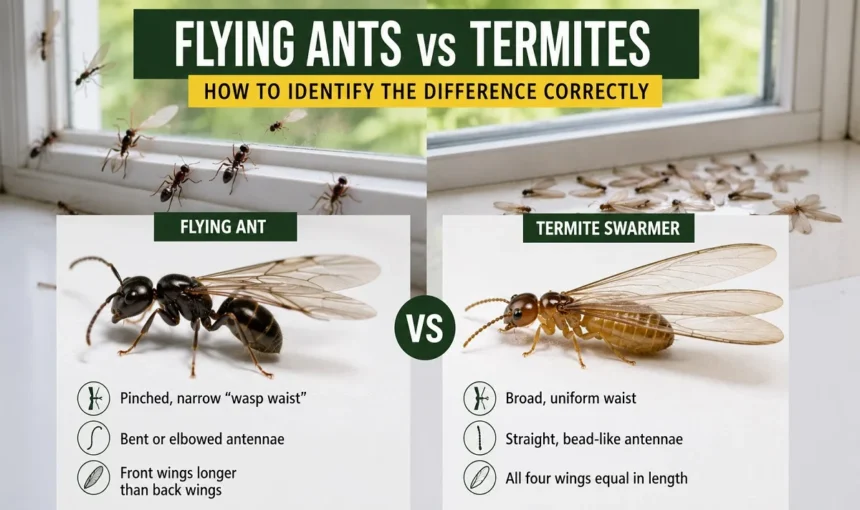
TL;DR: Flying ants have bent antennae, narrow waists, and uneven wings. Termite swarmers have straight antennae, broad waists, and four equal wings. Correctly telling flying ants vs termites apart helps you decide whether you have a minor nuisance or a potential structural problem.
You walk into your basement on a warm spring afternoon and notice two dozen winged insects near the window. Some are crawling on the sill. Others are flying clumsily toward the light. One question immediately comes to mind: is this a flying ants vs termites situation, or just a harmless swarm passing through?
- Quick Answer Box
- Flying Ants vs Termites: The 3-Second ID Check
- What Do Flying Ants Actually Look Like?
- What Do Termite Swarmers Actually Look Like?
- What Does This Mean for Your Home?
- Why Did They Suddenly Appear?
- Comparing the Risks: Flying Ants vs Termites
- Signs You May Have Flying Ants vs Termites
- What to Do Next: A Practical Action Plan
- Common Mistakes to Avoid
- Myth vs. Fact: Flying Ants vs Termites
- DIY vs. Professional Assessment
- Seasonal and Regional Notes
- Frequently Asked Questions
- Important Note
- Conclusion
Many homeowners experience this same moment of confusion during swarming season, and every year, countless people face it. Fortunately, most of these unexpected visitors turn out to be harmless flying ants. Still, identifying them correctly matters, since the two insects call for very different responses.
This guide explains how to tell the difference, what each insect means for your home, and the steps to take next.
Quick Answer Box
| If you see… | Most likely… |
|---|---|
| Pinched, narrow waist | Flying Ant |
| Broad, uniform waist | Termite Swarmer |
| Bent or elbowed antennae | Flying Ant |
| Straight, bead-like antennae | Termite Swarmer |
| Front wings longer than back wings | Flying Ant |
| All four wings equal in length | Termite Swarmer |
Flying Ants vs Termites: The 3-Second ID Check
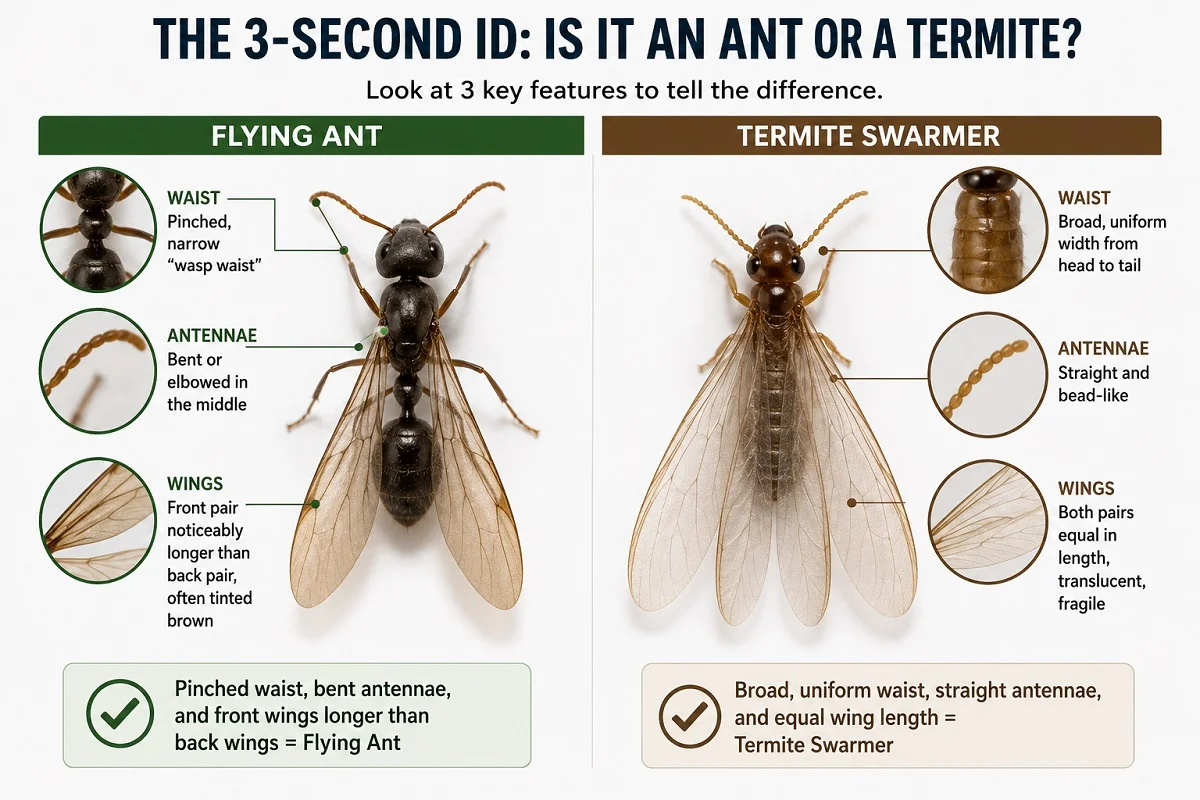
Before doing anything else, catch one of the insects. Use a piece of clear tape to gently trap it without crushing the body. Then, look at three specific body parts. This simple check can help you settle a flying ants vs termites question in seconds, and it works for most common species.
| Feature | Flying Ant | Termite Swarmer |
|---|---|---|
| Waist | Pinched, narrow “wasp waist” | Broad, uniform width from head to tail |
| Antennae | Bent or elbowed in the middle | Straight and bead-like |
| Wings | Front pair noticeably longer than back pair, often tinted brown | Both pairs equal in length, translucent, fragile |
If the insect has a pinched waist, bent antennae, and wings of different sizes, you are likely looking at a flying ant. On the other hand, if the body is uniform in width, the antennae are straight, and all four wings are the same size, you are likely looking at a termite swarmer.
According to the University of Maryland Extension, these three features — antennae shape, waist shape, and wing length — remain the most reliable way to separate the two insects, even for untrained observers.
What Do Flying Ants Actually Look Like?
A flying ant resembles the ants you’d see on a sidewalk, but with wings added. The body has a clearly segmented appearance, with a tightly constricted waist that creates an hourglass silhouette.
The antennae bend at a sharp angle. Meanwhile, the front wings extend noticeably beyond the back pair and often carry a brownish tint. Depending on the species, flying ants can be black, dark brown, or reddish.
When found indoors, flying ants typically cluster around windows and light sources. Unlike termites, however, they tend to keep their wings attached.
What Do Termite Swarmers Actually Look Like?
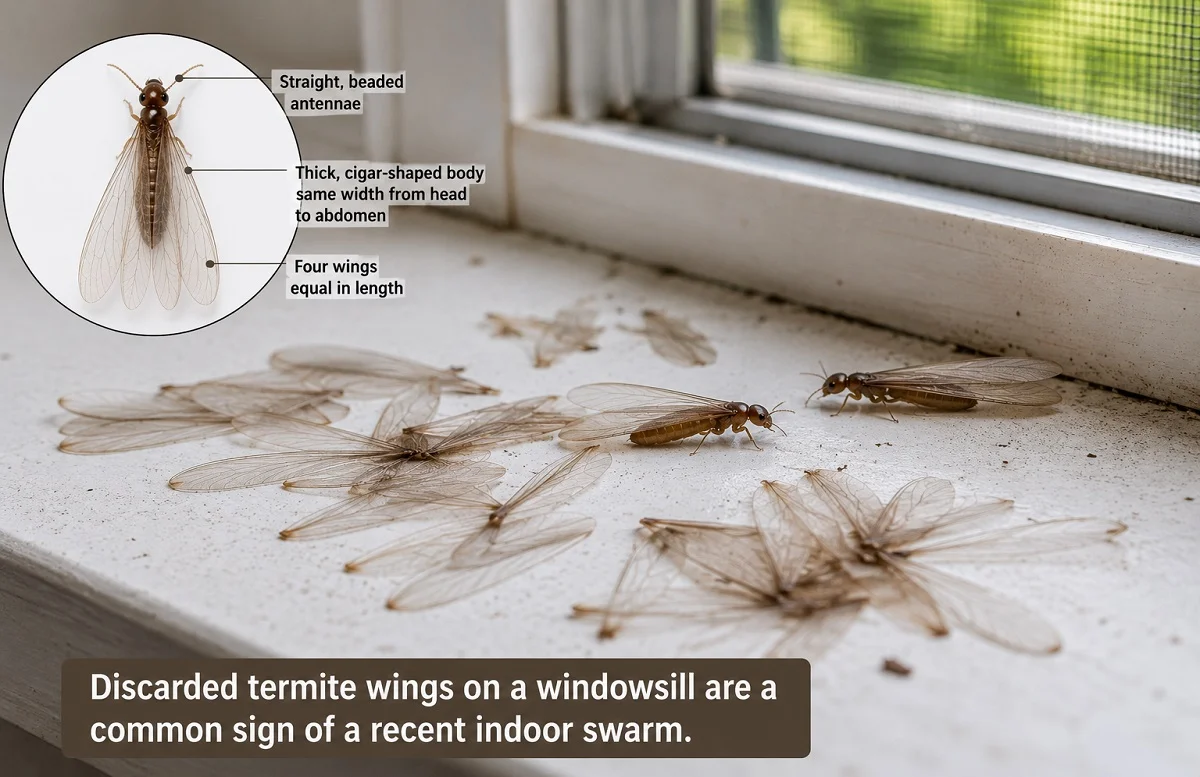
Termite swarmers have thick, cigar-shaped bodies that flow straight from the head to the abdomen without any narrowing.
Their antennae are straight with a gentle curve, resembling a string of tiny beads. This is a reliable identifying feature once you’ve observed it up close.
All four wings are equal in length and shape, and they appear translucent and fragile. Termite swarmers typically shed their wings within hours of landing, so finding piles of identical, translucent wings on windowsills or floors often suggests termite activity.
What Does This Mean for Your Home?
Identifying the insect is the first step. Next, it’s important to understand what its presence actually suggests.
If You Have Flying Ants
Most flying ant species are harmless. They are reproductive members of a mature colony somewhere nearby. On warm, humid days, often after rain, the colony releases these winged ants to mate and start new colonies.
Finding them inside usually means they entered through an open window, a door gap, or a foundation crack. In most cases, they are not emerging from a nest inside the walls.
The Exception: Carpenter ants are larger, often black or black-and-red, and tunnel through damp, water-damaged wood to build nests. They do not eat the wood; instead, they excavate smooth tunnels and push out fine sawdust called frass. So, finding large flying ants plus small piles of frass near wood suggests a carpenter ant issue worth investigating.
If You Have Termite Swarmers
Termite swarmers found indoors may suggest a mature colony is nearby. Subterranean termites live in underground colonies that can grow quite large over time.
Typically, a termite colony does not produce swarmers until several years after establishment. Therefore, seeing winged termites indoors means the colony has likely been active for some time without being noticed.
The swarmers themselves are reproductive members and do not cause structural damage. The real damage comes from pale, wingless worker termites that feed on cellulose within wood framing, floor joists, and support beams. These workers are rarely seen.
Why Did They Suddenly Appear?
Both ants and termites swarm for reproduction. Once a colony reaches sufficient size, it produces winged males and females that wait for suitable conditions before launching a synchronized flight.
The typical trigger is a warm day following rainfall. Moist soil helps newly mated queens burrow down to start colonies, while high humidity helps prevent the swarmers from drying out. This is why swarming activity often peaks in spring and early summer, though timing varies by region and local climate.
Comparing the Risks: Flying Ants vs Termites
| Factor | Flying Ants (Including Carpenter Ants) | Termite Swarmers |
|---|---|---|
| Threat Level | Low to Medium | Higher |
| Damage Type | Carpenter ants excavate smooth tunnels in damp wood. Most species cause no structural damage. | Worker termites consume wood from the inside, which can weaken structural elements over time. |
| Urgency | Monitor over days to weeks. Address moisture issues if present. | Arrange an inspection at your earliest convenience to assess the situation. |
| DIY Potential | Often manageable for common species. Carpenter ants may require professional assessment. | Over-the-counter products cannot reach an underground colony. Professional assessment is typically needed. |
Signs You May Have Flying Ants vs Termites
Beyond seeing the insects themselves, other signs around your home can help you determine what you are dealing with.
| If you notice | Most likely |
|---|---|
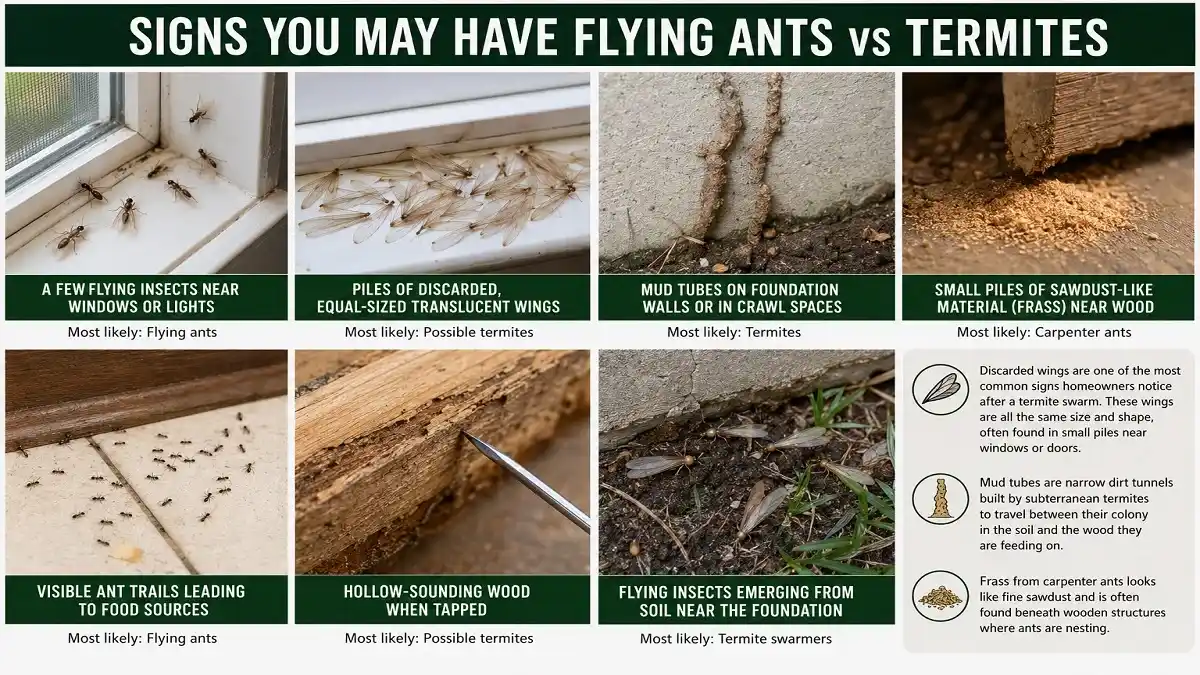
| A few flying insects near windows or lights | Flying ants |
| Piles of discarded, equal-sized translucent wings | Possible termites |
| Mud tubes on foundation walls or in crawl spaces | Termites |
| Small piles of sawdust-like material (frass) near wood | Carpenter ants |
| Visible ant trails leading to food sources | Flying ants |
| Hollow-sounding wood when tapped | Possible termites |
| Flying insects emerging from soil near the foundation | Termite swarmers |
Discarded wings are one of the most common signs homeowners notice after a termite swarm. These wings are all the same size and shape, and they often appear in small piles near windows or doors. Mud tubes, which look like narrow dirt tunnels, are built by subterranean termites to travel between their colony in the soil and the wood they are feeding on. Similarly, frass from carpenter ants looks like fine sawdust and is often found beneath wooden structures where ants are nesting.
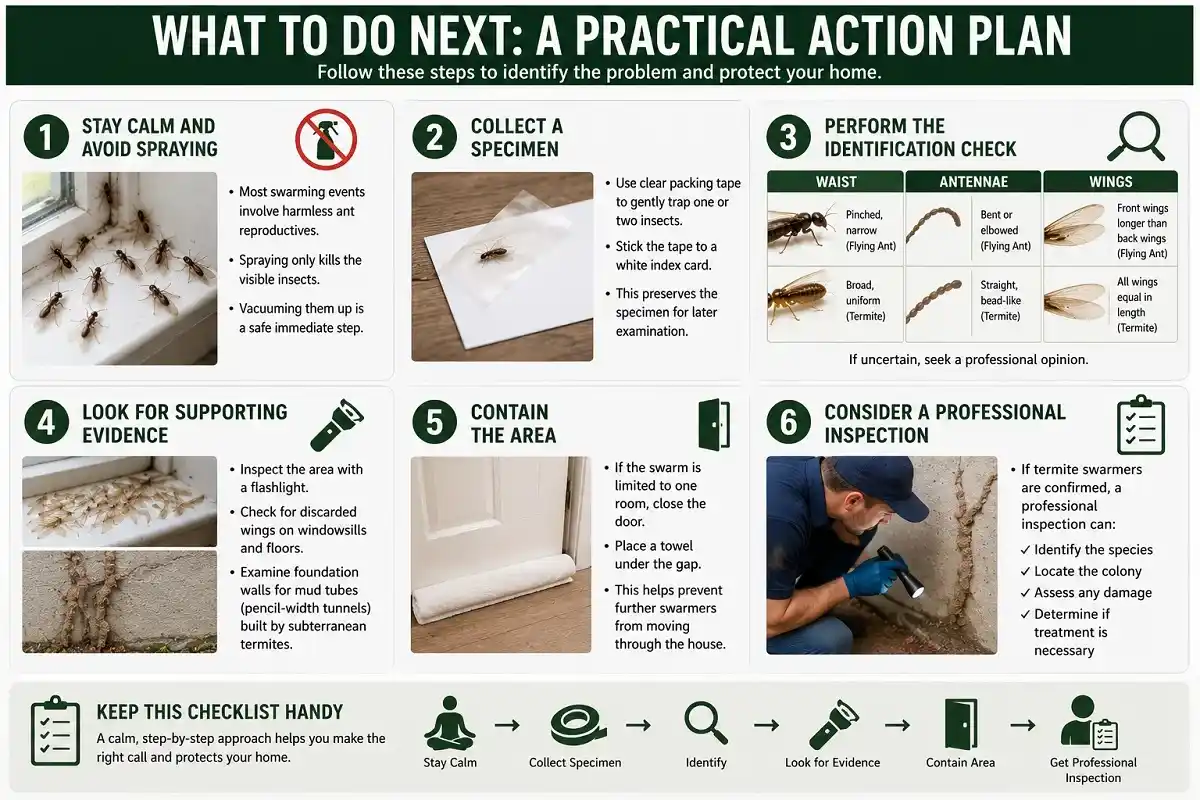
What to Do Next: A Practical Action Plan
Step 1: Stay Calm and Avoid Spraying
Most swarming events involve harmless ant reproductives. Even if termites are present, spraying household insecticide only affects the visible insects, since the colony itself remains unaffected. Instead, vacuuming them up is a safe immediate step.
Step 2: Collect a Specimen
Use clear packing tape to gently trap one or two insects without crushing them, then stick the tape to a white index card. This preserves the specimen for later examination if needed.
Step 3: Perform the Identification Check
Use the waist, antennae, and wing check described earlier. If the identification remains unclear, consider seeking a professional opinion.
Step 4: Look for Supporting Evidence
Inspect the area with a flashlight and check for discarded wings on windowsills and floors. Also, examine foundation walls for mud tubes, which are pencil-width tunnels that subterranean termites construct to travel between soil and wood.
Step 5: Contain the Area
If the swarm is limited to one room, close the door and place a towel under the gap. This helps prevent any further swarmers from moving through the house.
Step 6: Consider a Professional Inspection
If termite swarmers are confirmed, a professional inspection can help identify the species, locate the colony, assess any damage, and determine whether treatment is necessary.
Common Mistakes to Avoid
Mistake 1: Spraying swarmers and assuming the problem is resolved. Killing the winged insects does not affect the colony, so if termites are present, the workers continue their activity.
Mistake 2: Waiting to see if it happens again next year. Termite colonies grow gradually, and delaying assessment simply allows more time for activity to continue.
Mistake 3: Not saving a specimen. A clear photo is helpful, but a physical specimen allows for more accurate identification.
Mistake 4: Assuming size alone identifies carpenter ants. Many harmless ant species produce large swarmers, so check the waist and look for frass near wood instead.
Mistake 5: Confusing termite swarmers with ants based on color. Termite swarmers have dark brown or black bodies, similar to many ants; however, body shape and wings provide more reliable clues.
Myth vs. Fact: Flying Ants vs Termites
| Myth | Fact |
|---|---|
| Seeing flying ants means you have a termite infestation. | Flying ants and termite swarmers are different insects. Their presence indicates different situations. |
| Brick houses are immune to termite damage. | Brick homes have wooden structural components inside. Termites can travel through small cracks in mortar to reach wood. |
| Carpenter ants eat wood. | Carpenter ants excavate tunnels for nesting. They feed on other insects and food scraps, not wood. |
| New homes do not need termite considerations. | Construction can disturb soil and leave wood debris, which may attract termites. |
| Home remedies can eliminate a termite colony. | The queen may be located far from visible activity, so treatments that don’t reach her are unlikely to stop the colony. |
DIY vs. Professional Assessment
Managing Flying Ants
For most common species, practical steps include vacuuming swarmers and sealing visible entry points. Soapy water can kill individual ants on contact, though it does not address the colony itself.
For carpenter ants, locating the parent nest is important. Nests may be in tree stumps, wall voids, or moisture-damaged wood. Ant baits placed along trails can be helpful because workers carry the bait back to the colony. If the nest is difficult to access, however, a professional assessment may be useful.
Why Termite Treatment Differs
Subterranean termite colonies live underground. Workers travel through soil and mud tubes to reach wood, so treating only visible termites does not affect the main colony.
Instead, professional termite treatments typically create a treated zone in the soil around the foundation. Termites pass through this zone without detecting it, then carry the treatment material back to the colony through normal grooming and feeding. This transfer process allows the treatment to spread throughout the colony.
Ultimately, effective colony management requires reaching the queen, which hardware store products are not designed to accomplish.
Seasonal and Regional Notes
Spring is a common swarm season for subterranean termites in many regions, and carpenter ants also tend to swarm in late spring.
In some areas, summer brings drywood termite swarms. Unlike subterranean termites, drywood termites live directly inside wood. Their fecal pellets, which look like small six-sided granules, can be a useful identification clue.
During fall and winter, swarming activity decreases. However, termite workers remain active year-round in many climates, which makes these seasons practical times for an inspection, since the absence of swarmers allows for a more straightforward assessment.
Regional risks vary. Some areas have aggressive termite species, while others have higher carpenter ant populations due to moist conditions. Local pest identification resources or a professional familiar with your area can provide relevant guidance.
Frequently Asked Questions
Can flying ants damage a house?
Most flying ants do not cause structural issues. Carpenter ants can tunnel through damp or damaged wood, and large colonies may weaken wood over time, though they do not consume the wood.
Why do flying ants suddenly appear?
Flying ants are winged reproductives leaving a mature colony to mate. They typically emerge on warm, humid days, often after rain, and finding them indoors usually means they entered through an opening.
Should I worry if I find termite wings?
Finding piles of equal-sized, translucent wings indoors suggests that termite swarmers were present. The wings are shed after mating, so a professional inspection can help determine whether an active colony is nearby.
Do flying ants lose their wings?
Flying ants typically keep their wings after swarming. Unlike termite swarmers, which shed their wings shortly after landing, winged ants often retain theirs and may be found dead with wings still attached near windows and light fixtures.
Important Note
This guide is intended for general informational and educational purposes only. Proper identification of insects can be difficult, and many species look similar to untrained eyes. If you are uncertain about what you have found, consider saving a specimen and consulting a local expert or extension service before deciding on any course of action, since accurate identification is the foundation of effective pest management.
Conclusion
Finding winged insects indoors can be surprising, but a simple identification check provides clarity. Remember the three key features: waist, antennae, and wings. A pinched waist, bent antennae, and uneven wings point toward flying ants, while a broad waist, straight antennae, and equal-length wings suggest termite swarmers.
If you are uncertain, save a specimen using clear tape, and confirm the identification before taking any action. In many cases, these visitors are simply flying ants that pose little concern. But if the evidence points toward termites, avoid spraying and consider arranging a professional inspection to assess the situation.
Ultimately, knowing how to tell flying ants vs termites apart — and acting calmly on that information — makes a meaningful difference. Now you have what you need to take those steps.