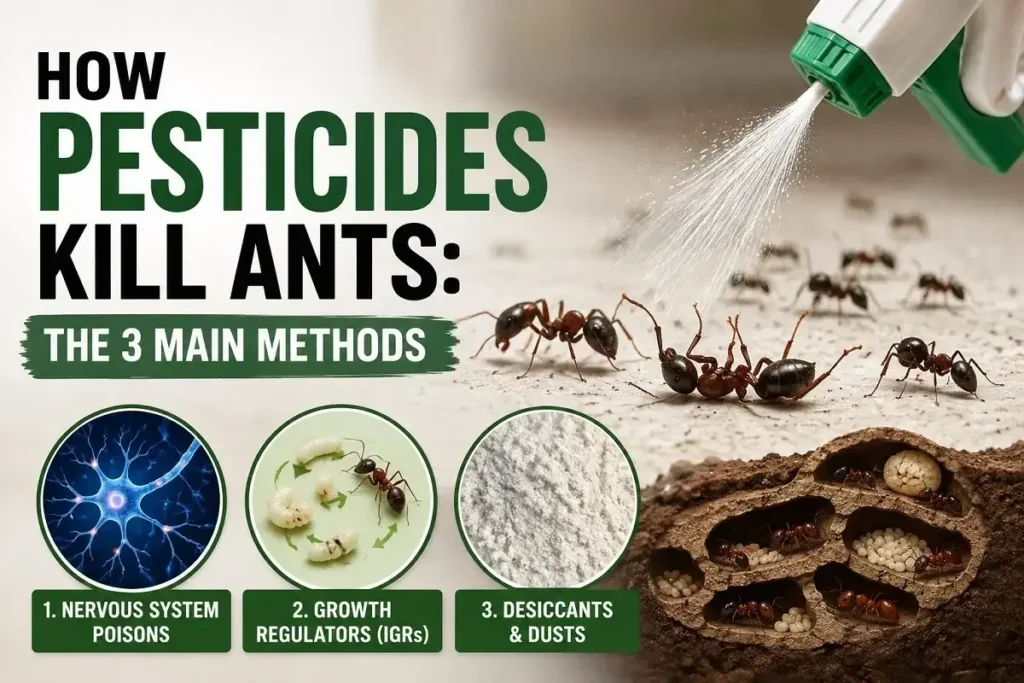
How Pesticides Kill Ants: The 3 Main Methods
Learn how pesticides kill ants — neurotoxins, growth regulators, and desiccants — and why sprays alone rarely eliminate the colony.

In this guide
- The Three Main Ways Ant Pesticides Work
- How Sprays and Baits Compare (At a Glance)
- Why Spraying Often Fails to Eliminate the Nest
- How Baits Work: Exploiting Ant Social Behaviour
- A Realistic Timeline: What to Expect
- How to Choose the Right Ant Killer (A Simple Decision Guide)
- 5 Common Mistakes That Reduce Effectiveness
- Frequently Asked Questions
- Final Thoughts
If you have ever sprayed a trail of ants and watched them die on the spot, you probably felt a sense of relief. But if those ants returned a few days later, you also experienced the frustration. Understanding how pesticides kill ants is the first step to breaking this cycle.
Here is the reality: In many cases, spraying visible ants doesn’t solve the infestation because it only kills the workers you can see. The queen, the eggs, and the rest of the colony remain hidden and untouched. This guide explains the biology behind ant killers, why some approaches fail, and how to choose the right method for your situation.
📌 How do pesticides kill ants? Pesticides kill ants by attacking their nervous system, disrupting growth and development, or damaging their protective outer layer. Sprays kill visible ants quickly, while slow-acting baits rely on food-sharing behaviour to reach the queen and the rest of the colony.
The Three Main Ways Ant Pesticides Work
Most commercial ant killers fall into three categories based on how they affect the insect’s biology.
Nervous System Poisons (Neurotoxins)
These are the active ingredients in most contact sprays. Common ingredients such as pyrethroids and fipronil interfere with the ant’s nerve signals, causing muscles to stop working normally. The ant experiences rapid paralysis, loss of coordination, and death within minutes or hours, depending on the dose. The U.S. Environmental Protection Agency notes that many insecticides act upon the insect’s nervous system, while others work as growth regulators or desiccants.
The key point: Contact sprays work well for immediate spot treatment. If you’ve sprayed a trail on your kitchen counter and the ants disappear, it provides quick relief. However, sprays are a short-term fix. They rarely eliminate the colony by themselves because they act too quickly to carry the poison back to the nest.
Insect Growth Regulators (IGRs)
IGRs (such as methoprene or fenoxycarb) do not kill adult ants directly. Instead, they mimic natural hormones that control growth and development. When worker ants carry IGR-laced bait back to the nest, the compound interferes with the molting process of larvae. Young ants fail to develop into functional adults, and the IGR may also disrupt the queen’s egg-laying.
The result is a gradual population decline. The existing workers eventually die of old age, and no new ants replace them. Colonies may take several weeks to collapse.
In practice: IGRs require patience. You won’t see instant results, but they are a valuable tool for long-term population control, especially when combined with other bait ingredients.
Desiccants and Dusts (Dehydrating Agents)
People often group powders like diatomaceous earth and boric acid together, but they work slightly differently.
- Diatomaceous earth is a physical abrasive. Its microscopic, sharp particles scratch the ant’s waxy outer cuticle. Once those particles damage this protective layer, the ant’s internal moisture evaporates, and it dies from dehydration.
- Boric acid works mainly as a stomach poison after ants groom themselves or consume bait containing it, although contact can also contribute to its effectiveness. Ants ingest the powder during grooming, and it disrupts their digestive system.
You apply both as dusts, and they work best in dry, low-humidity environments. In wet conditions, they clump and lose their abrasive or adhesive properties.
For practical purposes: Dusts work best in dry areas like wall voids, cracks, and crevices, where dampness won’t reach them. They are less effective outdoors after rain or in humid climates.
How Sprays and Baits Compare (At a Glance)
Here is a quick comparison to help you decide which method fits your situation:
| Method | Speed of Visible Effect | Reaches the Queen? | Best Use Case |
|---|---|---|---|
| Contact Sprays | Minutes to hours | Rarely | Spot treatment, visible trails, barriers |
| Slow-Acting Baits | Days to weeks | Yes | Eliminating established colonies |
| Growth Regulators (IGRs) | Weeks | Yes | Long-term population decline (supplement) |
| Dusts / Powders | Minutes to hours | Rarely (unless carried) | Dry crevices, wall voids, crawl spaces |
Why Spraying Often Fails to Eliminate the Nest
It is a common experience: spray the ants, watch them die, and find them back in the same spot the next week. Here is why that happens:
- The queen and brood are protected: Queens stay deep inside the nest, surrounded by eggs, larvae, and pupae. Sprays do not penetrate these hidden chambers.
- Only the foragers die: The workers you see are the oldest, most expendable members of the colony. They represent a tiny fraction of the total population.
- Species-specific responses: Some ants, particularly fire ants and certain invasive species, may react to disturbance by “budding,” the colony splits into multiple smaller colonies. In these cases, spraying a visible mound can actually increase the number of nests in your yard, though this behaviour is not universal across all species.
What to remember: If you spray a trail and the ants temporarily disappear, do not assume the problem is solved. They may simply shift their foraging route. Long-term control requires targeting the colony, not just the individuals you happen to see.
How Baits Work: Exploiting Ant Social Behaviour
Baits are fundamentally different from sprays. They combine an attractive food source with a slow-acting insecticide. The key is the delay.
Ants share food through a process called trophallaxis. Foragers store liquid food in their crop (often called a social stomach) and regurgitate it to larvae, the queen, and other nestmates back in the colony.
If a bait killed within five minutes, the forager would die on its way home. Slow-acting poisons—such as hydramethylnon or fipronil—take 24 to 48 hours to show effects. This delay gives foragers time to carry the poisoned food throughout the nest, reaching the queen and developing larvae before the first forager even shows signs of illness.
For homeowners: When you place bait and see a large number of ants feeding on it within the first day or two, that is a positive sign. It means the foragers have found the food and are actively carrying it back. Resist the urge to disturb or clean the area for at least 48 hours.
A Realistic Timeline: What to Expect
One of the most common questions is, “How long will this take?” The answer depends on the colony size, the active ingredient, and the season. Here is a general timeline of what you might observe after applying bait:
| Timeframe | What Typically Happens |
|---|---|
| First 1–2 days | Ant activity around the bait often increases. This is normal—foragers are collecting food and returning to the nest. |
| After several days | Foraging activity usually begins to slow down. Worker ants start to die, and the colony’s overall activity usually continues to decline. |
| One to two weeks | In many cases, the colony’s population drops significantly. Trails become sparse. Larger or multi-nest colonies may take longer. |
| Beyond two weeks | If activity continues, it may indicate multiple nests or that the ants have switched dietary preference. Rotating bait type (sweet vs protein) may help. |
A practical note: Continue monitoring the area and follow the product label. In many cases, bait remains effective for one to two weeks after activity declines.
How to Choose the Right Ant Killer (A Simple Decision Guide)
Not every ant problem is the same. Here is a simple way to decide where to start:
- For treating ants inside the house (kitchens, pantries, bathrooms): Start with gel baits. If you notice small ants around your kitchen sink or pantry shelves, they are often odorous house ants or sugar ants, which usually prefer sweet baits. If you find them around pet food bowls or greasy areas, switch to a protein/grease-based gel. For a more detailed breakdown, check out our guide on getting rid of sugar ants indoors.
- For drywall voids or between floorboards: You can puff dusts (like diatomaceous earth) into these spaces. Since little moisture reaches these spaces, dusts remain effective for a long time.
- For managing pests outside (lawns, patios, garden beds): Granular baits are a practical choice. For fire ant mounds specifically, scatter the granules around the mound, but do not disturb the mound itself before application. Understanding how to treat ants outdoors also means accounting for rain and sunlight, which can degrade some products.
- If you need a temporary barrier around your foundation: You can apply non-repellent sprays as a perimeter treatment. These work best as a supplement to baiting, not a replacement.
5 Common Mistakes That Reduce Effectiveness
Even with the right product, small errors can waste your time and money.
- Spraying near bait stations: Contact sprays and repellents can contaminate bait, making it unattractive to ants. Keep sprays at least a few feet away from bait placements.
- Using the wrong food type: Ants change their dietary needs with the season. Ants often prefer protein in spring, when colonies are raising brood, then shift toward sugary carbohydrate baits in summer and fall. If ants ignore a sweet bait for two to three days, switch to a protein-based option.
- Stopping treatment too early: Seeing fewer ants is not the same as eliminating the colony. Continue baiting for at least a week after the visible trail disappears to make sure the poison reaches the queen and remaining workers.
- Cleaning the trail immediately: Wiping away the pheromone trail disrupts foraging and may cause ants to abandon the bait. If possible, avoid cleaning the immediate area for the first day or two after placing bait. If cleanliness is a concern, place bait directly on the trail so ants find it before moving elsewhere.
- Ignoring environmental conditions: Moisture reduces the effectiveness of dusts—they clump and fail to stick to the ant’s cuticle. Direct sunlight can degrade certain bait ingredients over time. Place baits in shaded, relatively dry spots when applying outdoors.
Frequently Asked Questions
Why shouldn’t you spray ants?
Spraying is not always wrong—it is useful for immediate removal of visible ants. However, it should not be your only strategy. Spraying alone does not reach the nest and may, in some species, trigger colony budding or trail relocation.
Is it better to kill ants or let them be?
Ants are beneficial for soil health and natural pest control outdoors. If they are not entering your home or damaging structures, leaving them alone is a valid choice. If they are carpenter ants, fire ants, or causing indoor infestations, intervention usually makes sense.
Should you use bait and spray together?
Yes, but with caution. Avoid spraying repellent products directly on or near bait stations, as this contaminates the food source. Some professionals use non-repellent sprays as a perimeter barrier while placing baits indoors—this can work, but always read the product labels to ensure compatibility.
Do ants feel pain when you spray them?
Scientists still don’t fully agree on whether insects experience pain in the same way mammals do. Neurotoxins cause a mechanical shutdown of the nervous system, which does not match the pain response mammals feel. The effect is closer to immediate paralysis rather than a sensation of suffering.
What kills ants permanently?
No single method guarantees permanent elimination because ants can recolonise from neighbouring areas. However, slow-acting baits that reach the queen and larvae offer the best chance of eliminating the current colony and providing long-term control compared to contact sprays.
How quickly does ant powder kill ants?
Many ant powders begin working within minutes, although the exact timing depends on the specific product, humidity levels, and how you apply the powder. In damp conditions, the powder may take longer or fail entirely. For best results, apply in dry indoor spaces.
Why do I see more ants after using bait?
This is a common concern but usually a good sign. The bait is attractive, and foragers are arriving in larger numbers to collect it and transport it back to the nest. Increased activity typically lasts one to two days and indicates the product is working.
Final Thoughts
Sprays still have a place in ant control. They are convenient for quickly dealing with a few stray workers or creating a temporary barrier. But if your goal is to eliminate an established colony—especially one that has taken up residence in your walls, garden, or foundation—slow-acting baits are usually the more effective approach.
Understanding the science behind these products helps you choose the right tool for the specific situation. It also helps you avoid the common mistakes that leave colonies intact and homeowners frustrated.
If ants keep returning after repeated spraying, it usually means the colony is still active somewhere nearby. Switching to a bait-based approach and giving it enough time often produces better long-term results than repeatedly killing the workers you can see. For more guidance on permanent solutions, you can explore our detailed guide on eliminating ant colonies permanently.
And if the infestation continues even after following the label directions and using bait correctly, it may be time to inspect for hidden nests or consider seeking professional help.

Evan Brooks
Evan Brooks enjoys writing about ants and the way they live, build colonies, and adapt to different environments. His articles cover common ant species, nests, queens, seasonal activity, and everyday questions. He believes simple...
View all guides →