

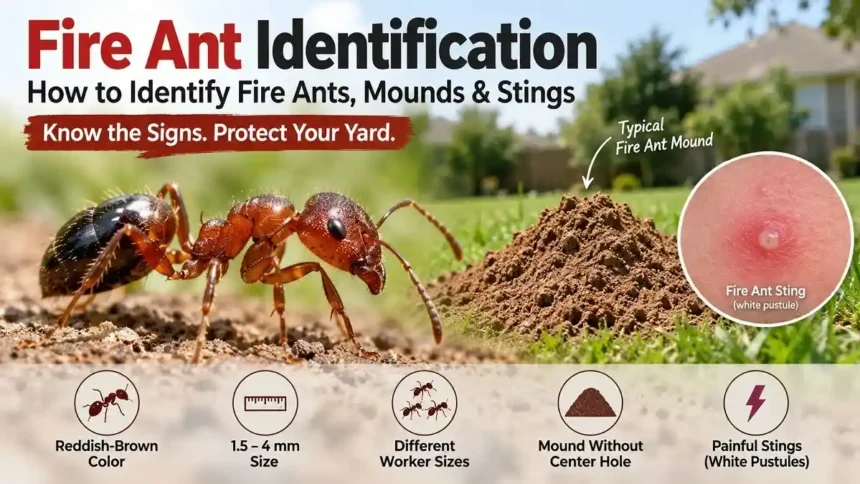
Not every red or reddish-brown ant in your yard is a fire ant. Several species look similar, so a confident identification depends on more than color.
Useful clues include different-sized workers, a mound without an obvious center opening, a fast defensive response, and painful stings that may later leave white pustules.
- Fire Ant Identification at a Glance
- How to Identify Fire Ants
- What Does a Fire Ant Mound Look Like?
- How Do Fire Ants Behave?
- What Does a Fire Ant Sting Look Like?
- Fire Ants vs Similar Ants
- Can Fire Ants Be Present Without a Large Mound?
- Are Fire Ants Dangerous?
- What Should You Do After Identifying Fire Ants?
- Why Can Fire Ants Return After Treatment?
- Identify the Ant Before You Treat the Colony
This guide shows you what to check first, how to compare similar ants, and what to do once you know what you are dealing with.
Fire Ant Identification at a Glance
If you find suspicious ants or a mound in your yard, start with these five signs:
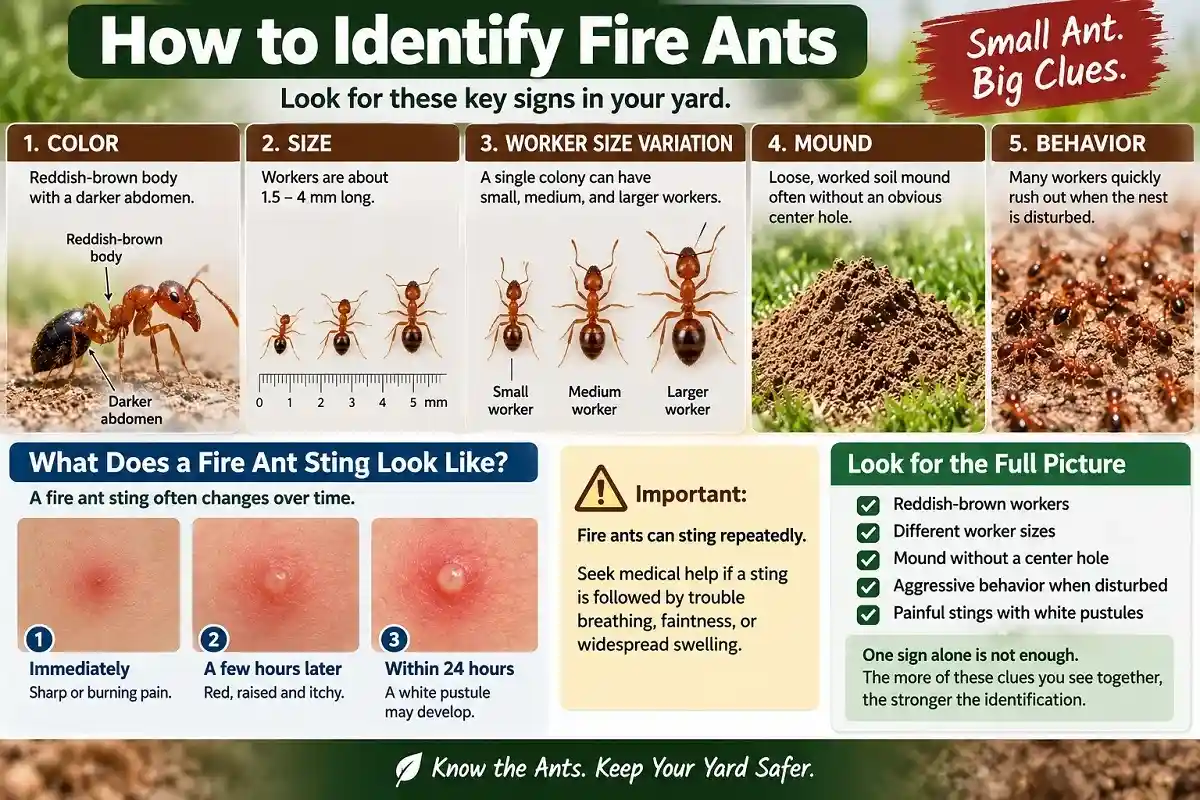
- Color: Red imported fire ant workers are usually reddish brown with a darker abdomen.
- Size: Workers are small, but ants from the same colony can be noticeably different sizes.
- Mound: The nest often looks like loose, worked soil without an obvious hole in the center.
- Behavior: Many workers can quickly defend an active nest when it is disturbed.
- Stings: They can sting repeatedly, and small white pustules may develop afterward.
The strongest field identification comes from seeing several of these signs together. One reddish ant or one pile of soil is not enough.
How to Identify Fire Ants
Red imported fire ants, Solenopsis invicta, are small, reddish-brown ants with darker abdomens. One of their more useful features is the range of worker sizes found within a colony.
Color
Workers generally appear reddish brown with a darker abdomen. Some may look more brown than red depending on their size and the lighting.
Treat color as a starting point. Other red, brown, and reddish-black ants can easily be mistaken for fire ants.
Size
Red imported fire ant workers are roughly 1.5 to 4 mm long. Measuring a moving ant outdoors is difficult, so comparing several workers is usually more practical than trying to judge an exact length.
Worker Size Differences
A single active colony can contain small, medium, and larger workers. Seeing that variation together is a useful clue when checking a suspected nest.
These are adult workers of different sizes, not simply young ants mixed with older ones.
Look Closely at the Body
Under a close view, workers have elbowed antennae and a narrow waist with two nodes. These tiny features are easier to examine in a sharp close-up photo or with magnification.
In the yard, worker-size variation and mound structure are usually easier to check than small anatomical details.
If your ants do not match these features, compare them with other common species to identify different types of ants before choosing a treatment.
What Does a Fire Ant Mound Look Like?
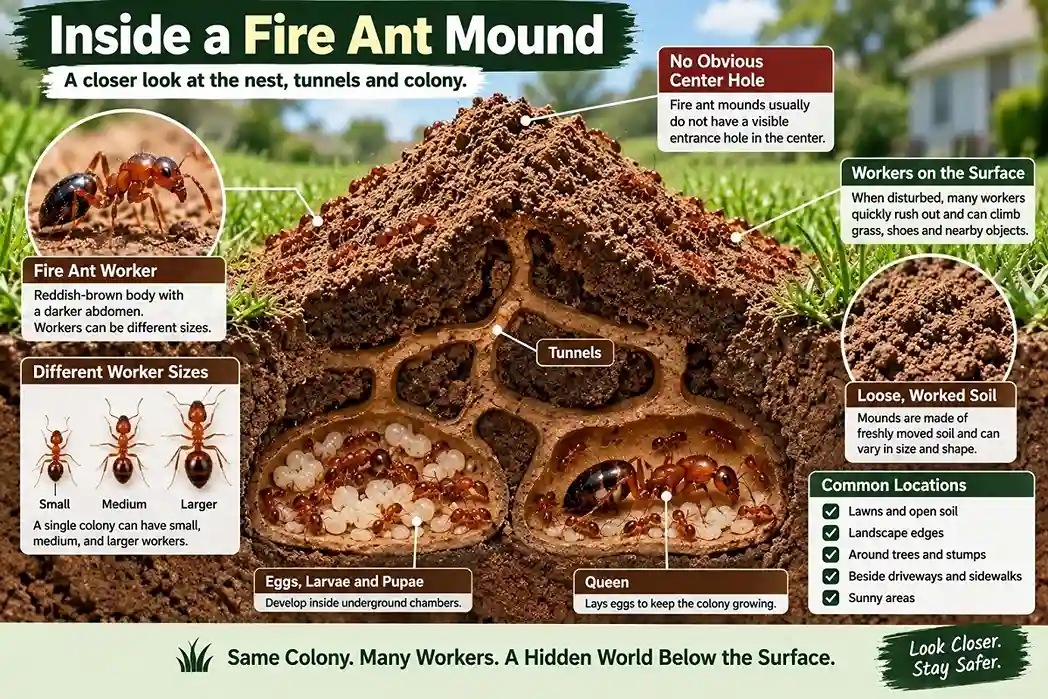
A fire ant mound often looks like a raised patch of loose, freshly worked soil rather than a neat anthill with a visible hole in the middle.
Mounds vary in size and shape. Soil conditions, weather, and colony development can change how much of the nest is visible above ground.
No Obvious Center Hole
Imported fire ant mounds usually lack an obvious entrance at the top center. Workers use underground tunnels that can reach the surface away from the visible mound.
As a result, the mound may look inactive even when many ants are living below the surface.
Loose, Worked Soil
Freshly moved soil is another useful clue. Mound-building can become easier to notice when soil conditions allow workers to move and reshape the ground.
Some nests form obvious raised mounds, while others remain low and easy to miss.
Where Should You Check?
Look across sunny lawns, landscape edges, open soil, areas around trees and stumps, and ground beside sidewalks or driveways. Pay extra attention to places where people or pets regularly spend time.
Quick mound check: Loose worked soil, no obvious center opening, and different-sized reddish workers nearby make the identification more convincing.
Do not kick, step on, touch, or dig into a suspected mound to test it. Use visible activity and the other signs first.
How Do Fire Ants Behave?
An active colony can respond quickly when its nest is accidentally disturbed. Large numbers of workers may reach the surface and move onto nearby grass, objects, shoes, or anything else touching the area.
You do not need to provoke a colony to identify it. If normal activity has already disturbed the mound, observe from a safe distance.
Workers Rush to Defend the Nest
The response can involve many workers rather than a few ants slowly leaving the nest. They may also climb nearby vertical surfaces while defending the colony.
They Can Sting More Than Once
A worker can grip the skin with its jaws and then use its stinger to inject venom. It can sting repeatedly, which is why accidentally standing on an active mound may result in several stings within a short time.
What Does a Fire Ant Sting Look Like?
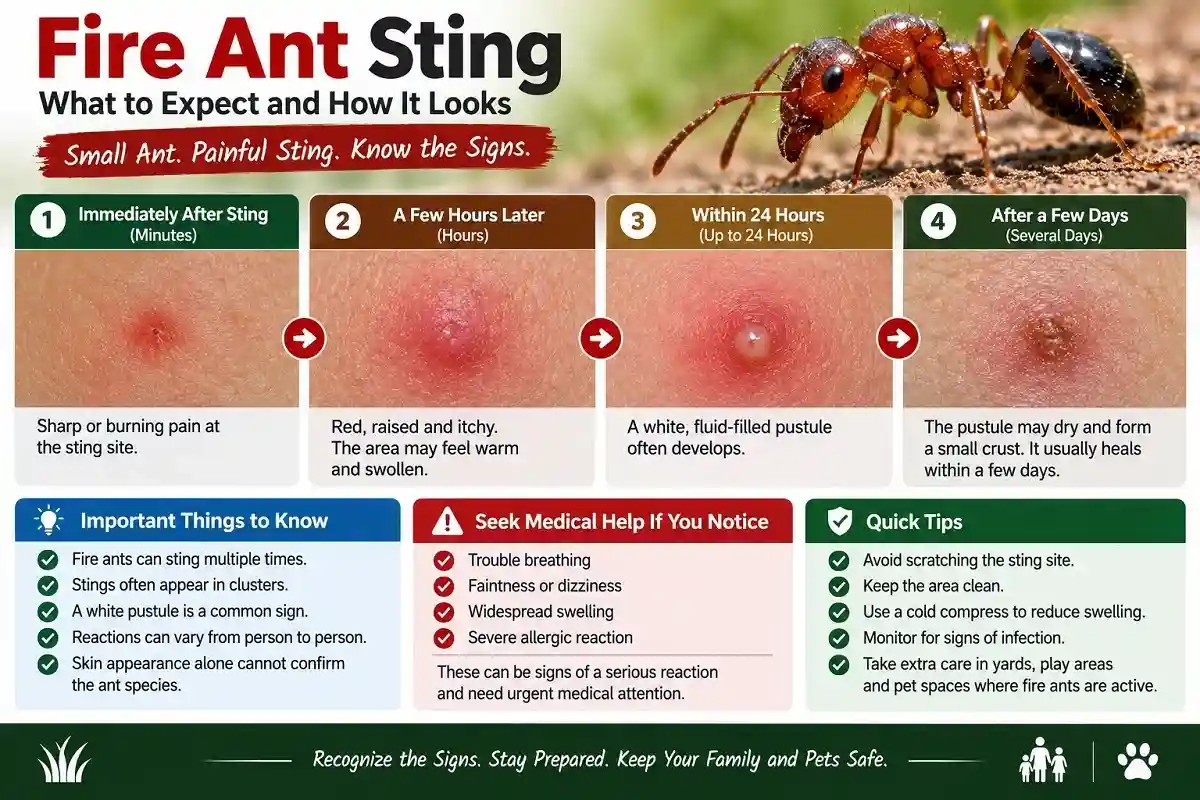
A sting commonly starts with sharp or burning pain. The area may then become red, raised, swollen, or itchy.
A small white, fluid-filled pustule can develop later, often within about 24 hours. This is a useful clue after a suspected encounter, but skin appearance cannot identify the ant species by itself.
Immediately After the Sting
Pain or burning usually begins quickly. Multiple workers can reach the skin during the same encounter, leaving several painful spots close together.
During the First Hours
Redness, itching, and raised bumps may appear as the local reaction develops. The exact amount of swelling varies from person to person.
A White Pustule May Develop
A characteristic white pustule can form at the sting site. Avoid scratching or deliberately opening it because broken skin can become infected.
Seek urgent medical help if a sting is followed by trouble breathing, faintness, widespread swelling, or other signs of a severe allergic reaction.
Fire Ants vs Similar Ants
Several ground-nesting ants can be mistaken for fire ants. This quick comparison focuses on features a homeowner may actually notice.
| Clue | Fire Ants | Harvester Ants | Bigheaded Ants | Carpenter Ants |
|---|---|---|---|---|
| Worker Size | Small workers with noticeable size variation | Generally larger workers | Small workers plus large-headed majors | Much larger workers |
| Appearance | Often reddish brown with darker abdomen | Varies by species | Major workers have unusually large heads | Often black, brown, or reddish black |
| Nest Clue | Worked-soil mound often without an obvious center opening | Ground nest may have a visible entrance and cleared area | Often nests in soil or protected spaces | Commonly associated with wood or structural spaces |
| Best Field Clue | Different worker sizes, mound structure, and defensive stinging | Larger workers and different nest structure | Distinctive oversized heads on major workers | Large ants associated with wood |
For example, large black or reddish-black ants around damp or damaged wood point more strongly toward carpenter ants. Our guide can help you identify carpenter ants before treating them.
Can Fire Ants Be Present Without a Large Mound?
Yes. A colony does not always produce a large, obvious mound. Young colonies, disturbed nests, weather, soil conditions, and the nesting site can all affect what you see above ground.
If you repeatedly notice different-sized reddish workers in one area, watch their natural movement from a safe distance. Their trails may lead toward a less obvious nesting area.
Are Fire Ants Dangerous?
The biggest concern around a home is accidental contact with an active colony. Children playing on a lawn, pets exploring the ground, or someone gardening near a hidden nest may encounter several defensive workers at once.
Mounds beside play areas, walkways, pet spaces, and other busy parts of the yard deserve particular attention because people are more likely to come into contact with them.
What Should You Do After Identifying Fire Ants?
The right response depends on two things: how certain you are about the identification and how many colonies you are dealing with.
If You Are Not Sure
Hold off on treatment until you have checked the workers and nest more carefully. Treating the wrong species can waste time and may leave the actual problem untouched.
If You Find One or Two Mounds
An individual mound treatment may suit a small, confirmed problem. Products labeled for fire ants can include baits, drenches, granules, or other mound treatments.
Use only products labeled for the site and pest you are treating, and follow the application directions rather than increasing the amount.
If You Find Many Mounds
When colonies are spread across a lawn, treating only the most visible mounds may leave others behind. An area-wide bait followed by targeted treatment of remaining problem mounds is one established approach.
For a wider lawn problem, our guide on how to get rid of ants in your yard explains broader outdoor control options.
If You Plan to Use Bait
Foraging workers must find and collect the bait. Worker activity, weather, bait condition, and correct application can affect how well the treatment performs.
Always follow the label for suitable application conditions. Seasonal activity also matters, so check the best time to treat ants when planning outdoor control.
If the Sting Risk Is High
Professional treatment may be worth considering when colonies cover a large property, repeatedly return, or occur around playgrounds, pet areas, walkways, and other busy spaces.
If cost is part of the decision, our breakdown of typical ant exterminator costs can help you compare professional treatment with a DIY approach.
Why Can Fire Ants Return After Treatment?
Removing existing colonies does not prevent new ones from becoming established later. This is especially relevant where fire ants are already common in surrounding properties or landscapes.
Check high-use parts of the yard periodically for fresh soil movement, new mounds, or concentrated ant activity. Catching a new colony early can make the problem easier to manage.
If you use a broadcast or repeat treatment, follow its label for timing, frequency, approved sites, and precautions around people and pets.
Identify the Ant Before You Treat the Colony
Start with what you can observe safely: the workers, their size differences, the mound, and existing colony activity. Together, those clues can give you a much clearer picture than color alone.
Once the identification is clear, match the treatment to the size of the infestation and follow the product label. If colonies are widespread or create a difficult sting risk around busy outdoor areas, professional treatment may be the safer and more practical option.