How Much Does an Ant Exterminator Cost? [2026] Plans & Prices
Find out how much an ant exterminator costs in 2026, compare DIY vs pro pricing, and see plans for every budget.

In this guide
- How Much Does Ant Control Cost in 2026? (Quick Summary)
- Cost Breakdown by Service Frequency
- Cost Breakdown by Infestation Severity
- Ant Treatment Cost Per Square Foot
- Professional Pest Control: National Chains vs. Local Companies
- DIY vs. Professional: Which is Cheaper in the Long Run?
- When Should You Actually Call an Exterminator?
- Is Hiring an Exterminator Worth the Money?
- Frequently Asked Questions (FAQ)
- Conclusion
Ants marching across your kitchen counter are annoying. But the first question most homeowners ask is simple: how much will this cost me to fix? This guide breaks down the exact ant control cost for 2026. You’ll find real price ranges, service plan options, and a clear answer on whether you need a pro or can handle it yourself. By the end, you’ll know your ant exterminator cost, how pricing changes with infestation size, and what to do next.
No extra searching needed. Not sure what type of ant you’re dealing with? Our black ant identification guide helps you figure it out.
Quick Cost Snapshot (2026):
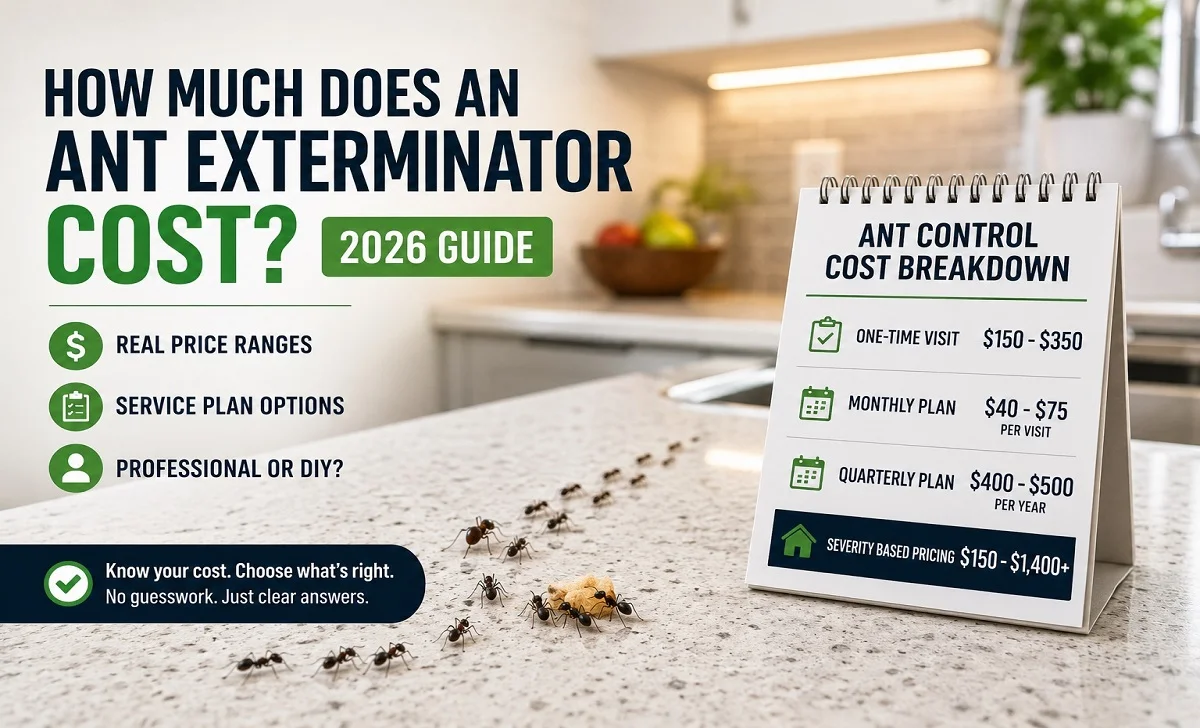
- Minor issue: $150–$300
- Moderate infestation: $300–$700
- Severe or carpenter ant issue: $800–$1,400+
- One-time visit: $150–$350
- Monthly plan: $40–$75 per visit
- Quarterly plan: $400–$500 per year
How Much Does Ant Control Cost in 2026? (Quick Summary)
The national average for professional ant treatment sits between $150 and $350 for a single visit. That’s the starting point for most homes with a light to moderate ant problem. 2026 ant control pricing depends on a few things: how bad the infestation is, your home’s size, and which service plan you pick. Whether you’re dealing with carpenter ants, fire ants, or sugar ants (odorous house ants), a small trail costs far less to treat than a full colony living inside your walls.
Here’s the general breakdown:
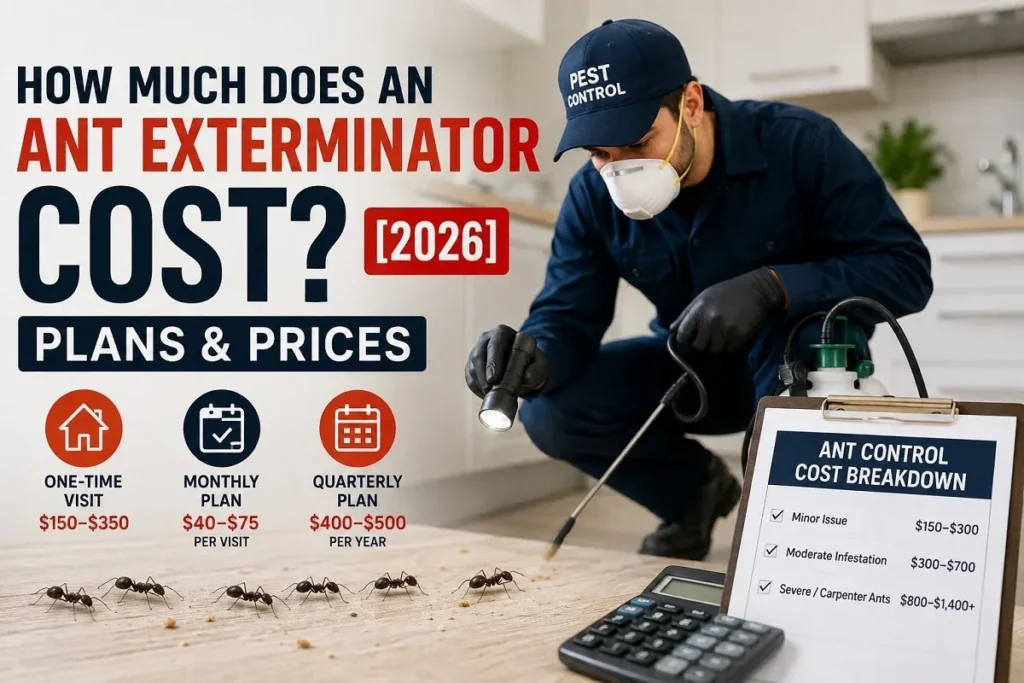
- One-time visit: $150–$350
- Monthly plan: $40–$75 per visit (often with a setup fee)
- Quarterly plan: $400–$500 per year
Your ant exterminator cost will land somewhere in these ranges unless you have major structural damage. In that case, prices can climb higher. We’ll cover exactly why below. All figures are estimated 2026 ranges; actual quotes vary by region and provider.
Cost Breakdown by Service Frequency
Not every ant problem needs the same level of service. Here’s how the three main options compare.
One-time visit ($150–$350). This is a single treatment for a specific ant problem. A one-time ant treatment works well if you have a one-off issue, like ants that showed up after a rainstorm.
Monthly plan ($40–$75 per visit). A technician comes back every month to check and re-treat as needed. The average monthly pest control cost suits homes with ongoing ant activity or other pest concerns that need regular attention.
Quarterly plan ($400–$500 per year). Visits happen four times a year, usually timed around seasonal ant activity. Most quarterly pest control plans are a popular middle-ground option for homeowners who want prevention without monthly visits. So which one fits you?
A one-time visit is often enough if ants show up occasionally and go away. For ants that return every season, a quarterly plan offers better value than paying for multiple one-time visits. And if your home has a history of pest issues beyond just ants, a monthly pest control plan may make more sense. Think about your climate, too.
Homes in warmer regions often see year-round ant activity, which makes a quarterly plan or monthly pest control option more practical than repeated one-time calls. Homes in colder climates may only need treatment during the warmer months, making a one-time visit or seasonal service enough to keep ants away. Want to know the best season to treat? Read our guide on the best time to treat ants.
It also helps to think about your budget over a full year. A one-time visit at $150–$350 might seem cheaper upfront, but if ants return two or three times a year, those costs add up fast. A quarterly plan spreads the cost out and usually includes touch-up visits between scheduled appointments at no extra charge. Not sure whether a single visit or a plan actually works out cheaper for your specific situation?
See our full cost comparison and break-even breakdown.
Cost Breakdown by Infestation Severity
Price depends heavily on how bad the ant problem actually is. Here’s what to expect at each level.
Minor / Localized ($150–$300). This covers a single room or one visible ant trail. Treatment usually involves gel baits or a simple perimeter spray, and one visit often solves it. For sugar ants specifically, see our sugar ant removal guide.
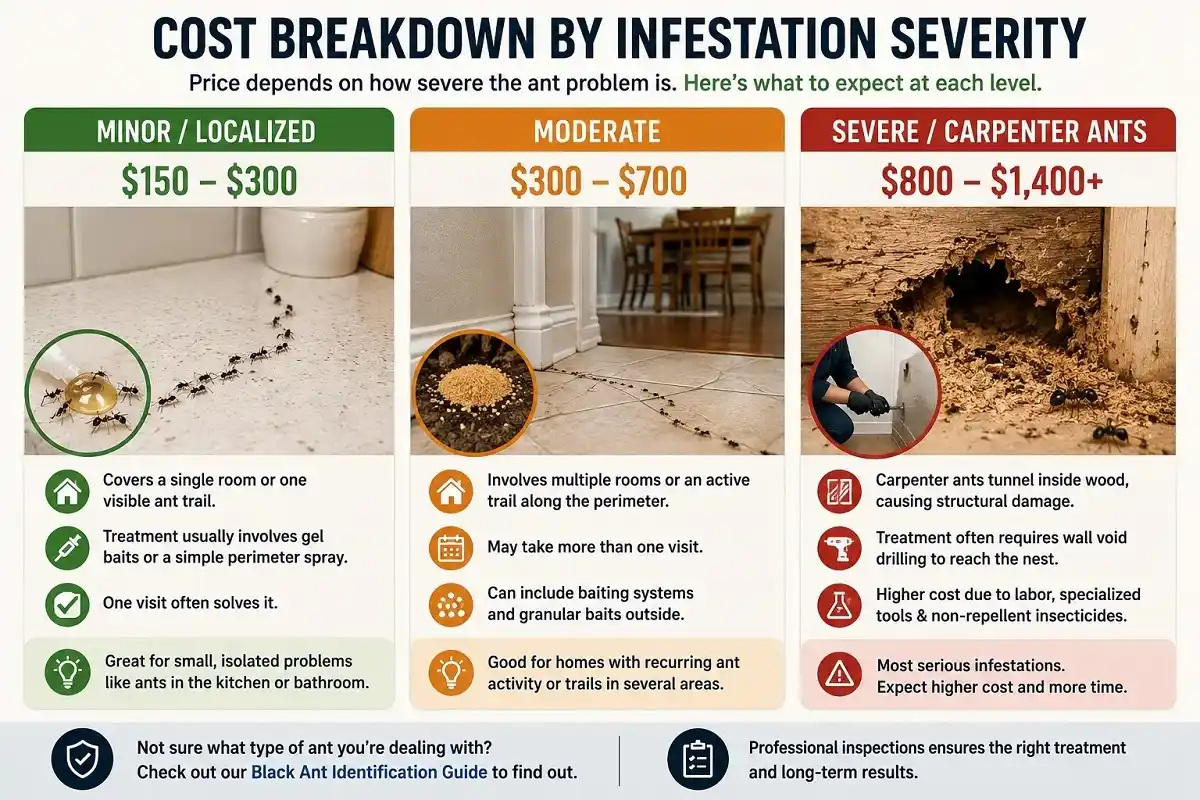
Moderate ($300–$700). This level involves multiple rooms or an active trail running along your home’s perimeter. It may take more than one visit and could include both baiting systems and granular baits outside.
Severe / Carpenter Ants ($800–$1,400+). This is the most expensive category, and for good reason. Carpenter ants tunnel inside wood, which means treatment often requires wall void drilling to reach the nest directly. The carpenter ant treatment cost runs higher because it takes more labor, specialized tools, and sometimes non-repellent insecticides injected into wall cavities.
If you notice structural damage, like weakened wood or sawdust-like debris, expect the bill to reflect that extra work. For a complete step-by-step guide on identifying and removing carpenter ants, check out our carpenter ant removal guide.
Ant Treatment Cost Per Square Foot
Some companies price by square footage instead of a flat rate. The typical range is $0.50 to $2.00 per square foot. Here’s a simple example. A 1,500 square foot home at the average rate of $1.00 per square foot would cost around $1,500 for full treatment.
At the lower end ($0.50), that same home would cost about $750. This ant treatment cost per square foot model is more common for larger properties or whole-home preventive treatments. Smaller, localized jobs are usually priced as a flat fee instead, which is why the numbers in the severity section above don’t always match a per-square-foot calculation exactly. If a company quotes you per square foot, ask them to also give you a flat total. That makes it easier to compare against other quotes.
Professional Pest Control: National Chains vs. Local Companies
When you search for local pest control companies, you’ll typically find two types: national pest control chains and local independent exterminators. Both can handle ant problems, but they differ slightly in how they operate. National chains tend to have standardized pricing, established guarantees, and consistent service protocols across locations. You generally know what you’re getting before they arrive.
Local independent exterminators often offer more flexible pricing and a more personalized approach. They may be quicker to schedule and more willing to adjust treatment based on your specific situation. The good news? Both options generally fall within the same $150–$350 range for an initial visit.
Price shouldn’t be the only factor. Ask about guarantees, follow-up visits, and what treatment methods they use before deciding.
DIY vs. Professional: Which is Cheaper in the Long Run?
Store-bought sprays and bait stations cost roughly $20–$50 total. That’s a fraction of the price of hiring a professional ant exterminator. DIY ant control works well for small, visible ant trails, especially outdoors or in a single spot like a kitchen counter. Gel baits and granular baits sold at hardware stores can handle light activity if applied correctly.
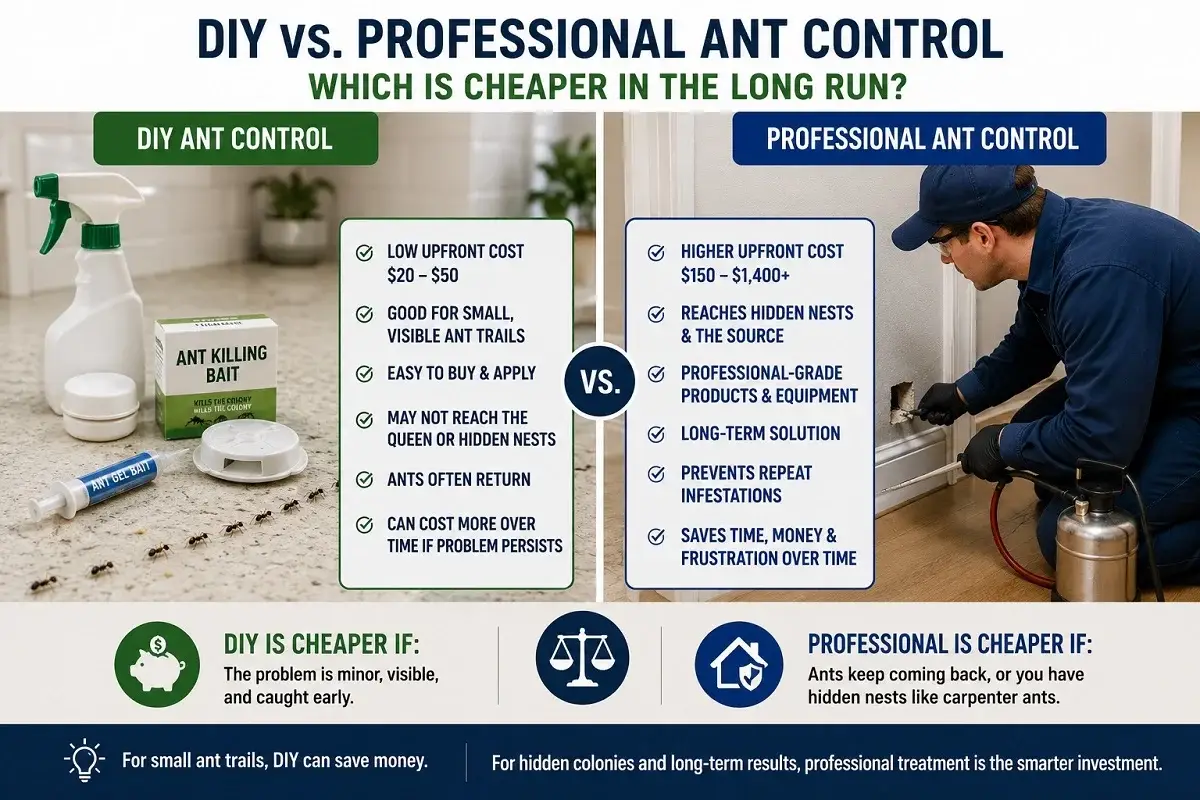
Where DIY often fails is with hidden colonies. Store-bought products rarely reach the queen, especially with carpenter ants nesting deep inside walls. If the source colony survives, the ants come back within weeks, and you end up buying more products anyway. So which is cheaper long-term?
For a minor, visible problem, DIY usually wins. For anything involving hidden nests or repeated appearances, professional treatment often costs less overall because it solves the problem at the source instead of treating symptoms repeatedly. There’s also a time cost to consider. DIY treatment means monitoring the problem yourself, reapplying products, and waiting to see if it works.
If it doesn’t, you’re back to square one, only now you’ve spent money and time with nothing to show for it. Professional treatment takes that guesswork off your plate, even though it costs more upfront. For a full DIY breakdown with room-by-room instructions, see our complete guide to getting rid of ants permanently.
When Should You Actually Call an Exterminator?
Not every ant sighting needs a professional. But there are three clear signs it’s time to call one.
1. Persistent, multiple trails. If you’re seeing ants in more than one area of your home, or the same trail keeps returning after cleaning, the colony is likely bigger than it looks.
2. Signs of carpenter ants. Small piles of what looks like sawdust near baseboards, window frames, or wood beams are a red flag. This usually means an active carpenter ant nest inside your structure.
3. Repeated DIY failures. If you’ve tried store-bought sprays or baits two or three times and the ants keep coming back, it’s a sign the main colony hasn’t been reached. Any one of these three situations is a good reason to bring in a professional ant exterminator rather than continuing to try products on your own.
Is Hiring an Exterminator Worth the Money?
This is the real question behind “is an exterminator worth it for ants.” The answer depends on your situation. The case for hiring a pro:
- Guaranteed results, often backed by a warranty or free follow-up visit
- Safer application of stronger, professional-grade products
- Better odds of eliminating the entire colony, not just visible ants
The case against:
- Higher upfront cost compared to a $20 bait station
- May not be necessary for a very minor, one-time issue
The balanced answer: if you’re dealing with a severe infestation, carpenter ants, or a problem that keeps returning, hiring a professional is worth it. The guarantee and colony-level treatment save you money and frustration over time. If you’re just seeing a handful of scout ants once in a while, it’s probably not worth the cost yet. Try a store-bought bait station first and monitor the situation before spending on a service.
Frequently Asked Questions (FAQ)
Q1: How much will it cost to get rid of ants?
Costs range from $150–$300 for a minor issue up to $800–$1,400+ for a severe or carpenter ant infestation. See the Quick Summary above for the full estimated breakdown by plan type.
Q2: Is an exterminator worth it for ants?
Yes, if you have a severe, recurring, or carpenter ant problem, since professional treatment reaches the full colony and comes with a guarantee. For a few scout ants or a very minor trail, a store-bought bait station is usually enough and cheaper.
Q3: How much to treat a house for ants?
Whole-house treatment often runs $0.50–$2.00 per square foot, meaning a 1,500 square foot home could cost roughly $750–$1,500 for full treatment. Flat-rate pricing based on severity ($150–$1,400+) is also common, depending on how the company prices its service.
Q4: When to call an exterminator for ants?
Call a professional if you notice persistent trails in multiple rooms, sawdust-like debris near wood (a carpenter ant sign), or if DIY products haven’t worked after a few attempts. These signs usually mean the colony is bigger or better hidden than store-bought treatments can handle.
Conclusion
Ant control cost varies a lot depending on severity, home size, and which service plan you choose. A minor trail might cost you $20 at the hardware store, while a severe carpenter ant infestation could run over $1,000 with a professional. Both DIY and professional options exist, and the right choice depends on what’s actually happening in your home. Here’s your next step: walk around your house and check if the ants are just a few scouts or a major trail.
If you see multiple trails or wood shavings, call a few local pest control companies for free inspection quotes. For minor issues, a simple store-bought bait station is a great, low-cost starting point. Don’t stress—there’s a solution for every budget. Just take the first step and assess what’s happening in your home.

Evan Brooks
Evan Brooks enjoys writing about ants and the way they live, build colonies, and adapt to different environments. His articles cover common ant species, nests, queens, seasonal activity, and everyday questions. He believes simple...
View all guides →