Per-Visit vs Annual Exterminator Cost: Which Saves More?
See how exterminator cost per visit compares to an annual plan, plus the break-even point and which option actually saves more money.

In this guide
- How Pest Control Pricing Works
- What Does Exterminator Cost Per Visit Look Like?
- What Does an Annual Ant Plan Cost?
- Cost Per Visit vs. Annual Plan: Quick Comparison
- When a Single Visit Saves You More
- When an Annual Plan Saves You More
- How to Find Your Break-Even Point
- Hidden Costs to Watch For
- Common Mistakes to Avoid
- Quick Questions to Ask Yourself
- Frequently Asked Questions
- Final Thoughts
Comparing exterminator cost per visit against an annual plan comes down to one thing. How often do the ants come back?
A single visit usually costs more upfront. An annual plan often costs less per treatment over time. But that’s only true if you actually need more than one or two visits a year.
For a small, one-time problem, paying per visit is often cheaper. For ants that keep coming back, an annual plan usually saves more money in the long run.
How Pest Control Pricing Works
Most companies price ant control in one of two ways. The first is a single visit. A technician comes out, treats the problem, and the job ends there.
The second is an ongoing plan. You pay for a set number of visits spread across the year.
These two options aren’t really the same service priced differently. They solve different problems. A one-time visit treats what you see right now. An annual plan is built to stop ants from coming back at all.
That difference matters more than the price tag. The “cheaper” choice on paper isn’t always cheaper after twelve months.
What Does Exterminator Cost Per Visit Look Like?
A single ant treatment usually costs more per visit than an annual plan. That’s because the price has to cover the whole job in one trip.
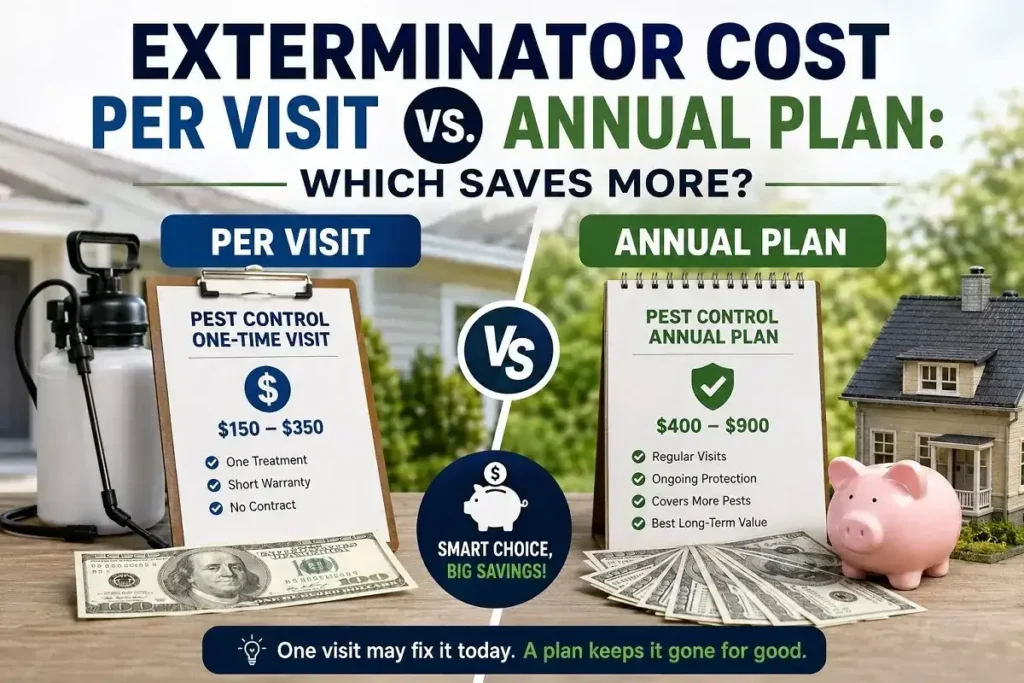
Many homeowners see quotes between $150 and $350 for a one-time visit. The exact price depends on your home’s size, the ant species, and how bad the problem is.
This price usually covers:
- An inspection to find nests and entry points
- Treatment of visible trails and nests
- A short warranty, often 30 to 90 days
That warranty matters. If ants return within that window, most companies will come back for free. Once the warranty ends, a new visit means a new full price.
For a one-time ant problem, like a trail that showed up after heavy rain, a single visit is often the smarter choice. You pay once, the issue gets handled, and you’re not locked into anything else.
What Does an Annual Ant Plan Cost?
Annual plans spread the cost across several visits instead of charging for one big job. Some companies offer monthly visits. Others offer quarterly visits.
When you divide the plan’s total cost by the number of visits, the price per visit is usually much lower. Monthly plans often fall between $40 and $75 per visit, compared to $150 or more for a single job.
The full yearly cost for these plans usually lands between $400 and $900. Quarterly plans tend to sit at the lower end of that range, while monthly plans with more visits included can run closer to the top. This shifts depending on your location and provider.
Whether your plan runs monthly or quarterly changes this number quite a bit. See our full pricing breakdown by service frequency for the exact split.
Annual plans usually include:
- Regular visits on a set schedule
- Follow-up treatment if ants come back between visits
- Ongoing checks near the foundation
- Coverage for other common pests, not just ants
That last point matters. Many “ant plans” are really general pest plans. They also cover spiders, roaches, and other pests. If ants are your only issue, you might be paying for coverage you don’t need.
Cost Per Visit vs. Annual Plan: Quick Comparison
| Factor | Per-Visit Treatment | Annual Plan |
|---|---|---|
| Typical cost | $150–$350 per visit | $400–$900 per year |
| Cost per treatment | Higher | Lower over time |
| Best for | A one-time ant problem | Ants that keep returning |
| Contract needed | No | Usually, often 12 months |
| Coverage | One issue, one visit | Ongoing prevention |
| Warranty | Short, 30–90 days | Active while the plan runs |
| Cancellation | Not applicable | May include a fee |
When a Single Visit Saves You More
A single visit usually saves money when the problem is small and unlikely to repeat. If this is your first time seeing ants, and the cause is obvious, a one-time treatment can solve it.
Renters often fall into this group too. Paying for a full year of coverage doesn’t make sense if you’re moving out in a few months.
Season also plays a role. Some ants show up heavily in spring, then vanish once the weather changes. If your ant activity follows the seasons instead of showing up all year, one well-timed visit may be all you need.
When an Annual Plan Saves You More
An annual plan tends to pay off when ants keep coming back. This is common with species like odorous house ants or pavement ants, which often nest close to your foundation.
Here’s a simple way to see the math. Say a single visit costs $200. If you end up needing three or four visits in a year, you’re already spending more than most annual plans cost in total.
Once you pass two or three visits a year, a plan usually becomes the cheaper choice. Homes near mulch beds, dense plants, or older foundations tend to see ants return more often. In these cases, ongoing treatment stops the problem at the source, again and again.
How to Find Your Break-Even Point
This number decides which option actually saves you money. It’s easy to work out.
Divide the annual plan’s total cost by your local exterminator cost per visit. That tells you how many single visits it would take to match the plan’s price.
For example, say a plan costs $500 and one visit costs $200. The plan pays for itself after 2.5 single visits. Since you can’t book half a visit, three separate treatments would already cost more than the plan.
Most homeowners underestimate how many visits a repeat ant problem needs. An outdoor colony often takes several treatments to fully clear, not just one.
Hidden Costs to Watch For
The advertised price isn’t always the full story. A few details can change the real cost of either choice.
- Contract length. Many plans require a 12-month commitment. Canceling early can bring a fee.
- First-visit fee. Some plans charge more for the first visit because it includes a deeper inspection.
- Species-specific treatment. Carpenter ants often need extra inspection that a basic plan may not cover.
- Add-on charges. If a plan doesn’t cover your exact ant species, you may pay extra.
- Property size. Larger homes usually cost more under either pricing model.
Always check what’s included, and what counts as an extra charge, before you compare prices.
Common Mistakes to Avoid
Assuming the lower monthly price always wins. A low per-visit cost on a plan doesn’t help if you only ever needed one visit.
Signing a long contract for a problem that’s already gone. If the ants disappeared after one treatment, a 12-month plan may cover something you no longer need.
Ignoring your warranty window. Some homeowners pay for a second full-price visit when the first one was still under warranty. Always check the return terms first.
Not asking what’s included. “Ant treatment” means different things at different companies. The cheapest quote isn’t always the most complete one.
Quick Questions to Ask Yourself
Before you choose, ask a few honest questions.
- Has this happened before, or is it the first time?
- Is the cause obvious, like an open food source?
- Will you stay in the home long enough to use a full year of service?
- Does the activity follow a season, or does it show up all year?
If most answers point to a one-time, clear cause, a single visit is likely the better deal. If the problem keeps repeating, or your home has ongoing conditions that attract ants, an annual plan will likely save you more.
Frequently Asked Questions
Is it cheaper to just call an exterminator every time ants show up?
Only if ants show up rarely. Once you need more than two or three visits a year, the combined cost usually passes what a plan would charge.
Do annual plans guarantee ants won’t come back?
No plan can promise a completely ant-free home, since new colonies can move in from outside. A plan offers regular treatment, so new activity gets handled early.
Can I switch from a one-time visit to a plan later?
Usually, yes. Many companies apply part of a recent visit toward a new plan if you sign up soon after, though this depends on the company.
What happens if I cancel a plan early?
This depends on your contract. Some plans allow cancellation anytime. Others include a fee, especially if you got a discounted first visit.
Do plans cover carpenter ants the same way?
Not always. Carpenter ants can cause structural damage, so some plans treat them as a separate service instead of standard coverage.
Final Thoughts
There’s no single answer that fits every home. Exterminator cost per visit usually looks cheaper upfront, and it’s the right call for a first-time or clearly isolated problem.
An annual plan costs more per visit at first glance. But once a home needs treatment two or three times a year, it usually ends up being the cheaper option overall.
The real decision comes down to pattern, not price. Look at how often ants have shown up, what’s likely drawing them in, and how long you plan to stay in your home. Then choose the option that fits your situation best.
For a full breakdown of average pricing across treatment types, see our complete guide on how much an ant exterminator costs in 2026.

Evan Brooks
Evan Brooks enjoys writing about ants and the way they live, build colonies, and adapt to different environments. His articles cover common ant species, nests, queens, seasonal activity, and everyday questions. He believes simple...
View all guides →