Signs of Termites in Your Home: 8 Warning Signs to Check
Worried about termites? Check the 8 warning signs, from mud tubes and frass to hollow-sounding wood, and learn where to look first and when to call an inspector.

In this guide
- Two Termite Types Leave Two Different Sets of Signs
- 1. Mud Tubes on Foundation Walls
- 2. Discarded Wings Near Windows
- 3. Wood That Sounds Hollow or Papery
- 4. Blistered or Bubbling Paint
- 5. Frass Piles Under Tiny Holes
- 6. Doors and Windows That Suddenly Stick
- 7. Clicking Sounds Inside Walls
- 8. Damaged Wood Under Floors and Furniture
- The Eight Signs at a Glance
- Where to Check First
- Mistakes That Let Termites Keep Feeding
- When a Professional Inspection Is Warranted
- After the All-Clear
- Frequently Asked Questions
Termites rarely announce themselves. Most homeowners find the damage first and the insects much later, sometimes years after a colony moved in.
The good news is that termites almost always leave evidence behind.
That evidence looks different depending on the type of termite in the house. Learn the eight signs below and you can check your own home in under an hour.
Quick answer. The most reliable signs of termites are pencil-wide mud tubes on foundation walls, piles of shed wings on window sills, wood that sounds hollow when tapped, and tiny pellet piles under small holes in wood. One sign alone is a warning. Two or more together mean it is time for a professional inspection.
Two Termite Types Leave Two Different Sets of Signs
Subterranean termites live in the soil. They need moisture to survive, so they travel back and forth between their underground nest and the wood in your home. UC IPM notes that these termites build covered tubes of soil and saliva to make that trip without drying out.
Drywood termites live inside the wood they eat. They need no contact with the ground, and a colony can spend its whole life inside a single beam, a piece of furniture, or an attic frame.
Knowing which type you are dealing with tells you where to look first.
1. Mud Tubes on Foundation Walls
Mud tubes are the classic sign of subterranean termites.
The University of Kentucky entomology department describes them as pencil-wide tunnels of soil that run over foundations, piers, sill plates, and floor joists.
Inside the tube, termites stay moist and hidden from predators.
Walk the outside of your home and scan the foundation from ground level upward.
Inside, check crawl space walls, basement piers, and the spots where pipes pass through the slab.
An empty tube does not clear your house.
Kentucky extension entomologists point out that termites often abandon one section of tube while feeding somewhere else in the structure. Treat any tube, old or fresh, as a reason to keep looking.
2. Discarded Wings Near Windows
Winged termites, called swarmers, leave a mature colony to start new ones.
After a short flight they land, shed their wings, and pair off to start a new colony.
The shed wings pile up on window sills, along floor edges, and in spider webs near lights.
A swarm that happens indoors points to a colony in or very near the house. Wings are easy to confuse with flying ant wings, so check our guide to flying ants vs termites before you decide what you found.
3. Wood That Sounds Hollow or Papery
Termites eat wood from the inside and leave the surface looking normal.
UC IPM notes that damaged wood is often thin at the surface and easy to puncture with a knife or screwdriver. Tap baseboards, door frames, and window sills with the handle of a screwdriver as you go.
Solid wood answers with a dull thud.
Hollowed wood sounds papery or empty, and the surface may dent under light pressure.
Subterranean termites feed along the grain and leave the harder layers behind. Badly damaged pieces can feel layered when you probe them.
4. Blistered or Bubbling Paint
Paint that blisters, bubbles, or darkens in patches often gets blamed on a plumbing leak. Termites tunneling close beneath the surface can cause the same look, because their galleries sit right under the paint film. UC IPM lists darkening and blistering of structural wood as a possible sign of infestation.
Press the area gently with a fingertip. If the surface feels thin or gives way and the wall behind it is dry, termites belong on your list of suspects.
5. Frass Piles Under Tiny Holes
Drywood termites keep their galleries clean by pushing droppings out of the wood.
The droppings, called frass, fall through tiny openings known as kick-out holes and collect in neat piles below. UC IPM describes the pellets as hard, oval, and six-sided, with a look somewhere between coarse pepper and sawdust.
Check under attic beams, window frames, wooden furniture, and picture frames. UC IPM suggests sweeping a pile away and checking the spot again in a few days. Old piles can sit undisturbed long after a colony is gone, so the recheck is what separates history from a live problem.
6. Doors and Windows That Suddenly Stick
A door that worked fine last season and now rubs its frame has a story to tell. Termite feeding inside the frame, plus the moisture subterranean termites bring into the wood, can swell and warp the trim until the fit changes.
Windows that jam or refuse to latch deserve the same suspicion.
Sticking frames have other causes, including humidity and normal settling. Treat this sign as a prompt to check for the other seven rather than proof on its own. A frame that starts sticking in the same season you find wings or tubes is rarely a coincidence.
7. Clicking Sounds Inside Walls
In a quiet house, an active colony can sometimes be heard. Pest management references describe soldier termites banging their heads against tunnel walls when the colony is disturbed, sending a warning vibration through the wood.
The result is a faint clicking or tapping that seems to come from inside the wall.
Workers feeding in large numbers can add a soft, papery rustling. These sounds are subtle, so silence means very little either way.
8. Damaged Wood Under Floors and Furniture
Floors hide some of the worst damage.
Termites feeding on joists and subflooring can leave boards springy, sagging, or blistered long before anything shows on the surface.
Lift the edge of rugs and check flooring near exterior walls and plumbing runs.
Furniture matters too, especially solid wood pieces stored against walls or in the attic. Drywood termites often arrive inside infested furniture and then spread to the structure around it.
The Eight Signs at a Glance
Use this table to match what you found with the problem it usually points to.
| Sign | Where you see it | What it usually means |
|---|---|---|
| Mud tubes | Foundation walls, crawl space piers, sill plates | Subterranean termites traveling between the soil and the wood |
| Shed wings in piles | Window sills, floor edges, near lights | A swarm happened nearby and a colony is established |
| Hollow or papery wood | Baseboards, door frames, window sills | Feeding has hollowed the wood from the inside |
| Blistered or bubbling paint | Painted trim, wall studs, beams | Tunnels are running close under the surface |
| Pellet piles with tiny holes above | Under attic beams, furniture, window frames | Drywood termites feeding in the wood overhead |
| Sticking doors and windows | Wooden frames anywhere in the house | Warped or weakened frames, often with other signs present |
| Faint clicking in walls | Quiet rooms with wood framing | Soldier termites signaling alarm inside active galleries |
| Springy or sagging floors | Flooring near walls, under heavy furniture | Damage to joists or subflooring underneath |
Where to Check First
Start where termites start.
- Basement walls, piers, and the sill plate where framing meets the foundation
- Crawl space joists and any wood close to bare soil
- Exterior foundation walls, especially shaded sides that stay damp
- Window sills and frames on the ground floor
- Wood piles, stumps, and landscape timbers stacked against the house
- Attic beams and stored wooden furniture
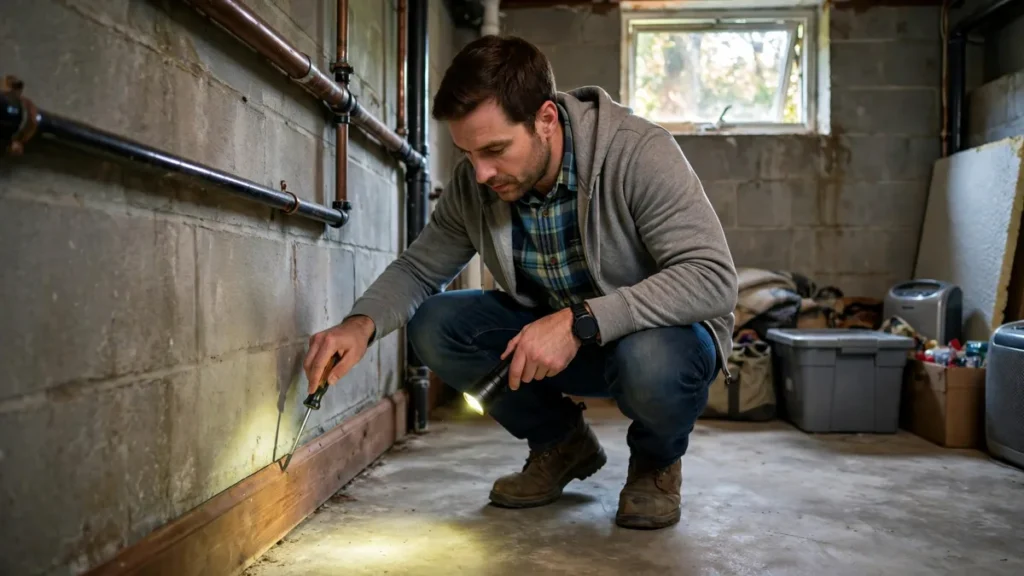
Bring a flashlight and a flat screwdriver for tapping and gentle probing. Move slowly, because several of these signs are easy to walk past.
Mistakes That Let Termites Keep Feeding
Breaking a mud tube off the wall and moving on is the most common mistake. The colony stays underground, the workers build a new route, and the feeding continues out of sight. Leave tubes in place until an inspector has seen them.
Trusting a single sign is the second mistake. One blister can be a leak, one pellet pile can be old, and one sticking door can be humidity.
Patterns matter more than any single clue.
Store-bought sprays are the third trap. The University of Kentucky warns that do-it-yourself products sold to homeowners seldom get rid of an existing termite problem, and killing a few visible termites leaves the colony intact.
When a Professional Inspection Is Warranted
Call for an inspection the moment you find live termites, a mud tube, or two or more signs together. Hidden infestations take a trained eye to map, and treatment differs completely between subterranean and drywood colonies.
An inspector can also tell active damage from old damage. That distinction changes what needs treating and what can be left alone. Ask for the findings in writing so you can compare quotes later.
Homes in termite-prone regions benefit from a professional look every year or two even without signs. Buying or selling a house is another moment when a documented inspection protects you.
After the All-Clear
Once your home checks out clean, small habits keep it that way.
Keep firewood and mulch off the foundation, fix leaks quickly, and keep soil from touching siding or wood trim.
Our room-by-room guide to how to pest-proof your home covers the sealing and moisture work that discourages termites along with most other household pests.
Frequently Asked Questions
Can I have termites without seeing any of these signs?
Yes, they can stay hidden for a long time. Colonies feed inside walls and under floors long before evidence reaches a visible spot, which is why periodic inspections matter in high-risk areas.
Does one mud tube mean my house is infested?
It means subterranean termites are traveling between the soil and your structure, and that is enough to act on. Only an inspection can show how far the feeding has spread.
Are frass piles always from termites?
Not always. Carpenter ants leave coarse sawdust that often contains insect parts, while drywood termite pellets stay uniform, hard, and six-sided under a magnifier, according to UC IPM.
Should I break open a mud tube to check for termites?
Photograph the tube first and leave the full run in place for the inspector. UC IPM notes that breaking a tube open can reveal live workers and soldiers, but tearing tubes down removes the evidence an inspector uses to plan treatment.
How fast do termites damage a house?
Damage builds slowly at first because colonies feed from the inside out. The pace depends on colony size, species, and how much wood is reachable, so early signs deserve quick action rather than a guess at a timeline.

Henry Lawson
Henry Lawson focuses on termites and the questions homeowners ask most. He writes about termite behavior, swarm seasons, wood damage, and early warning signs using trusted information and clear language. His goal is to...
View all guides →