Backyard Mosquito Control: What Actually Works (And What to Skip)
Backyard mosquito control that works, Bti buckets done right, fans, barrier sprays on shrubs, and what to skip. Plus the 3 to 4 week timeline to expect.


In this guide
- Bti Buckets and Dunks, Done Right
- Set Your Clock to Three or Four Weeks
- Cut Down the Shelter and Fix the Wet Ground
- Fans Guard the Seats, Not the Whole Yard
- Barrier Sprays Belong on Shrubs, Not on Grass
- Thermacell and Its Conditions
- What to Skip
- The Methods at a Glance
- One Evening Event in a Bad Yard
- Frequently Asked Questions
- The Bottom Line
Most backyard mosquito products fail for the same reason.
They get aimed at the wrong stage of the mosquito’s life, or at the wrong part of the yard.
If mosquitoes are also getting inside the house, start with our complete guide to getting rid of mosquitoes and come back here for the outdoor work.
Quick answer. Treat every bit of standing water with Bti so no new mosquitoes hatch, clear the shady shelter where adults rest, and put moving air or a barrier between mosquitoes and your seats. Skip the gadgets. Give the system three to four weeks.

Bti Buckets and Dunks, Done Right
Bti is a naturally occurring soil bacterium that kills mosquito larvae in the water where they develop. It is registered with the EPA, which considers Bti low risk to people, pets, and wildlife when used as the label directs.
Bti does nothing to the mosquitoes already flying.
The bucket setup
The setup that spread through gardening communities is often called the mosquito bucket of doom, a method entomologist Doug Tallamy popularized to turn the female’s own egg-laying habit against her.
Fill a bucket roughly halfway with water and add a handful of hay, straw, or dead leaves. As it breaks down, the water smells like the stagnant pool a female mosquito hunts for.
Drop in a Bti dunk, or a piece of one, and set the bucket out. She lays her eggs there, the larvae feed and die, and no new adults leave that bucket.
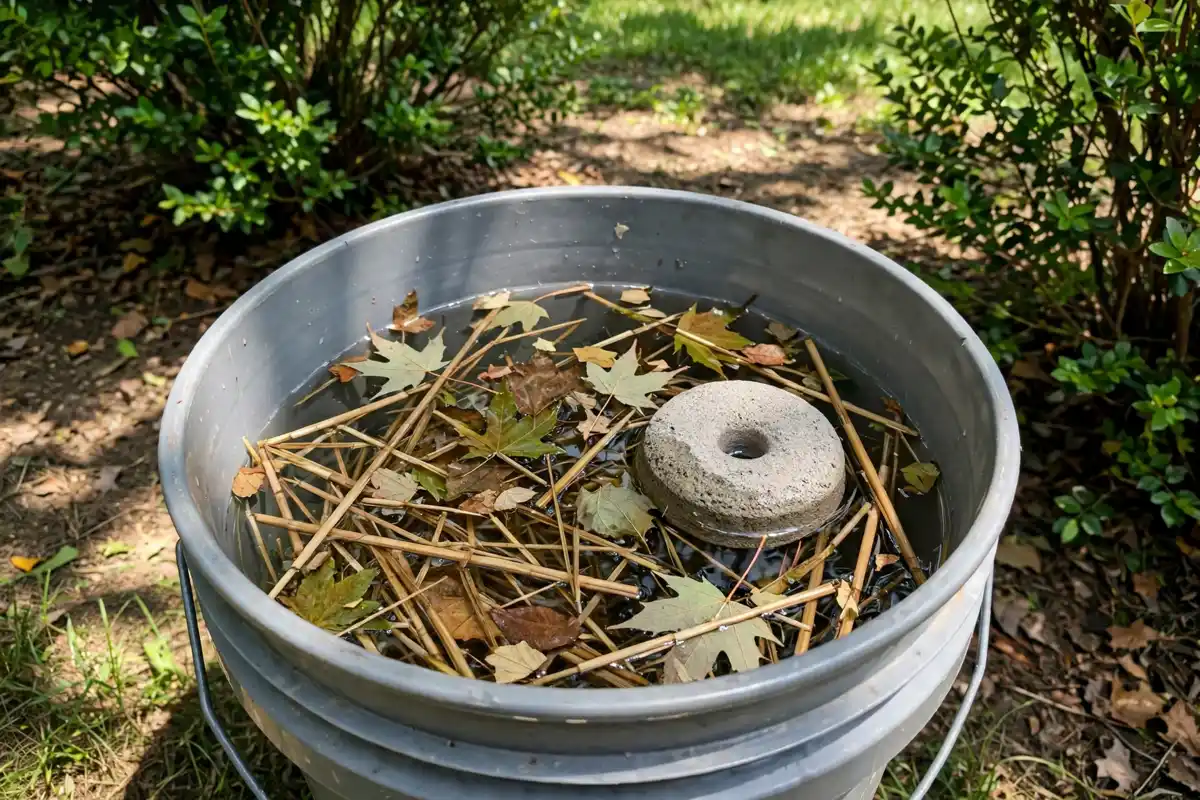
One dunk treats up to about 100 square feet of water surface and keeps working for roughly 30 days, according to the product label. One dunk can therefore serve a bucket plus several small containers.
How many buckets, and where they go
Coverage follows the water and the resting shade, not the size of the lawn. One bucket near the patio and one near a damp, shaded corner covers a small yard, and bigger yards with several wet corners need one per zone.
Place buckets in shade, near the shrubs and ground cover where adults rest. A bucket in open sun sits far from the mosquitoes you are trying to intercept. Top the water up in dry spells, because a dry bucket stops working as a trap.
Every other water source counts too
Buckets only cover the water you put in them, so every other source in the yard needs a dunk, a screen, or the dump treatment.
Walk the yard after a rain and treat or empty everything on this list.
- Plant saucers and self-watering pots
- Tarps and covers that hold pockets of rain
- Toys, buckets, and watering cans left outside
- Clogged gutters and flat spots on the roof edge
- Birdbaths, which take a dunk piece or a full water change twice a week
- Rain barrels, screened or dunked
- Wheelbarrows and old tires that hold water
Containers you cannot treat, scrub instead. Aedes mosquitoes glue their eggs to the container wall above the waterline, those eggs survive drying out and hatch at the next filling, which is why extension guidance pairs dumping with scrubbing.
Set Your Clock to Three or Four Weeks
Here is the mistake that kills this method. A homeowner sets out buckets, gets bitten on day nine, and throws the whole system away.
Nothing about that result means the Bti failed. The mosquitoes biting on day nine hatched before the buckets went out, and Bti never touches flying adults.
Judge the method at three to four weeks, not at one.
By then the adults already flying have lived out their lives, and treated water has produced no replacements.
One condition comes attached to that timeline. It holds only when every water source in the yard is treated or emptied. One untreated saucer or clogged gutter keeps restocking the yard the whole time.
Expect a real drop, not a mosquito-free yard. Neglected water across your fence line can keep sending in replacements.
Cut Down the Shelter and Fix the Wet Ground
During the day, adult mosquitoes rest in cool, humid shade.
Tall grass, dense ground cover, ivy, and the space under a deck are their waiting rooms.
Mowing on the shorter side and trimming back ground cover removes the resting layer closest to your seats. Cutting shrubs back from the patio and clearing leaf litter pushes the resting zone farther from people.
Wet ground is the other half of shelter, and low spots that hold puddles for days work as both a rest stop and a nursery.
Fill shallow low spots with topsoil and reseed, and regrade where downspouts dump water beside the foundation. For ground that stays swampy, a French drain or a dry well gives water somewhere to go that mosquitoes cannot use.
The target is water that sits for most of a week. Extension sources put the egg-to-adult cycle at roughly 7 to 10 days in warm weather, so water gone inside that window rarely matters.
Fans Guard the Seats, Not the Whole Yard
Mosquitoes are weak fliers.
A steady breeze makes it hard for them to reach you and scrambles the carbon dioxide and scent trail they follow in.
A fan kills nothing. It defends the patch of yard where people sit.
One pedestal or oscillating fan aimed across a small seating area helps. A bigger patio or a table for six does better with two fans sweeping the zone from different sides. Aim for overlap across the people, not coverage of the whole patio.
Set fans beside or slightly behind the group so the breeze moves across everyone and pushes scent away from the seats.

Fans protect only the zone the air covers, and only while they run. They need no chemicals, no refills, and no waiting period, and they work the first evening you switch them on.
Barrier Sprays Belong on Shrubs, Not on Grass
A barrier spray is a residual insecticide applied where mosquitoes rest, so they pick it up while they sit in the shade during the day.
On the right surfaces, one application keeps working for a few weeks as new adults wander in and settle.
The classic failure is spraying the open lawn.
Almost no mosquitoes rest on sunny grass, so a lawn treatment spends itself where the target never lands. Aim instead at shrub foliage, working the spray up into the undersides of leaves.
Treat the shaded side of fences, dark corners under decks and porches, and a band of vegetation around seating rather than the whole property line.
Protect pollinators while you do this, because extension guidance is consistent here. Never spray open blooms, so spray before bloom or shield flowers where you can. Apply in calm weather so spray lands on target leaves instead of drifting.
Early morning and evening are usually calmest, and bees are less active then. Let treated foliage dry before people and pets use the area, and follow the label on waiting time and limits near gardens, ponds, and play areas.
Thermacell and Its Conditions
A Thermacell unit heats a repellent mat and builds a zone of protection around a small seating area. On a still evening, it can work very well inside that zone.
The maker describes the zone as roughly 15 feet across. The unit needs about 15 minutes of running before the zone is established. Switch it on first and set out the chairs second.
Wind is the hard limit, because a breeze thins the zone and pushes it sideways, and on a windy evening the device gives little protection no matter how fresh the mat is.
Mats age once opened, whether they get used or not, and a mat left in the unit since last season has been losing strength the whole time. The maker rates each mat for only about four hours of use.
Treat Thermacell as a tool for one calm seating zone, and pair it with a fan when the air is moving.
What to Skip
Four common purchases fail the same test. None of them reduces the number of mosquitoes that reach your skin.
Bug zappers
Zappers kill insects drawn to light, and mosquitoes barely use light to find people. They hunt by carbon dioxide, body heat, and scent.
Researchers who sorted through zapper catches found biting insects made up only a tiny fraction of the kill. The bulk of the catch was moths, beetles, and other insects that were never going to bite anyone.
Ultrasonic repellers
Plug-in and wearable ultrasonic devices promise a sound mosquitoes cannot stand. In controlled tests reviewed by extension entomologists, they showed no useful effect on mosquito biting.
A potted citronella plant as a plan
A citronella or lemon balm plant sitting on the patio is decoration, not defense. The oils stay locked inside intact leaves, and trials of planted repellent species found no meaningful drop in bites nearby.
The leaves must be crushed and the oil released before any of it works, and a plant in its pot does none of that.
Spraying the open lawn
Grass in full sun is not where mosquitoes spend the day, so lawn-wide spraying buys effort without the result.
The Methods at a Glance
Every method here has a condition attached.
| Method | Works when | Fails when |
|---|---|---|
| Bti buckets and dunks | Every standing water source is treated and dunks get replaced about once a month | One source is missed, or the method is judged inside two weeks |
| Dumping and scrubbing containers | Done weekly, with a scrub of the walls where eggs stick | Done once and forgotten for the season |
| Fans | Moving air sweeps the seating area while people are sitting in it | Protection expected beyond the breeze |
| Barrier spray | Applied to shaded foliage and leaf undersides in calm weather | Sprayed on open lawn or onto blooms bees are working |
| Thermacell | Calm air, a fresh mat, and 15 minutes to build the zone | Wind, an old mat, or an area bigger than one seating zone |
One Evening Event in a Bad Yard
A graduation party or a big cookout changes the goal.
You cannot rebuild the yard’s mosquito population in a weekend, and you do not need to.
A one-off barrier treatment can knock down the adults resting in your shrubs for that evening, especially sprayed onto the foliage a day or two ahead. It cannot stop fresh mosquitoes from drifting in from neighboring yards during the party.
Yard fogging fades faster still, with relief measured in hours rather than days.
The reliable layer for the night itself is physical. Fans sweeping the seating and food tables, plus a Thermacell or two in calm corners, protect guests where they gather.
Start buckets and dunks three to four weeks before a big date. Anything started the same week is a gift to next month’s guests, not this one’s.
Empty every saucer, tray, and cooler drain on the morning of the event, because party gear adds fresh water to a yard you cleaned.
Frequently Asked Questions
How many mosquito buckets does a yard need?
Start with one near the main seating area and one near each damp, shaded zone, then add one for each extra wet corner. Most suburban yards land between two and four, because the count follows water and shade, not lawn size.
I put dunks out two weeks ago and still get bitten. Are they working?
Probably, and two weeks is too early to judge. Dunks kill larvae only, so the adults biting you hatched before the dunks went in. Judge at three to four weeks, and check for a water source you missed.
Can I skip the buckets and only spray?
You can, but expect to spray all season. Spraying knocks down the adults resting today while untreated water keeps producing replacements, so the population refills between applications.
Do fans really keep mosquitoes away?
Within the moving air, yes. Mosquitoes are weak fliers and lose your scent trail in a breeze, so a fan sweeping the chairs gives real relief with no chemicals. Step outside the breeze and the protection ends.
Is one treatment enough before a party?
Enough to help, not on its own. A barrier treatment a day or two ahead cuts the adults resting in your yard, and fans at the tables do the rest while guests are seated.
The Bottom Line
Backyard control is a system, not a purchase. Treat the water, clear the shelter, defend the seats, and give it a month to prove itself. None carries the yard alone.
For the whole home picture, including mosquitoes already indoors, go back to our complete guide to getting rid of mosquitoes.

Miles Turner
Miles Turner writes about mosquitoes, their life cycle, breeding habits, and seasonal activity. He enjoys explaining why mosquitoes behave the way they do and turning research into practical information that readers can understand in...
View all guides →