How to Get Rid of Mosquitoes: The Complete Home & Yard Guide
Get rid of mosquitoes for good. Diagnose your situation first, remove breeding water, fix the yard and indoors, and follow a week-by-week plan that works.


In this guide
- Start With Diagnosis. Which Mosquito Problem Do You Have?
- The Standing-Water Audit. Where Mosquitoes Actually Start
- Yard Control That Actually Works
- Mosquitoes Inside the House
- Why Mosquitoes Keep Coming Back for Weeks
- Bites, Repellents, and Gadgets in Short
- Your Week-by-Week Timeline
- When to Call a Professional
- Frequently Asked Questions
- The Bottom Line
Most mosquito advice starts with a product. That is backwards, because the right fix depends on which mosquito you have, when it bites, and where it is breeding.
Get the diagnosis right and the control part gets much shorter.
This guide works in that order. First you identify your situation, then you remove the breeding sites, then you deal with the adults that are already flying.
Quick answer. Getting rid of mosquitoes takes two jobs done together. Remove or treat every source of standing water so new mosquitoes stop hatching, and cut down the adults already resting in your shrubs and shaded corners. Expect steady improvement over three to four weeks, not overnight.
Mosquito work also rewards patience in a way ant or roach work does not. The payoff arrives by the week, not by the day, and the households that understand that are the ones that stick with the routine long enough to see it land.
Start With Diagnosis. Which Mosquito Problem Do You Have?
Two clues tell you almost everything. When the bites happen, and where the water is. Everything else in this guide hangs off those two observations.
The Asian tiger mosquito, Aedes albopictus, bites during the day, especially around the ankles and lower legs. It breeds in small containers near the house, and it rarely travels far from where it hatched.
It is one of the easier mosquitoes to recognise. It is black with bright white stripes on the legs and a single white line running down the back.
Dusk biters are a different situation. Culex mosquitoes come out around sunset and into the night, and they breed in larger or dirtier water such as clogged gutters, storm drains, and neglected swimming pools. They are also the group linked with West Nile virus, which is one more reason dusk pressure near drains is worth taking seriously.
The fix differs because the breeding sites differ.
Container breeders mean your problem is within a short walk of your chair.
Dusk biters can be flying in from a wider area, including a neighbour’s yard or a drain down the street.
Use the two clues together rather than guessing from a single bad evening. Bites at the ankles in the middle of the day point at containers near the house, while bites that start at sunset point at bigger water further away.
| What you notice | Likely mosquito | Where to look first | First fix |
|---|---|---|---|
| Bites in daytime, mostly on ankles and lower legs | Asian tiger mosquito (Aedes albopictus) | Pots, saucers, buckets, toys, and tarps near the house | Dump and scrub every container once a week |
| Bites at dusk and after dark | Culex species | Gutters, storm drains, birdbaths, neglected pools | Clear or treat the larger water, screen rain barrels |
| Bites indoors at all hours | Breeding or resting inside the house | Plant pots, floor drains, sump pits, drip pans | Find the indoor water and seal the entry points |
| A swarm right after heavy rain that fades within days | Floodwater species | Low spots that hold rainwater briefly | Drain or fill the low areas and wait it out |
If you are getting bitten indoors around the clock, skip ahead to the indoor section below. That pattern usually means the source is inside the house, not in the yard.
Keep notes for the first week if the pattern is unclear. Write down when the bites happen and where you were sitting, because memory blurs the pattern while a few lines on paper make it obvious.
The Standing-Water Audit. Where Mosquitoes Actually Start
Every mosquito in your yard started in water. Females lay eggs in standing water or on surfaces that flood.
In warm weather the young can go from egg to biting adult in about a week to ten days, according to the CDC.
The speed of that cycle is why timing matters so much. Miss the audit for one week and a fresh batch of adults is already on the wing. Miss two weeks, and the yard feels exactly as bad as the day you started.
No water means no next generation. Walk the property slowly and look at everything that can hold even a small amount of water for a few days.
Even a bottle cap can hold enough water for a batch of larvae.
Where water hides
- Clogged gutters you cannot see from the ground
- Flowerpot saucers and pots nested inside decorative pots
- Puddles under the air conditioner and along its condensate line
- Corrugated drain pipes that hold water in their ridges
- Tarps, buckets, wheelbarrows, and children’s toys
- Birdbaths and pet bowls that never get fully emptied
- Rain barrels without a fine mesh screen
- Low spots in the lawn that stay wet after rain
The visible puddles are rarely the whole story.
In most yards the real nursery is a gutter hidden above your head or a saucer tucked under a pot.
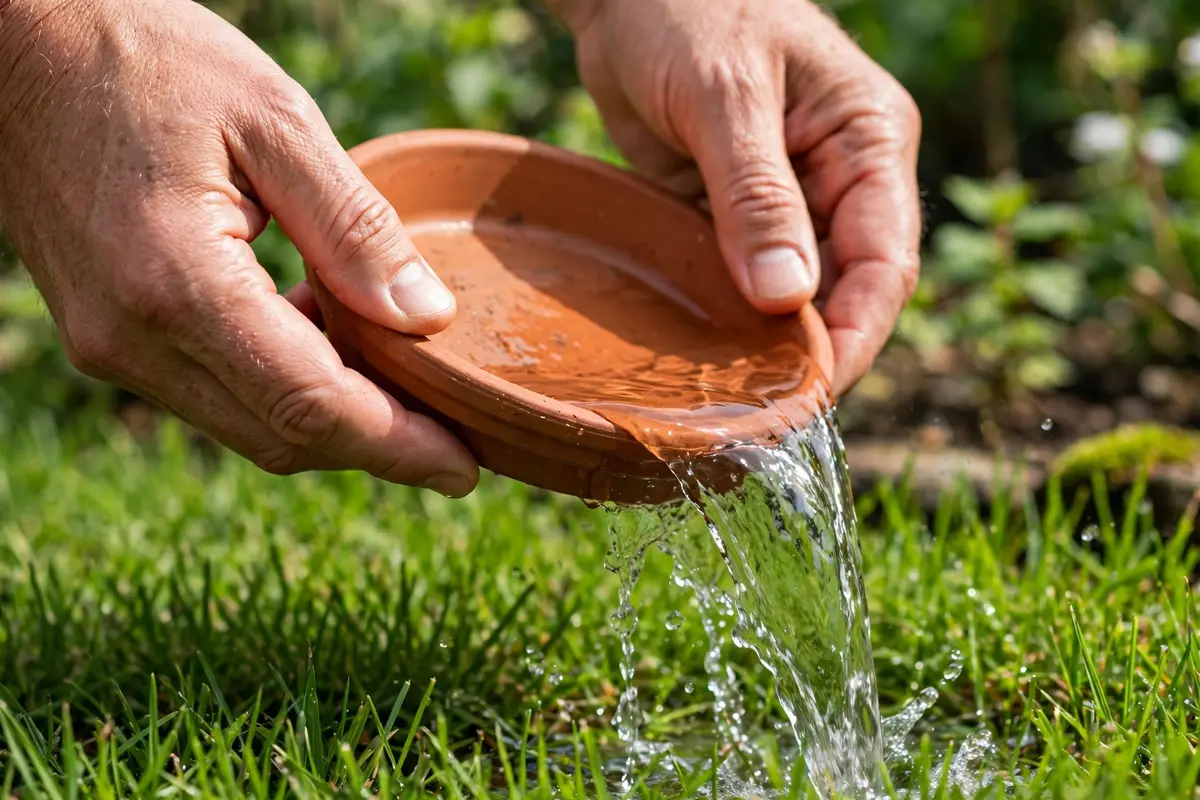
Dumping the water out is only half the job.
Aedes females glue their eggs to the inside wall of a container above the waterline. The CDC notes that these eggs can survive drying out for months, stuck to the wall, waiting.
When the container fills again, the eggs hatch. That is why extension services teach a dump and scrub routine instead of dumping alone.
A brush or cloth run around the inside wall removes the eggs. A weekly rhythm then breaks the breeding cycle before new adults can emerge.
Plan on the audit once a week through the season, and do one extra pass after heavy rain, even if it breaks the weekly rhythm. Storms refill everything at once, including the spots that sat dry on your normal day.
Water that cannot be dumped needs a different answer.
Rain barrels can be covered with fine mesh. Water that cannot be drained, such as a pond or a ditch, can be treated with Bti dunks, which kill the larvae in the water.
Bigger water needs the same logic at a bigger scale. A neglected pool can produce mosquitoes for a whole street, which is why an unused pool next door belongs in the neighbour and professional conversation further down this page.
Yard Control That Actually Works
Source reduction stops the next generation. It does nothing about the adults that are already in your yard today.
Adult control starts with where mosquitoes spend their day. They are not out in the open on your lawn.
Mosquitoes rest in shade during the heat of the day, inside shrubs, under decks, in tall grass, and on the undersides of leaves. They are weak fliers that avoid sun and wind.
This is why spraying the open lawn disappoints so many people.
The spray lands where mosquitoes are not. The ones resting under the deck survive untouched and come out to bite that same evening.
If you use a yard spray, aim it at the resting sites instead. Treat the shrubs, hedges, and shaded walls near seating areas, follow the label directions, and keep spray off flowering plants where bees are feeding. Spray in the calm of early morning or evening, when the product lands where you aim it instead of drifting.
Most yard sprays are contact killers, the same basic pattern covered in our guide to how pesticides kill ants.
Sun and rain break them down outdoors, so the effect fades within a few weeks.
Cutting back overgrowth helps at the margins too. Tall grass and dense ground cover hold the cool, damp air where adults rest, so trimming them shrinks the shelter near seating areas. Keep the effect in perspective, because tidy planting on its own does not empty a yard that still has breeding water in it.
A fan is the simplest adult control on a deck or patio.
Moving air makes it hard for a weak flier to reach you.
It also breaks up the plume of carbon dioxide and scent that mosquitoes follow to find a person.
Traps have a place as monitors rather than solutions. A falling trap catch tells you the pressure is dropping, but no trap empties a yard that is still breeding mosquitoes faster than the trap can catch them.
None of this replaces the water audit.
Adult females often live two to four weeks.
A yard that keeps breeding them replaces every adult you kill, which is why the weekly routine matters more than any single treatment.
Mosquitoes Inside the House
Indoor mosquitoes fall into three groups.
Some wandered in through a door or a torn screen, some are resting indoors through the day, and a smaller number are breeding inside the house itself.
The fix depends on which group you have, so start with entry.
Check window screens, gaps under doors, and the openings around window air conditioners, then seal what you find.
Screens deserve a closer look than they usually get. A small tear near a bedroom window is enough for a nightly visitor, and patching or replacing the mesh is a ten minute job. It is also the cheapest fix in this entire guide.
Our guide to how to pest-proof your home walks through that sealing work room by room.
Then check the hidden indoor water.
Plant pots nested inside decorative pots are a classic source, because water collects in the gap between the two pots and never dries.
Unused floor drains, sump pits, and refrigerator drip pans can each hold enough still water to raise a batch.
If you suspect a particular container, look for the larvae themselves. They hang at the surface of still water and dive to the bottom when you disturb it, and finding them settles the argument about whether that water is the problem.
A single mosquito whining around the bedroom each night is usually a stray that slipped in through a door.
A fresh batch every few days, with the windows kept closed, points to water inside the house.
One more mix-up is worth knowing about before you start spraying the wrong pest. Tiny flies hovering around houseplants are usually fungus gnats, not mosquitoes. They come from wet potting soil and they do not bite.
Why Mosquitoes Keep Coming Back for Weeks
You did everything right last weekend and you are still getting bitten.
This is the point where most people decide the whole effort failed.
It usually has not, because mosquito control works on generations, not on individuals. The adults biting you today hatched before you started. Removing them, or outliving them, takes time.
Eggs already laid keep hatching in waves in the meantime.
Aedes eggs wait dry on container walls for the next rain. Eggs sitting in a gutter or a drain hatch whenever water returns, so one storm can restart the clock.
Each wave is smaller than the last if the routine holds. That downward trend, slow as it feels in week two, is the sign the plan is working.
Then there is the neighbour factor.
Mosquitoes do not respect fences. A neglected pool, a stack of wet junk, or a blocked drain two doors down can keep reseeding a yard that is doing everything right.
Your routine still matters.
A property with no breeding sites of its own produces far fewer mosquitoes than one left alone. Most counties also run vector control programs that can inspect and treat problem water off your land when you report it.
Bites, Repellents, and Gadgets in Short
Three topics come up with every mosquito problem, and each has its own full guide coming in this category. Here is the short version of each.
For bites you already have, wash the skin and use a cold pack for the swelling, and do your best not to scratch, because broken skin is where infections start. Heavy swelling, spreading redness, or fever deserve a call to a doctor, and our full guide to mosquito bites covers the reaction patterns and the warning signs in detail.
Skin repellent is the personal layer of protection while the yard work catches up. The EPA keeps a search tool that matches registered repellents to the hours of protection you need, and our full repellent guide will walk through how to choose between DEET, picaridin, and oil of lemon eucalyptus for different ages and situations.
The gadgets get the shortest answer of all. Bug zappers mostly kill insects that never bite anyone, plug-in ultrasonic devices have shown no reliable effect in field testing, and citronella candles help a little within a short distance of the flame and do almost nothing across a whole patio.
Your Week-by-Week Timeline
Here is a realistic picture of how results unfold when you follow the routine. Judge the effort at week three or four, not after the first weekend. The timeline also assumes the breeding sites are on your own land, where you can actually reach them.
| Week | What to do | What to expect |
|---|---|---|
| Week 1 | Do the full water audit. Dump and scrub every container, treat water you cannot dump, and set up fans where you sit. | The adults already flying keep biting. Nothing feels different yet, and that is normal. |
| Week 2 | Repeat the audit. Check the indoor hiding spots and seal screens and door gaps. | Fewer fresh mosquitoes near the house. Bites start to thin out in the areas you treated. |
| Week 3 | Repeat the audit again. This is when larvicide work starts to show, because the generation it blocked never appears. | A clear drop if every breeding site was found. A stubborn pocket of bites means one site is still hiding. |
| Week 4 and after | Keep the weekly dump and scrub going all season. | A low background level you can live with. Expect a brief spike after heavy rain, which fades as the routine continues. |
If nothing has improved by week four, the source is almost always a site you have not found yet, or one that is not on your property.
Go back to the diagnosis table and check your timing clue again. A problem that bites all day is close to home, even when it feels like it is coming from everywhere.
When to Call a Professional
Call in help when the breeding site is beyond your reach or your tools.
Common triggers are a swampy low area you cannot drain, a large neglected property next door, or biting pressure that stays severe after a month of steady routine.
A mosquito problem tied to a septic issue or a drainage fault also belongs with a professional, not with more spray.
A professional service can treat resting sites and standing water on a schedule.
County vector control can deal with drains and public water that you are not allowed to touch.
Most services work on a cycle of visits every few weeks through the season. That rhythm exists because treatments fade and eggs keep hatching, not because the first visit failed, so price the season rather than the single visit when you compare quotes.
Ask any service what they will treat and how often they will return. A single visit rarely holds a whole season, and an honest company will tell you that upfront.
Events are the other fair reason to call, because a one-off treatment before a wedding or a big gathering can knock the adults down for that weekend. Book it knowing the effect is temporary. Keep your own routine running either way, since the treatment buys comfort rather than control.
Frequently Asked Questions
Why am I still getting bitten two weeks after putting out mosquito dunks?
Dunks kill larvae, not adults. The mosquitoes biting you now hatched before the treatment went out, and the dunk only pays off when the next generation fails to appear, which usually shows around week three.
I have no standing water anywhere. Why do I still have mosquitoes?
Check the places water hides, such as clogged gutters, the air conditioner condensate line, saucers under pots, and corrugated pipes holding water in their ridges. If your own yard is truly dry, the mosquitoes may be flying in from a neighbouring property, which is common in built-up areas.
Can mosquitoes breed inside my house?
Yes, anywhere water sits still for a week or more. Nested plant pots, unused floor drains, sump pits, and drip pans are the usual indoor nurseries, and they explain the cases where bites continue with every window closed.
Why do mosquitoes bite me more than everyone else?
Part of it is chemistry you cannot change, including the carbon dioxide you breathe out and the mix of bacteria living on your skin. It is not your imagination, and a full breakdown of what attracts mosquitoes to certain people is coming as its own guide in this category.
Are those huge slow flies mosquito hawks that eat mosquitoes?
No. Crane flies look like oversized mosquitoes, but they do not bite people, and they do not hunt mosquitoes either, so they are harmless neighbours rather than free pest control.
The Bottom Line
Mosquito control is a routine, not a purchase.
Diagnose your mosquito, remove its water every week, and give the routine three to four weeks to show what it can do. Households that keep that rhythm usually get their yard back for most of the season. The single habit that separates them from everyone else is the weekly walk, done even when the yard already feels better.
Start with the audit this weekend. The first walk around your own property will tell you more than any product label.
The mosquitoes will test the routine after every storm. What changes, once the system is in place, is how fast the yard recovers. That recovery speed is the real measure of success.

Miles Turner
Miles Turner writes about mosquitoes, their life cycle, breeding habits, and seasonal activity. He enjoys explaining why mosquitoes behave the way they do and turning research into practical information that readers can understand in...
View all guides →