
Mosquitoes in the House: Where They Are Coming From and How to Get Them Out
Mosquitoes inside your house with the windows closed? Work out if they are strays, breeding indoors, or slipping in nightly, and how to get them out for good.


In this guide
- First, Work Out Which Problem You Have
- Situation One: The Stray That Followed Someone In
- Situation Two: Mosquitoes Breeding Inside the House
- Situation Three: A Nightly Entry Route
- Where Indoor Mosquitoes Rest During the Day
- The One Mosquito Keeping You Awake
- It Might Not Be a Mosquito at All
- Do Not Forget the Yard
- Frequently Asked Questions
- The Bottom Line
The windows are shut, the air conditioning is running, and you are still getting bitten in your own living room.
It is one of the most frustrating pest problems in the house, because the source feels invisible.
Indoor mosquitoes almost always come down to one of three situations.
One stray followed somebody in through an open door. A small group is breeding somewhere inside the house. Or a gap in a screen or a door frame is letting new ones in every single night.
Each situation has different signs, and each one has a different fix.
Treating a breeding problem like a stray problem is why the bites keep coming back week after week.
Quick answer. Start by working out which of the three indoor situations you have. A stray needs patience, not products. Breeding indoors means hidden standing water in places like nested plant pots, dead drains, or a sump pit. New bites every night with none of those sources points to an entry gap.
First, Work Out Which Problem You Have
Do not start with a spray can. Start with two nights of paying attention, because the pattern of the bites tells you more than any product label will.
Bites that fade after one or two nights and never return usually mean a stray.
Bites that keep appearing in waves, with fresh mosquitoes showing up even in dry weather, suggest breeding inside the home. Bites that start fresh every evening after a quiet day point to something getting in at dusk.
| Your situation | The signs | The fix |
|---|---|---|
| One stray mosquito | One or two bites on a single night, then nothing | Find it resting during the day and kill it. No products needed. |
| Breeding inside the house | New bites in waves over weeks, mosquitoes appearing in still weather | Find and remove the hidden standing water, then scrub the container |
| A nightly entry route | Quiet days, fresh bites every evening, no indoor water found | Repair screens, seal door gaps and frame cracks, check the garage route |
The table gives you the working diagnosis.
The sections below take each situation in turn, starting with the one that needs the least work.
Situation One: The Stray That Followed Someone In
A single mosquito rides in on clothing, slips through a door held open for groceries, or comes up from the garage with you.
It has no nest, no eggs, and no reinforcements indoors.
Your only job is to find it before it finds you at 2 a.m.
Strays rest during the day in dark, still corners near where people sit or sleep. Check behind curtains, under the sink cabinets, and on the wall behind the sofa before you reach for any spray. Kill it, and the problem is over.
Situation Two: Mosquitoes Breeding Inside the House
Breeding indoors sounds unlikely until you remember how little water a mosquito needs. Extension entomologists point out that container-breeding mosquitoes such as the Asian tiger mosquito can raise a generation in very small amounts of standing water.
The water in your house is rarely in plain sight.
The classic hiding place is a potted plant sitting inside a decorative outer pot. Water collects in the gap between the two pots, nobody ever sees it, and it can sit undisturbed for weeks.
Unused floor drains and shower drains also turn up again and again when pest professionals trace an indoor problem. A guest bathroom that nobody uses can be raising mosquitoes two rooms away from where you sleep.
Hidden indoor water sources to check
- Water trapped between a plant pot and its decorative outer pot
- Unused floor drains and shower drains in guest bathrooms
- Sump pits without a tight cover
- Refrigerator and dehumidifier drip pans
- The tank of a toilet that almost never gets flushed
- Saucers under plants that stay wet for days
Fixing a breeding source means removing the water, not treating it.
Separate nested pots and let the gap dry, flush unused drains every week, cover the sump pit, and empty and dry the drip pans.
One more check belongs in the laundry room and at the utility sink. Buckets, mop sinks, and hoses that hold water between uses are easy to walk past for weeks.
Scrub the container walls as well as emptying them. University extension sources note that Aedes eggs stick to container walls above the waterline, survive drying out, and hatch the next time the water rises. Within a week of the water going, the indoor waves stop.
Situation Three: A Nightly Entry Route
If the house is dry inside and the bites still start every evening, stop hunting for water. Something is getting in.
The route is usually boring and mechanical.
Window screens develop tears at the corners and along the frame where the mesh pulls away.
A screen that looks fine from across the room can have a gap a mosquito uses every night.
Doors are the other main route, especially doors without a sweep at the bottom.
Pet doors with worn flaps and garage doors that do not seal at the corners leave a standing invitation.
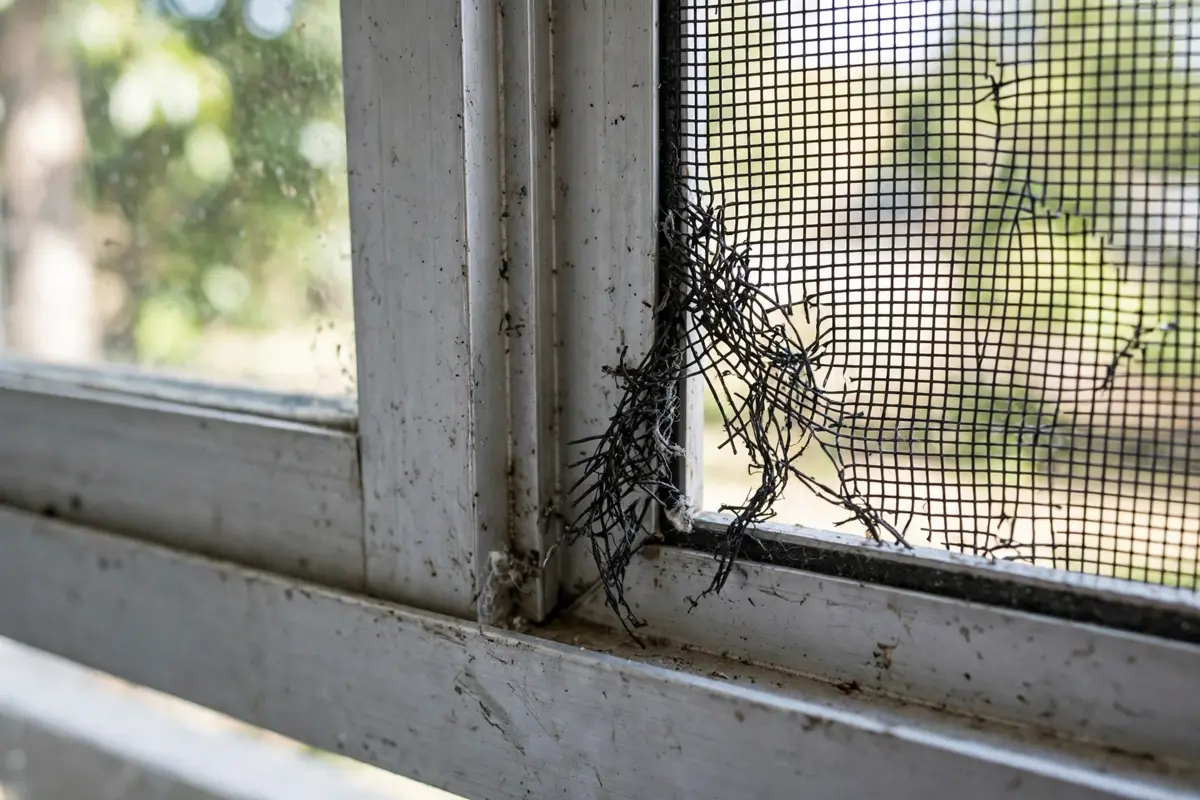
Garages deserve a check of their own, because mosquitoes rest in them during the day and follow you into the house at night.
Soffit vents with damaged screening above the garage can feed that pattern.
Seal the frame gaps, repair or replace torn screens, and fit sweeps where light shows under the door. Our guide to pest-proofing your home walks through the sealing materials room by room.
When the route closes, the nightly bites stop with it.
Where Indoor Mosquitoes Rest During the Day
Hunting a resting mosquito is easier than hunting a flying one. The CDC describes mosquitoes resting in dark, humid places, and indoors that habit points to a short list of spots.
Under the kitchen and bathroom sinks is the first place to look.
Closets, laundry rooms, and the still air behind heavy curtains come next. Mosquitoes avoid fans and moving air, so they gather where the air sits still for hours. Bedrooms with dark corners and little airflow belong on the same round.
A slow pass through those spots with a vacuum hose or a fly swatter in the late afternoon removes the day’s resters. That one habit does more than most plug-in gadgets.
Work from the darkest room outward. A resting mosquito flushed from a closet usually lands again within a few feet, so move slowly and check each new landing spot.
The One Mosquito Keeping You Awake
The whine next to your ear at night is a female working the warm air around your head. She is following the carbon dioxide you breathe out, which is why she always seems to find your ear and miss the empty side of the bed.
Chasing her in the dark almost never works.
Turn on the light and stand still instead. A mosquito that was hunting you will usually land on a nearby wall or curtain within a minute, and a light-colored wall makes her easy to spot.
A flashlight held flat against the wall is the old trick that actually helps. The beam throws a long shadow from any insect sitting on the surface, so a slow sweep of the walls near the bed finds her.
A bedroom fan pointed across the bed is the backup plan.
Mosquitoes are weak fliers, and moving air breaks up the trail of breath and body heat they follow. Many people sleep bite-free under a fan even in houses where mosquitoes are still present.
It Might Not Be a Mosquito at All
Some indoor mosquito problems are not mosquitoes. Overwatered houseplants produce fungus gnats, tiny dark flies that drift up from the soil when you water or brush the leaves.
Fungus gnats do not bite, and they do not need blood. Extension plant clinics describe them as a soil problem, breeding in the top layer of wet potting mix.
The confusion is understandable, because a gnat beside the bed looks like a baby mosquito.
The simplest test is your skin. Fungus gnats leave no bites at all, so a swarm of tiny flies with zero welts means the plants need attention, not the spray can. No welts, no mosquito problem.
Let the top of the potting soil dry between waterings and the gnat breeding cycle breaks. Yellow sticky cards at soil level catch the adults while the soil dries out.
Do Not Forget the Yard
Indoor work has one limit worth naming. If your yard is raising mosquitoes by the thousand, a few will keep finding their way in no matter how well the house is sealed. For the outdoor half of the job, our complete guide to getting rid of mosquitoes covers breeding sites, yard treatment, and the timeline to expect.
Frequently Asked Questions
Can mosquitoes really breed inside a house?
Yes, and it takes very little water. Any still water that sits for a week or more can raise a generation, which is why nested plant pots, dead drains, and drip pans matter more than the big obvious sources.
Why do I only get bitten in the bedroom?
Because that is where you hold still for eight hours and breathe out a steady trail of carbon dioxide. A single mosquito resting behind the bedroom curtain can feed night after night without ever showing herself in the living room.
Will a plug-in ultrasonic repeller solve an indoor mosquito problem?
No. University and agency testing of ultrasonic devices has repeatedly found that they do not repel mosquitoes, and the real source stays untouched while one hums beside the bed.
How long until the house is clear once I find the source?
Adults already inside live for days to a few weeks, so expect the odd stray even after the water is gone. With the source removed and the entry route closed, most homes are quiet within one to two weeks.
When should I call a professional about indoor mosquitoes?
Call when you have worked through the water sources and the entry points and the bites continue for another two weeks. Bring notes on where and when the bites happen, because that pattern is what a good technician will diagnose from.
The Bottom Line
Indoor mosquitoes feel mysterious because the three causes look identical from the sofa. Separate them, and each one has a plain fix that needs no special equipment.
Find the situation first. The rest follows from there.

Miles Turner
Miles Turner writes about mosquitoes, their life cycle, breeding habits, and seasonal activity. He enjoys explaining why mosquitoes behave the way they do and turning research into practical information that readers can understand in...
View all guides →